MONOFILAMENT · FIXED LOOP
“Line is line” holds up fine right until you tie this loop. The Kryston Non-Slip Loop has tested very well in monofilament and poorly in fluorocarbon, and nothing about tying it in fluoro feels any different. The loop just creeps later, under the kind of pull you tied it for. So this is a mono loop, not a lure loop to throw on whatever happens to be on the spool.
Five stages, and the tag has to end up facing the right way
What holds it
Monofilament.
Fluoro warning
Published testing reports poor fluorocarbon performance, and the loop creeps there under load. This isn’t a fluorocarbon knot.
What it’s actually best for
A small fixed non-slip loop in mono, sized before it closes, tag pointing away from the retrieve so it doesn’t collect weed or debris. Stay narrow with it on purpose — that narrowness is what makes it earn its spot once the job actually matches it.
Job
A mono terminal loop that lets the lure or hook swing free.
Nylon holds this knot together. Fluorocarbon takes it apart.
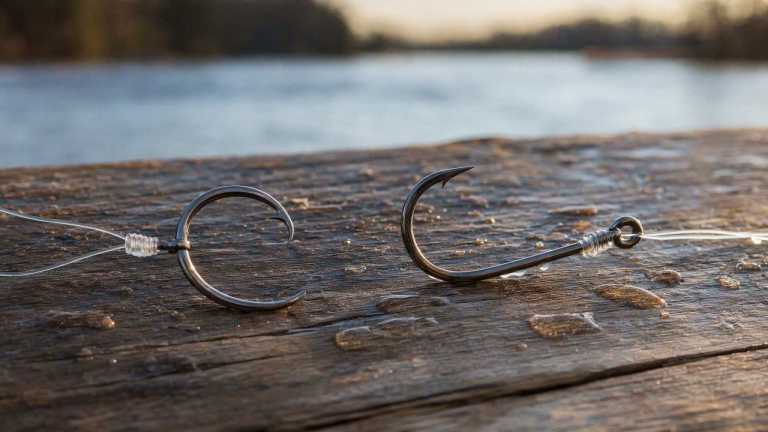
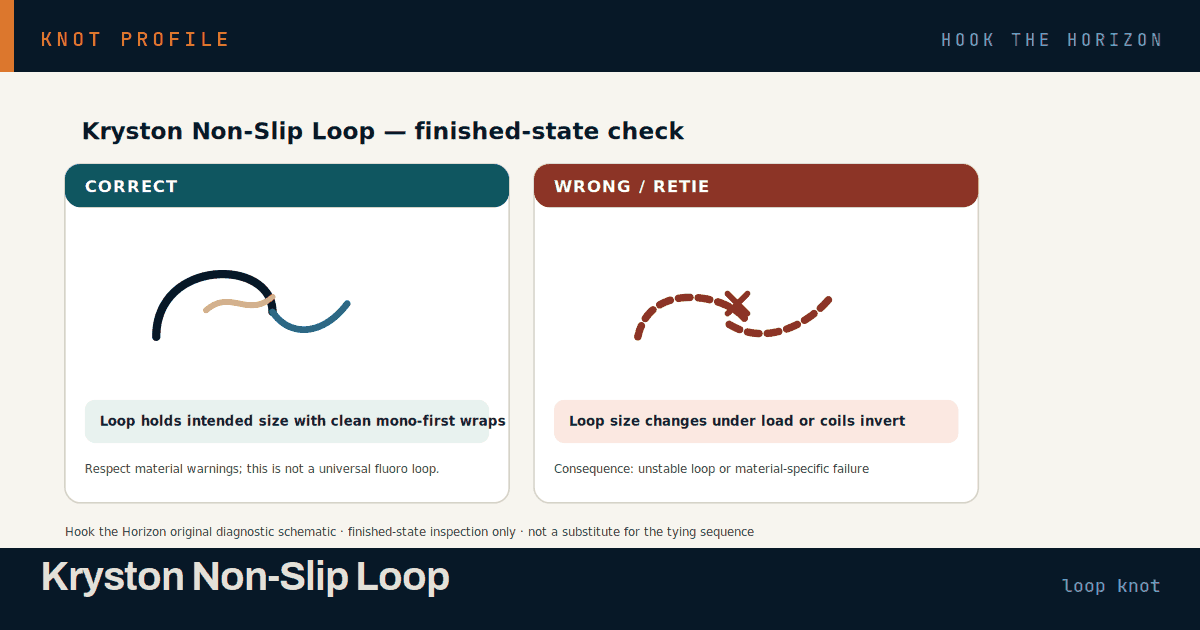
The working line forms a loop, passes through the eye, and follows a compact crossing path that fixes the loop size once you tighten it. The tag ends up pointing away from the retrieve, which is worth something when you’re fishing around weed or debris and don’t want anything sticking out to collect it. The friction pattern is the part that decides whether you tie this knot at all. Fluorocarbon doesn’t behave like nylon here. You won’t feel that while you’re tying it — the difference only shows up afterward, in the test numbers, which is exactly what makes it a mistake worth making once and never again.
The tag has to finish pointing away from the retrieve
- Form the initial loose mono loop at the intended distance from the tag.
- Pass tag through the hook/lure eye.
- Route tag through the loop/crossing exactly as the Kryston method specifies.
- Adjust the open-loop size before the knot closes.
- Wet the nylon and pull gradually until the lock is compact.
- Pull-test it, then check the tag orientation and the loop size before you trim.
Failure clue
Fluorocarbon went on in place of mono — an easy mix-up when both spools look alike, and it doesn’t announce itself until the loop starts creeping under a real pull. The loop shut itself while the knot was closing. The return path ran backwards. Or the hardware is small and stiff enough to pull the loop out of shape. Sizing is the fussy part regardless of material, because you’re holding an open loop at the size you want while the lock draws down around it, and getting the same size twice in a row takes a few goes.
Nylon only, and the test numbers are why
Use: monofilament lure/hook loop. Skip: fluorocarbon. Compare: Kreh/Non-Slip Loop for mono or fluoro; Rapala for another lure-action loop; Homer Rhode for heavy leader.
How I check the material before I even start tying
Before I tie this one, I confirm what’s actually on the spool, not what I assume is on the spool — that habit exists because fluoro and mono feel the same in your fingers on this knot. Once it’s tied, I pull-test it harder than I expect a fish to and watch the loop size the whole time; if it shrinks under that pull, I retie it in the right material instead of trusting it anyway. NetKnots’ Kryston Non-Slip Loop page has the testing notes alongside the tying sequence, which is worth reading before you decide this is the loop for the job in front of you.
Open the deeper knot workflowJob, material, route, dressing, seating, pull-test checks and the standardized comparison record.
THE SIX-MOVE CHECK
Job → Material → Route → Dress → Seat → Test
- Job. Name what the connection has to do before choosing the knot.
- Material. Confirm the line, leader, rope, wire, and hardware actually suit this structure.
- Route. Trace every pass before tightening anything.
- Dress. Put strands, wraps, and loops in their intended order with no accidental crossings.
- Seat. Tighten in the order this knot needs. More force does not repair bad geometry.
- Test. Inspect the finished shape, load it by hand when appropriate, and retie if anything moves or fails the article-specific checks.
Practice / pass test. Tie this knot three clean times without rushing. A tie passes only when it matches this article’s What to check before you trust it geometry, shows none of the listed failure clues, and survives the stated load/inspection test. If you cannot tell why one attempt is better than another, keep practicing—the lesson is recognition, not memorization.
KNOT SPEC
Kryston Non-Slip Loop Knot — the short answers
- ALSO CALLED
- No widely used alternative name. It carries the name of the tackle brand whose tying method it follows, and it is a specialist choice rather than a knot most anglers have heard of.
- KNOT TYPE
- Fixed end loop — compact crossing lock, sized before it closes
- WHAT IT CONNECTS
- Monofilament straight to a hook or lure, giving the bait a small open loop to swing on. Not a line-to-line knot, and not a leader-butt loop for loop-to-loop work.
- LINE TYPES
- Monofilament, and honestly only monofilament. Published testing reports poor performance in fluorocarbon, and the loop creeps there under load. Not a braid knot and not for wire.
- STRENGTH BAND
- High in nylon monofilament, where it has tested very well, and poor in fluorocarbon. Very few knots split that hard on material, which makes the material choice the whole decision here.
- DIFFICULTY
- Intermediate. The path is short and the hands are easy; what takes practice is holding the open loop at the size you want while the lock draws down around it. Repeatable sizing is the skill.
- STEPS AND WRAPS
- Six moves, no wrap count to remember. The lock is a compact crossing rather than a barrel of wraps. There is no braid variation, because it is not a braid knot.
- TIE TIME
- A boat knot once sizing is in your hands, a home knot before that. Twenty-five to forty seconds when fluent.
- POOR CONDITIONS
- Middling. No count to lose and no orientation to reverse, which helps, but sizing an open loop with cold hands is fiddly and the return path can run backwards in poor light.
- THROUGH THE GUIDES
- Small and compact for a loop knot, and the tag finishes pointing away from the retrieve, so it does not stand proud and catch. It is tied at the lure, so guide passage rarely matters.
- LUBRICATION
- Yes. Wet the nylon and pull gradually. This lock closes over itself in a small area, and a dry pull concentrates the heat exactly where the loop bears.
- TAG END
- An eighth of an inch, trimmed after you have checked the tag is pointing away from the direction of retrieve. That orientation is a real feature around weed and debris, so do not undo it with a long tag.
- TOOLS
- None. Nippers to trim. Knowing what’s actually on the spool before you start beats anything you could carry in a tool bag.
- BEST SUITED TO
- Not species-specific — chosen by the material and the bait. It suits mono lure and hook work, including small baits fished around weed where a proud tag would collect trash.
The strength bands are rough on purpose. Published knot tests don’t agree with each other — the same braid-to-leader knot has tested near ninety percent of line strength on one machine and under half on another, because the line brand, its diameter, how fast it got cinched, whether it was wet and whose hands tied it all move the number more than the knot does. Use the band to compare this knot with the others, not as a number to quote.
NYLON ONLY
In monofilament it is unusually strong for a small loop, and the bait swings instead of sitting locked to the eye. Tie the same knot in fluorocarbon and the loop creeps under load with nothing in the tying to warn you.
Advantages
- It is very strong in nylon monofilament, which is unusual for a small single-strand loop knot.
- The open loop gives the bait real freedom — small crankbaits and suspending jerkbaits work more freely, streamers and small soft plastics move rather than track stiff, and jigs fall with the head loose.
- The lock is compact and small, so it does not overwhelm a light bait the way a bulky loop can.
- The tag finishes pointing away from the retrieve, so it collects less weed and debris than most loop knots.
- Loop size is set before the knot closes, so the pivot is a decision rather than an accident.
Disadvantages
- It is a mono knot. In fluorocarbon it tests poorly and the loop creeps under load, and nothing about the tying tells you that is happening.
- Holding the open loop at a repeatable size while the lock draws down takes practice, so two knots in a row rarely match at first.
- It is a narrow, specialist choice, so it is one more path to keep in your hands for a job other loops also do.
- Small stiff hardware can pull the finished loop out of shape.
- It offers nothing on lures already fitted with a split ring, a snap or a swivel, where the pivot exists already.
Use a different knot when
- Non-Slip Loop / Kreh Loop — when the line is fluorocarbon, or when you want one loop knot that covers both mono and fluoro
- Rapala Knot — when you want another mono lure-action loop and prefer that finishing path
- Homer Rhode Loop or Baja Knot — when the leader is heavy enough that a small compact loop will not seat
- Improved Clinch or Palomar — when the bait does not benefit from a pivot at all
WHAT TO CHECK BEFORE YOU TRUST IT
Its case is narrow and genuine: a small, strong, tidy loop in nylon on a light bait. Baits that gain from it are the ones that swim — small crankbaits, suspending jerkbaits, streamers and small soft plastics, and jigs where the fall matters. Baits that gain nothing are anything already hinged on a split ring, snap or swivel. Watch two things. First, what is actually on the spool, because the mono-to-fluorocarbon difference here is invisible while tying and expensive later. Second, loop size, which on this knot has to be held deliberately while the lock closes, and which most anglers set by accident every single time.
What actually makes it fail
- Tying it in fluorocarbon instead of mono, where it tests poorly and the loop creeps under a real pull.
- The loop shutting itself while the lock draws down, because tension was lost on the open loop.
- The return path run backwards, which produces a lock that looks tidy and is not the same knot.
- Pulling it down dry, which cooks the nylon in the small area where the lock closes.
- Small stiff hardware distorting the loop until it no longer pivots.
How to test it, and how it ages
Confirm the material before you tie, then wet it and draw down gradually while you hold the open loop at the size you want with a fingernail. Finished, look for a compact lock that has not migrated, a loop that has kept its size, and a tag pointing away from the retrieve. Then pull harder than you expect a fish to and watch the loop the whole time. If it shrinks during that pull, retie — and if it is fluorocarbon, retie in mono or use a different knot.
Over a session: Good in nylon over a session; the compact lock stays put and does not migrate. Check the loop where the eye rides on it after every fish, and retie once the loop has gone flat or has begun to close under load.
Troubleshooting
Why does the loop creep on me when it never used to?
Check the spool. This is a mono knot, and in fluorocarbon it creeps under load without giving you any warning while you tie it.
Why does my loop shut as I tighten it?
You let go of the open loop too early. Keep a fingernail inside it and hold the size while the lock draws down.
Why can I never get the same loop size twice?
Because the size is held, not set by a measurement. Pick a reference — the width of the lure eye, the width of a fingernail — and hold to it every time.
Does the tag direction actually matter?
Around weed and debris, yes. A tag pointing away from the retrieve collects far less junk than one standing into it, and on a small bait that junk kills the action.
Should I use this instead of a Kreh Loop?
Only in mono, and only if you like the tidier lock. The Kreh Loop covers both mono and fluoro, which makes it the safer single knot to carry.
FIELD OBJECT
This one should leave the page.
The article is the long version. These are the pieces worth carrying into the next trip.
The 30-second version
The Kryston Non-Slip Loop has tested very well in monofilament and poorly in fluorocarbon, and you can’t feel the difference while tying it. Check the spool first, then hold the loop size while it closes.
What to watch
- Five stages, and the tag has to end up facing the right way
- Nylon holds this knot together. Fluorocarbon takes it apart.
- The tag has to finish pointing away from the retrieve
- Seat check
Field card
- Form the initial loose mono loop at the intended distance from the tag.
- Pass tag through the hook/lure eye.
- Route tag through the loop/crossing exactly as the Kryston method specifies.
- Adjust the open-loop size before the knot closes.
- Wet the nylon and pull gradually until the lock is compact.
RIGHT TOOL, NEXT
Knot Analyst
Carry the connection problem into a knot choice built around line, hardware, conditions, and failure mode.