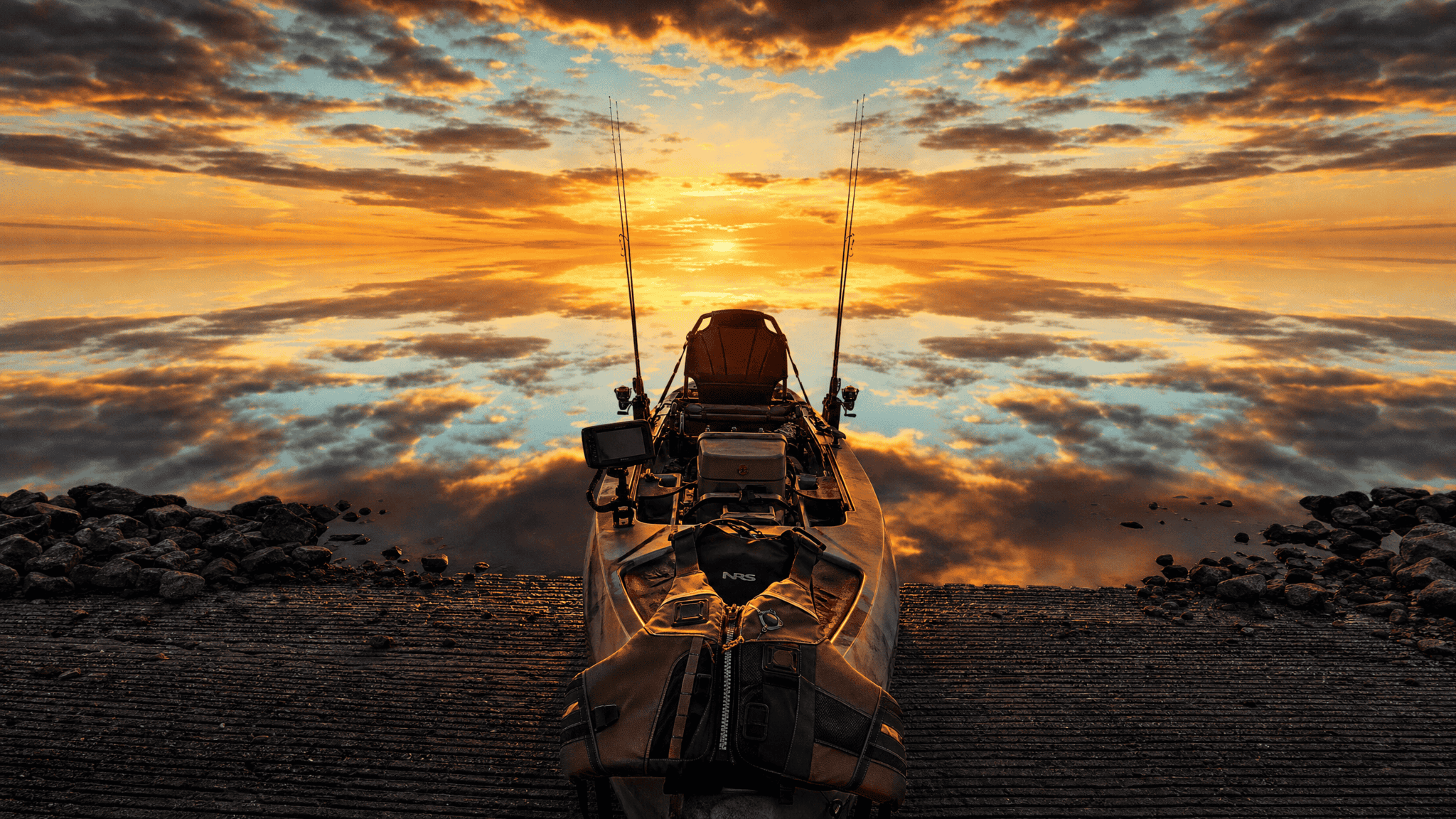
A kayak gets you onto quiet water that bigger boats can’t reach, and it does it with you sitting practically on the surface.
DECISION PLATE · STOP
Decide the stop before you are standing in it.
That’s the fun part and the problem in the same seat. You’ve got a lot less margin for weather, current, cold, bad balance, or gear loaded in the wrong spot. So the first question isn’t where the next rod holder goes. It’s whether the boat, the load, what you’re wearing, the route and the conditions still leave you a safe way home.
Before the kayak moves
Wear a properly fitted life jacket
The U.S. Coast Guard recommends wearing an appropriate, properly fitted, Coast Guard-approved life jacket or buoyancy aid while boating. Wear it, don’t stash it within reach; a capsize can leave you no practical time to put one on. Carriage and wear rules change by vessel, activity, age and state, so check the current rules with the state boating agency and the Coast Guard for the water you’re fishing.
For fishing, fit matters as much as the label. The jacket has to stay put when you raise your arms, paddle, cast, and twist around in the seat. One that rides up constantly or fights the seat back is the one that gets unbuckled “for a minute” or left in the truck.
Calm water isn’t a substitute for flotation. A capsize can start with something ordinary — reaching behind the seat, leaning too far, taking a wake wrong, stepping out onto an awkward bank — not only in obviously rough conditions.
Check the kayak’s capacity before loading it
Use the manufacturer’s current weight and loading limits for the exact kayak you’re in, not a guess. That number has to cover you, your clothes, water, battery, electronics, crate, tackle, anchor gear, cooler, all of it.
Capacity isn’t a number to push against. A heavily loaded kayak sits lower, responds slower, takes on more water, and gets a lot harder to turn or recover when something goes wrong.
Keep the heavy stuff low and near the center where the design allows. A tall stack of gear behind the seat looks tidy at the launch and turns into pure leverage the second the boat starts to roll.
Build the return route before the launch route
Wind and current can make the trip out easy and the trip back brutal. Before you launch, picture the paddle home if the wind builds, swings around, or starts pushing you away from the landing.
On bigger water, fetch — how much open water the wind gets to build waves across — matters a lot. A moderate wind over a long open stretch can raise waves that don’t exist back in a protected cove. Wind Redraws the Fishing Map puts direction, fetch, exposure and return margin together so you’re not guessing.
If the way back only works when conditions stay perfect, the plan was too thin before you ever left shore.
Leave a float plan
Tell someone reliable where you’re launching, roughly where you’ll fish, when you expect to be back, and what they should do if you’re late. The Coast Guard pushes float plans hard because rescuers move faster when they know where to start looking.
It doesn’t have to give away a spot you care about. The public launch, the waterbody, a general route, a return time, what your kayak looks like and how to reach you does a lot more good than a secret waypoint ever would.
Check current weather, not just the morning forecast
Right before you launch, check current official weather information and any marine or local warnings that apply. Open water can be having a completely different day than the nearest town.
Decide your stop conditions before the first cast: lightning, wind picking up, poor visibility, cold exposure, wildfire smoke, dangerous heat, rising current, or anything else that takes away the margin this particular trip needs. The safety and access planning treats the route home as part of the fishing plan for exactly that reason.
Practice getting in and out before adding gear
Launching and landing deserve their own practice. Start in easy conditions with almost no gear and learn how the kayak behaves coming off a shallow bank, dock, beach, or a ramp that’s legal for that craft.
No one technique works everywhere. Mud, current, waves, ice, slick rock, boat wakes, steep banks and low docks each change the problem. Practice getting back in from the water too, somewhere warm and shallow with someone watching, before the day you actually need it.
Nobody looks graceful the first few times they haul themselves back onto a kayak from the water. It mostly looks like a wet dog trying to climb onto a pool float. That’s fine — it’s supposed to look like that in warm water with a friend around, so it doesn’t have to be figured out for the first time in cold water by yourself.
Standing is optional
Some fishing kayaks are built so you can stand in the right conditions. That doesn’t make standing mandatory, or safe everywhere.
Only stand if the kayak is designed for it, the load’s balanced, the water’s suitable, and you’ve actually practiced it. Wind, a wake, current, cold water, or a fish that hits at the wrong second can erase the stability you felt at the launch.
If sitting gives you the control you need, stay seated. The fish don’t hand out bonus points for elevation.
Keep the working deck simple
Every loose thing on a small boat is a snag, a trip, or a tangle waiting to happen. Start with one or two rods, one compact tackle kit, a landing tool sized to what you’re after, line cutters, pliers or forceps, water, and whatever safety gear is required. Put the tools you’ll need while handling a fish where you can reach them without twisting halfway around in the seat.
A kayak doesn’t fish better because the whole garage came along.
Tethers solve one problem and can create another
Leashes keep a paddle, rod or important tool from disappearing after a capsize. Too many cords turn into an entanglement hazard fast.
Use purpose-built tethers deliberately: short lines, kept organized, never wrapped around your body, and a cutting tool within reach in case a line ever becomes the hazard instead of the fix. Not everything needs a leash just because it was expensive.
Anchor only when the water and anchor setup allow it
Anchoring a small boat gets dangerous fast in moving water, strong wind, waves or boat traffic. Current pushing against a kayak that’s held in place can turn a fishing convenience into a capsize quicker than it sounds.
Use only equipment and methods suited to the kayak and conditions, follow the manufacturer’s guidance, and skip anchoring altogether if you can’t hold a safe orientation and release the anchor quickly. When you’re not sure, drift, reposition, or go fish somewhere safer instead of forcing the kayak to hold one spot.
Boat control comes before the cast
A perfect casting angle doesn’t mean much when the kayak spins halfway through the retrieve. Learn how paddle strokes, rudder, pedals, wind and current change which way the boat points before you worry about the cast itself.
Set the boat, then cast. Shorter casts usually give you better lure control anyway, since there’s less line out in the wind and less time for the kayak to swing before the lure reaches the strike zone. Field Ops Desk is a good place to work through depth, speed and control as one connected problem instead of three separate tackle purchases.
Landing a fish changes the balance problem
As a fish gets close, shorten the loose line and clear the deck. Keep your center of gravity under control and bring the fish to the side you can manage best, rather than leaning way out over the far side.
Big fish, treble hooks, toothy species or strong current can all need more room and different tools, so plan for that before the fish is hooked. If you can’t handle a fish safely from the kayak, move to a legal, practical spot on shore instead of forcing it.
Cold water deserves a separate decision
Warm air doesn’t mean warm water, and a sunny spring afternoon over snowmelt is the classic setup for getting caught by it. Dress for the water, not the air: if going in would take your breath away, that means a wetsuit or drysuit under the PFD, not a fleece. Stay close to shore, keep the route short, and treat the whole trip as a cold-water trip no matter what the forecast says. State boating agencies and the Coast Guard publish cold-water guidance, and a lot of them post current water temperatures, so use the current source for your exact water and season.
Carry communication that works where you are
A phone in a waterproof case only helps where there’s service and the battery still has charge. Depending on the water and how far out you’re going, extra communication or signaling gear might make sense too. Check current legal carriage requirements and local emergency guidance before the trip, and don’t let one device be the entire plan.
A simple first-trip setup
- Choose protected, familiar water with legal access.
- Wear a properly fitted life jacket.
- Leave a float plan.
- Bring one or two rods and one compact tackle box.
- Keep the first route close enough that turning back is easy.
- Practice turns, stopping, launching and landing before fishing far from the access.
- Set a weather stop and a return time.
- End the trip before being tired starts making the decisions.
Tackle gets added when it fixes a fishing problem you actually ran into. Until then, the kayak has one job, and that’s getting you out there and back.