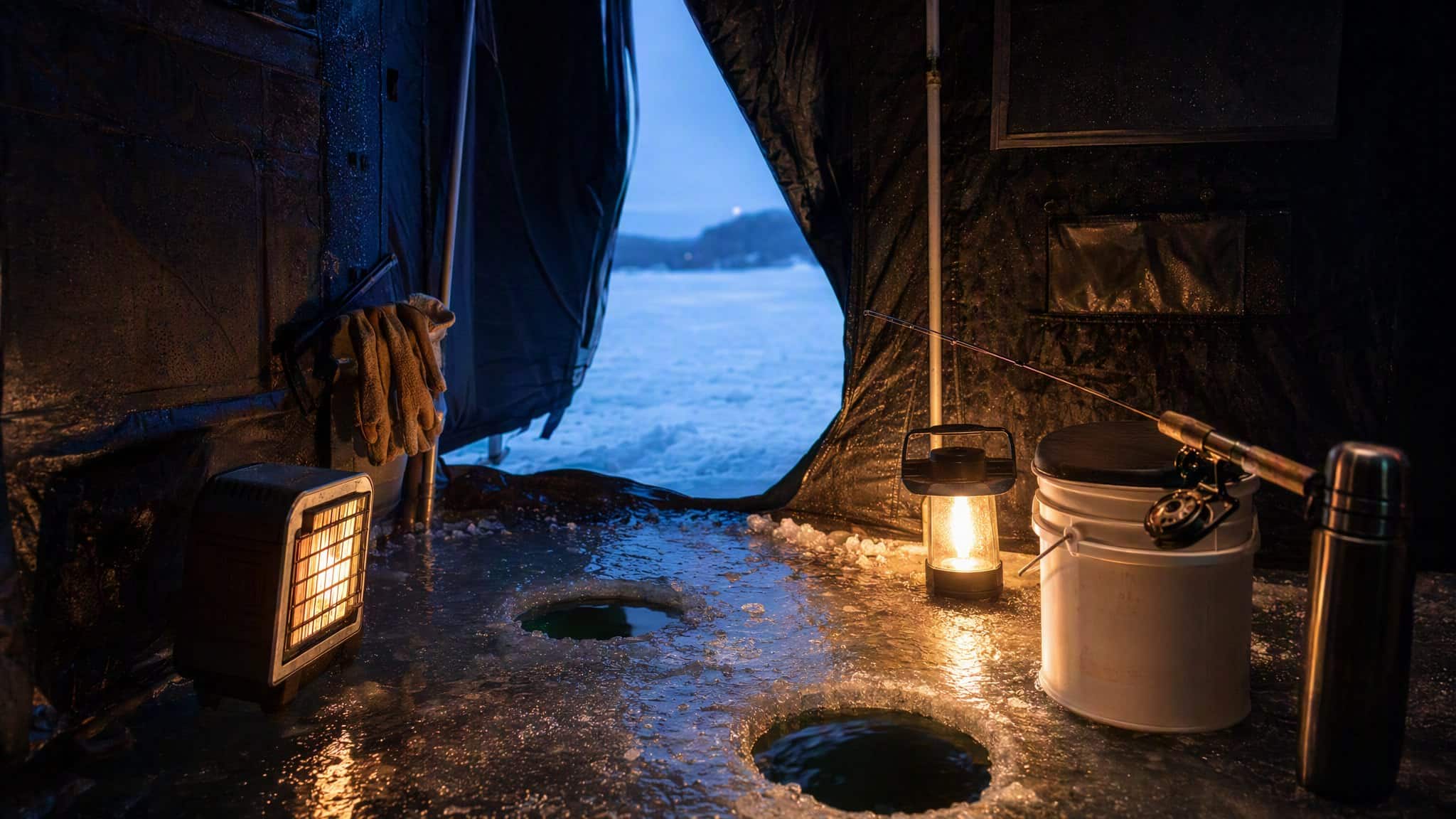
About forty minutes into a slow afternoon, the shelter stops being equipment and starts being an opinion.
The heater’s running. Your gloves are drying on the rail. The gear is out of the sled and arranged in a way that took some effort. And now the evidence is suggesting you should be two hundred yards east, and a small committee inside your head is forming to argue that the evidence is probably wrong.
That committee is not neutral. It is warm.
What a shelter is actually for
The obvious job is extending your day. Somebody who can stay out for six hours in real cold will fish the low-light window at the end, and that window does a lot of the work in winter. The walleye windows piece is basically an argument for still being there at four-thirty. A shelter also keeps your hands working, which is its own subject and the thing that most often ends trips early.
The underrated one is that it darkens the hole. In clear, shallow water a dark shelter lets you see down the hole and watch fish come to the bait, which is useful, and also one of the best things ice fishing has going for it.
What it costs
Water covered.
Not because the shelter is heavy, though it is. Because setup creates sunk cost, and sunk cost is very good at disguising itself as patience. The hole doesn’t get better because you built a room over it. It just gets harder to leave.
This matters more for some fish than others. Perch move constantly, and a perch angler who sets a shelter at nine in the morning has more or less decided to fish whatever swims past — the perch piece is all about what standing still costs. Crappie schools drift. Walleye on a travel route, by contrast, are coming to you, and sitting is the plan rather than a failure of nerve.
Stage it: search first, settle second
The version that works is sequencing.
Start with a bucket, rod, auger and whatever electronics you run. Drill a set of holes and fish them until you find something. Then go get the shelter and set it on whatever you found. That’s an extra trip to the truck, and it’s almost always worth it.
The alternative — set up first, then search — means either you don’t search, or you search and then have to tear down and rebuild, which nobody does. So in practice, setting up first is deciding not to search.
The exception is genuinely brutal weather, where the shelter is the only reason you’re fishing at all and finding the perfect spot is a luxury. Being out in a mediocre spot beats being home, and anybody who tells you otherwise has never tried to fish at fifteen below in wind.
Which kind, honestly
Flip-over. Sled, seat and shelter in one unit. You drag it, you flip it, you’re fishing in under a minute, and you can be up and moving in about the same. This is the best compromise for people who actually want to move and also want to be warm. It seats one or two comfortably and it gets heavy to pull across bare ice in wind.
Hub. Pops up into a big room, fits three or four people and a heater, and is much more pleasant to spend a day in. It also takes several minutes and a dozen ice anchors to set and about as long to take down. This is a shelter for a spot you’ve already chosen, or for a social day where catching is a bonus.
Bucket. Five gallons, a foam lid, and a windbreak if you’re lucky. Cold, mobile, and the correct answer more often than the market would like you to believe. If you’re just starting, fish from a bucket for a season before you buy anything. You’ll learn more about where fish are, and you’ll find out whether you actually enjoy this before spending real money.
Nobody needs permission to buy a nice shelter. They’re good and they make winter days a lot more pleasant, and there’s no rule that says fishing has to be uncomfortable to count. Just buy it knowing what it does to your willingness to move.
The heater conversation, said plainly
Propane heaters in an enclosed shelter produce carbon monoxide, and the fabric that keeps the wind out also keeps the exhaust in.
Crack a vent — top and bottom, so there’s actual airflow, not one flap that makes you feel better. Run a carbon monoxide detector. They cost very little and they work, and the reason to have one is that CO poisoning doesn’t feel like poisoning. It feels like being tired and slightly off, in a shelter, on a cold day, when being tired and slightly off is the expected condition.
This isn’t a corner worth cutting. It’s the one piece of ice-fishing gear where the failure mode isn’t losing a fish.
And the ice under it
A loaded shelter with a heater, gear, and two adults is real weight in one spot. Minnesota DNR’s thickness guidance scales up for heavier loads and doubles for white ice, which is only half as strong as new clear ice. A heater also melts what’s directly under it over a long sit.
And the general point still holds: the ice that supported you at the access isn’t a promise about the ice under the spot you chose. Check it where you’re setting up. The thickness guide has the numbers.
The question to ask before you unzip anything
What would have to happen for me to move?
If you can answer that — a specific amount of time, a specific absence of marks, a specific hour — the shelter is fine, because you made the call before the heater got a vote. If you can’t answer it, you’re not setting up a shelter. You’re building a reason to stay.
FIELD OBJECT
This one should leave the page.
The article is the long version. These are the pieces worth carrying into the next trip.
The 30-second version
Once the heater's running and the gear's spread out, leaving gets a lot harder to justify. Better to know that about yourself before you set up than after.
What to watch
- What a shelter is actually for
- What it costs
- Stage it: search first, settle second
- Which kind, honestly
Field card
- What a shelter is actually for
- What it costs
- Stage it: search first, settle second
- Which kind, honestly
- The heater conversation, said plainly
RIGHT TOOL, NEXT
Field Sense Navigator
Take the article’s water or access question into a place-specific conditions and route check.