Call it a hog snapper at the dock if you want. The fish is a wrasse, and it doesn’t act like a snapper either. Lachnolaimus maximus starts life female, and some fish later switch to male. Juveniles settle into shallow seagrass before adults move out to deeper rock and reef, and that long pig snout is a tool for rooting crabs and shellfish out of the bottom. Most hogfish get taken by spearfishing rather than on hook and line, and once you see how it feeds, that stops being a mystery.
At a glance · The short version
Scientific name
Lachnolaimus maximus
Family
Wrasse (Labridae), not snapper.
Identification
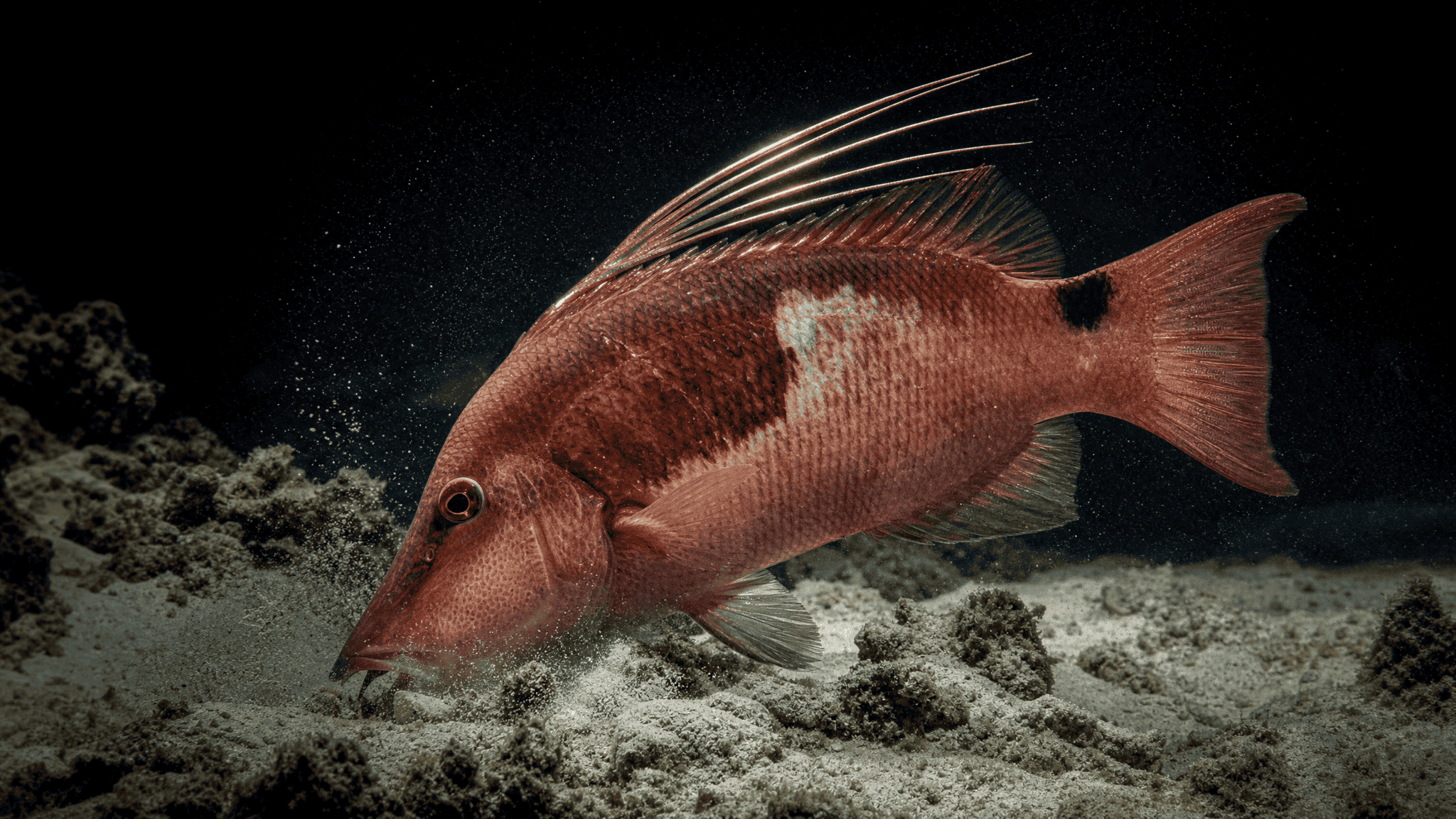
Long hog-like snout, first three dorsal spines elongated, compressed body, black blotch near rear dorsal, adult tail lobes extended.
Life-stage habitat
Juveniles settle into shallow seagrass nurseries; adults shift toward deeper rocky bottoms, ledges, and offshore reefs.
Sex system
Sequential protogynous hermaphrodite: all begin female; some older/larger fish transition to male.
What fish is this?
The Snout Settles the Family Question
Head and dorsal
Adult hogfish have an elongated snout used for rooting bottom prey and the first three dorsal spines are greatly elongated. FWC also notes a black blotch near the rear of the dorsal fin and elongated upper/lower tail lobes in adults.
Juvenile color
Young fish are mottled and can vary strongly in color before the adult form becomes obvious. Identification should therefore lean on body structure as much as adult coloration.
Source: FWC Hogfish
‘Hog snapper’
The common nickname is taxonomically misleading. Hogfish are wrasses, not members of the snapper family. That matters because the feeding mechanics, sex-change system, and management history are all very different from true snappers.
The life stage moves the fish
Grass Nursery to Reef Adult
Settlement
FWC summarizes a larval duration around 26 days before young hogfish settle into shallow inshore nursery habitat such as seagrass beds. A healthy adult reef fishery therefore begins in habitat that may be miles from the reef.
Source: FWC
Adult shift
As hogfish mature they move toward deeper rocky bottom, ledges, and offshore reefs. This is a real ontogenetic habitat shift, not simply bigger fish choosing deeper water because they prefer depth.
Source: FWC
What does it eat?
The Snout Is a Bottom-Foraging Tool
Prey
Hogfish root through sediment and reef substrate for mollusks, crustaceans, and other benthic invertebrates. The long snout is therefore a feeding adaptation, not an ornamental shape.
Source: FWC Hogfish
Why hook-and-line can be awkward
FWC notes hogfish are not commonly caught on hook and line because of this feeding behavior. A bait sitting several feet above the bottom can be perfectly attractive food but still outside the fish’s normal search lane.
Source: FWC
Bottom laneinference
If targeting them legally with hook and line, a small crustacean/mollusk-like natural offering held close to the substrate fits the documented feeding job better than a large suspended bait designed for a snapper or grouper.
Sex change
A Big Male Is a Social Role
Protogyny
All hogfish begin female; some older and larger individuals transition to male. That makes size structure directly connected to the breeding system.
Source: FWC
Harem structure
During the long breeding season, a male defends a territory and harem of females and can spawn repeatedly with individual females, typically late in the day. Removing a large male therefore changes more than the number of fish on a reef; it can alter the social structure that triggers and organizes reproduction.
Source: FWC
Breeding season
FWC summarizes spawning activity from November through June, with peaks in March and April. That broad window is one reason the profile avoids pretending a single spawn-week defines the fishery.
Source: FWC
Age
Older Than the Average Reef Trip Makes Them Look
Longevity
FWC reports an oldest recorded female around age 12, a transitional specimen aged to 18, and a possible life span reaching roughly 23 years. That is long enough that a large hogfish represents many seasons of survival.
Source: FWC
How would I fish for one?
Start With the Feeding Lane, Not the Nickname
Evidence level. I’ve never caught a hogfish. What’s below starts from how the fish feeds and works out how I’d get a bait in front of it. Worth testing, not proven.
Hook-and-lineinference
Keep a small legal natural bait close to bottom around rubble, sand pockets, ledges, and reef edges where benthic prey can be rooted out. The goal is to enter the same search lane as the fish, not to make the bait louder.
Spearfishing context
FWC notes hogfish are primarily harvested by spearfishing. That makes exact identification and size estimation before harvest especially important because the retention decision can occur before the fish is in hand.
Source: FWC
Do not target a harem blindlydecision rule
Where one large male and multiple females are visibly using the same territory, understand what that distribution means biologically before treating the largest fish as simply the obvious target.
Release from depth
The Reef-Fish Gear Rules Still Apply
Barotrauma
Adult hogfish can be caught from offshore reef depth. Florida reef-fish vessel rules require the appropriate hook/dehooking gear and a descending device or venting tool rigged and ready in state waters. Use pressure-release equipment when the fish actually shows barotrauma rather than as a ritual on shallow fish.
Source: FWC Reef Fish Gear Rules
The decision layer
What Changes the Next Move?
You are seeing hogfish but not hooking them
Get the offering into the bottom foraging lane before changing species of bait.
One big male anchors a group
Recognize the harem structure and sex-change biology before deciding the largest fish is automatically the best harvest.
Deep released fish struggles
Use the prepared barotrauma tool, then decide whether repeated deep releases make that piece a poor target.
— · Not established
What I Won’t Pretend
- a hook-and-line method that outperforms experienced local hogfish specialists everywhere
- a fixed size at which every female becomes male
- that ‘hog snapper’ makes this a snapper-style feeding problem
— · Sources
FEEDING ECOLOGY · STANDARDIZED
How this fish gets fed.
Primary prey
Crabs, shrimp, mollusks, sea urchins and other benthic invertebrates are central prey.
Feeding mode / location
A daytime bottom forager that uses its elongated snout to root and pick prey from sand, rubble, reef edges and seagrass-adjacent hard bottom. The feeding problem is prey extraction from bottom, not chasing open-water bait.
Diel / seasonal pattern
Hogfish are primarily diurnal foragers; they feed actively by day and use shelter rather than open foraging at night. Seasonal spawning and sex change remain separate from ordinary feeding.
Ontogenetic diet shift
Juveniles use smaller crustaceans and benthic invertebrates; larger hogfish increasingly exploit larger crabs, mollusks, urchins and other hard or mobile bottom prey.
The snout is feeding equipment first: it is built to search bottom rather than to chase prey through the water column.
Primary References
- Florida FWC: Hogfish — identification, life-stage habitat, feeding, reproduction, sex change, age, and fishery context.
- Florida FWC: Reef Fish Gear Rules — current release-tool and hook requirements.
Compiled 2026-09-11. Limits and advisories are set per water and per state and change between seasons — the managing agency for wherever you are fishing has the current answer.