Greater Amberjack: They Get Called Reef Donkeys and It’s Earned
Greater amberjack start out under floating Sargassum and end up over reefs and wrecks, where the first run straight down decides most fights. They also take three or four years to mature, which matters when the biggest fish keep getting kept.
By HunterUpdated September 24, 2026Read 6 min
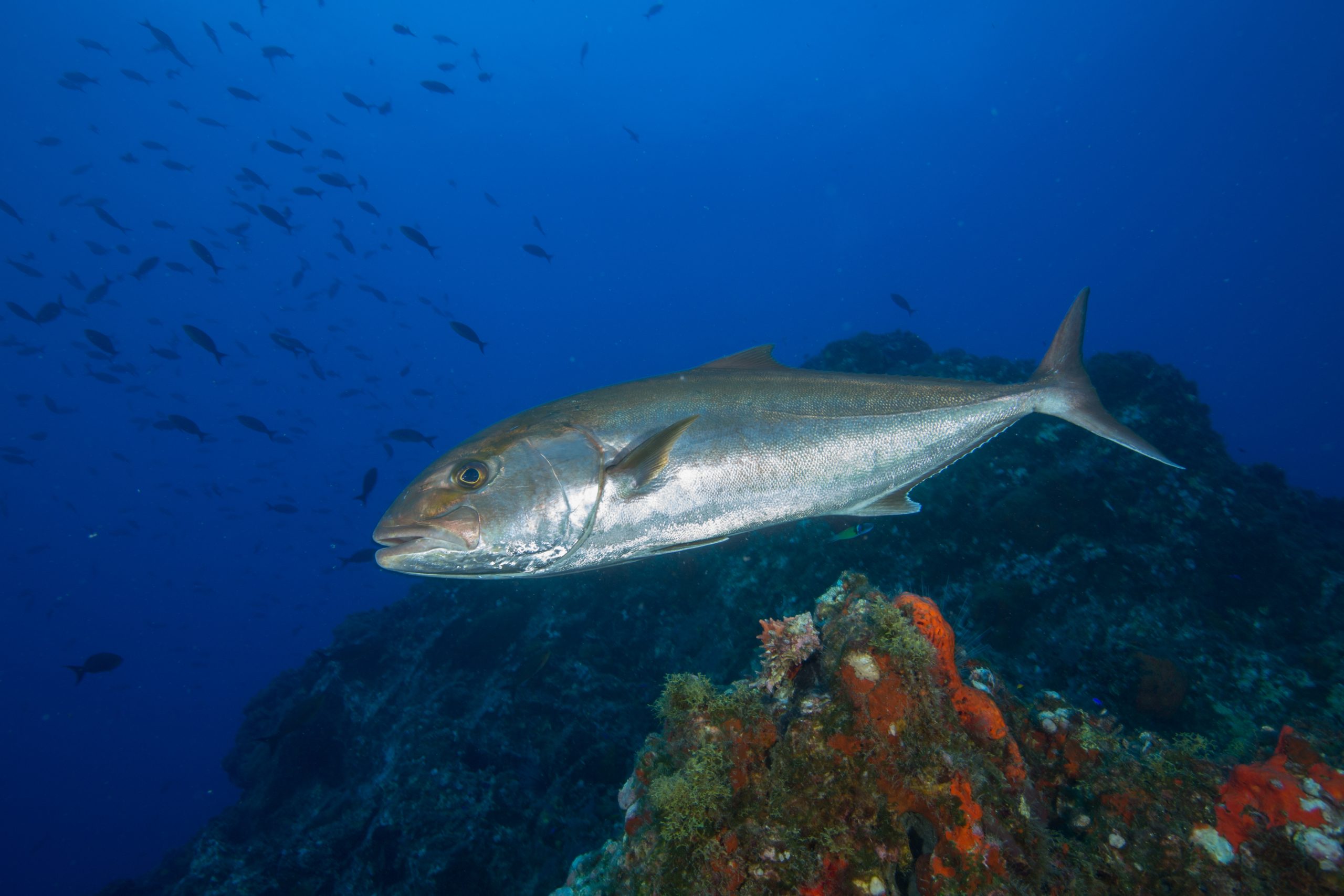
Greater Amberjack (Seriola dumerili) cruising a coral-crusted ledge in Flower Garden Banks National Marine Sanctuary, Gulf of Mexico, big enough that the long low soft dorsal and the thick wrist of the tail read as the reef-donkey build the name promises. Photo: G. P. Schmahl / Flower Garden Banks National Marine Sanctuary, NOAA, CC BY 2.0.
With a greater amberjack, the first run is most of the argument. Seriola dumerili hangs over wrecks, reefs and other offshore structure, and when one decides to go down, you don’t get much time to negotiate. The fight is the famous part, and the reason people call it a reef donkey, or just a donkey fish. The rest of the fish is less famous and just as useful to know: young ones start life under floating Sargassum, adults take three or four years to mature, and a worm in the fillet is neither a guaranteed non-issue nor a guaranteed ruined dinner.
At a glance · The short version
Scientific name
Seriola dumerili
Maximum age
NOAA reports fish to about 17 years.
Adult habitat
Reefs, wrecks, rocky outcrops, and hard bottom, commonly 60-240 ft.
Juvenile habitat
Pelagic Sargassum and floating structure before a shift toward demersal habitat around 5-6 months.
Maturity / spawning
Mature roughly age 3-4; primary spawning March-June around reefs/wrecks.
What fish is this?
The Eye Stripe and Gill Rakers Beat a General Jack Shape
Adult appearance
Greater amberjack carry an olive/brownish to bluish-gray back, silver sides, an amber horizontal stripe, and a dark stripe running from the snout through the eye toward the first dorsal fin. FWC notes that stripe becomes more pronounced when a fish is excited or feeding.
FWC gives 11-19 gill rakers per arch for greater amberjack. Lesser amberjack carry more, roughly 21-24, and usually remain much smaller. Gill-raker counts are not the first thing I want to do on a fish headed for release, but they are useful when a legal identification genuinely cannot be settled by proportion and size.
NOAA notes juveniles can be yellowish with five or six dark vertical bars. A small Sargassum jack should therefore not be forced into the adult color pattern before identification.
Young greater amberjack school around pelagic Sargassum mats and floating objects. NOAA places the major shift from pelagic to demersal habitat around five to six months of age.
Larger fish congregate around reefs, wrecks, rocky outcrops, and hard bottom, commonly in roughly 60-240 feet. FWC also notes that they often swim above the reef rather than sit directly on the bottom.
NOAA notes some populations are relatively resident while others migrate. A productive wreck can therefore be a real home range in one context and only a seasonal stop in another.
A Powerful Fish With a High Reproductive Output—but Not a Fast-Replacing Stock
Adult diet
Adults eat fish, squid, crabs, and other reef-associated prey. Juveniles start on planktonic prey. The forage shift mirrors the habitat shift from Sargassum nursery water toward adult structure.
NOAA summarizes maturity around three to four years. Females grow larger and live longer than males, which matters when a fishery disproportionately removes the biggest fish.
Primary spawning occurs March through June around reefs and wrecks. NOAA estimates a female can release roughly 18-59 million eggs across a season. High egg production does not erase the fact that fish need years to reach maturity.
The fish does not need a hundred-yard horizontal run to beat me. It needs enough line to reach the wreck. I set drag before the bait goes down, keep the rod in a lifting position, and try to get the fish’s head moving up immediately.
Boat positioninference
Being directly over the worst steel or reef makes every downward foot dangerous. Positioning slightly off the structure can create a fighting angle that gives the fish somewhere to move without instant abrasion.
Mid-water presentation
FWC specifically notes amberjack often swim above the reef. If the sounder marks them suspended, use only enough lead to hold the bait in that layer instead of dragging everything to bottom by habit.
FWC describes 50-100 lb tackle as typical and emphasizes pre-setting drag to match both equipment and angler. The exact number is less important than the system: rod, reel, line, leader, knots, and angler all have to survive the initial load.
A 40-pound leader tied badly is not 40-pound tackle. I retie connections, inspect line for abrasion, and set the drag before the first fish proves which piece I ignored.
Handing off a rod
There is nothing noble about exhausting the angler until the fish wins. On a long vertical fight, handing the rod to someone with fresh arms can be the best way to keep pressure controlled and shorten the fight.
Release and food handling
Do Not Turn a Strong Fish Into a Casual Handling Fish
Release from depth
Greater amberjack are managed as reef fish and can be caught from depths where barotrauma matters. Florida reef-fish gear rules apply, including state-water barotrauma equipment requirements. A strong fish can still be compromised by a long fight and a long surface interval.
Amberjack can carry visible parasites. I haven’t run into one myself, and calling them categorically harmless is more confidence than the sources support. A visible parasite does not automatically mean the whole fish is spoiled, but species identification, trimming, cold handling, and thorough cooking matter. If there is any doubt about a parasite or the condition of the flesh, the safe call is to follow current food-safety guidance rather than guess from appearance.
The decision layer
What Changes the Next Drop?
Fish are suspended
Stop fishing the seabed. Put the bait where the amberjack actually mark.
First run reaches structure
Fix drag, tackle authority, and boat angle before changing bait.
Long fights are stacking up
Increase control or stop targeting them. A legal fishery does not require every fish to be fought on sporting-light gear.
— · Not established
Where the Evidence Runs Out
a universal drag number
a claim that every amberjack is resident to one wreck
a claim that visible parasites are automatically harmless or automatically spoil the whole fish
Whether the amberjack sitting over your specific wreck is a resident fish or one passing through for the season isn’t something a profile can settle. That takes months of tags on that exact structure, not another paragraph here.
— · Sources
FEEDING · ABOVE THE WRECK, NOT IN IT
Amberjack patrol over structure in the current and run prey down in open midwater, so the wreck is where they wait rather than where they eat.
What it eats
Fishes, squid and other cephalopods, and crustaceans are major prey, with larger amberjack strongly oriented toward sizeable fish prey.
How and where it hunts
A powerful midwater pursuit predator associated with wrecks, reefs, rigs, pinnacles, current edges and offshore structure. Fish commonly patrol above and beside structure rather than feeding directly on bottom.
When it feeds
The profile does not establish one universal daily feeding window. Current, prey position, seasonal movement and water temperature provide stronger feeding context than a fixed clock.
What changes as it grows
Young fish use smaller crustaceans and fishes; larger Greater Amberjack become increasingly oriented toward larger fishes and squid.
“Reef donkey” describes fight behavior, not feeding mode; the feeding fish is often above the structure.
Compiled 2026-09-11. Limits and advisories are set per water and per state and change between seasons — the managing agency for wherever you are fishing has the current answer.
FIELD OBJECT
This one should leave the page.
The article is the long version. These are the pieces worth carrying into the next trip.
The 30-second version
Greater amberjack start out under floating Sargassum and end up over reefs and wrecks, where the first run straight down decides most fights. They also take three or four years to mature, which matters when the biggest fish keep getting kept.
What to watch
The Eye Stripe and Gill Rakers Beat a General Jack Shape
Sargassum First, Wrecks Later
A Powerful Fish With a High Reproductive Output—but Not a Fast-Replacing Stock
Down Is the Problem, Not Distance
Field card
a universal drag number
a claim that every amberjack is resident to one wreck
a claim that visible parasites are automatically harmless or automatically spoil the whole fish
We use necessary cookies to operate the site. With your choice, we may also use analytics and advertising cookies. Choose Accept All, Reject, or Preferences.
Contains information related to marketing campaigns of the user. These are shared with Google AdWords / Google Ads when the Google Ads and Google Analytics accounts are linked together.
90 days
__utma
ID used to identify users and sessions
2 years after last activity
__utmt
Used to monitor number of Google Analytics server requests
10 minutes
__utmb
Used to distinguish new sessions and visits. This cookie is set when the GA.js javascript library is loaded and there is no existing __utmb cookie. The cookie is updated every time data is sent to the Google Analytics server.
30 minutes after last activity
__utmc
Used only with old Urchin versions of Google Analytics and not with GA.js. Was used to distinguish between new sessions and visits at the end of a session.
End of session (browser)
__utmz
Contains information about the traffic source or campaign that directed user to the website. The cookie is set when the GA.js javascript is loaded and updated when data is sent to the Google Anaytics server
6 months after last activity
__utmv
Contains custom information set by the web developer via the _setCustomVar method in Google Analytics. This cookie is updated every time new data is sent to the Google Analytics server.
2 years after last activity
__utmx
Used to determine whether a user is included in an A / B or Multivariate test.
18 months
_ga
ID used to identify users
2 years
_gali
Used by Google Analytics to determine which links on a page are being clicked
30 seconds
_ga_
ID used to identify users
2 years
_gid
ID used to identify users for 24 hours after last activity
24 hours
_gat
Used to monitor number of Google Analytics server requests when using Google Tag Manager
1 minute
Jetpack's built-in visitor analytics. It records page views, referring sites, search terms, and outbound link clicks, and also carries the shared visitor-tracking library used by Jetpack Instant Search and WooCommerce Analytics.