FLY TIPPET · COMPACT LOCK
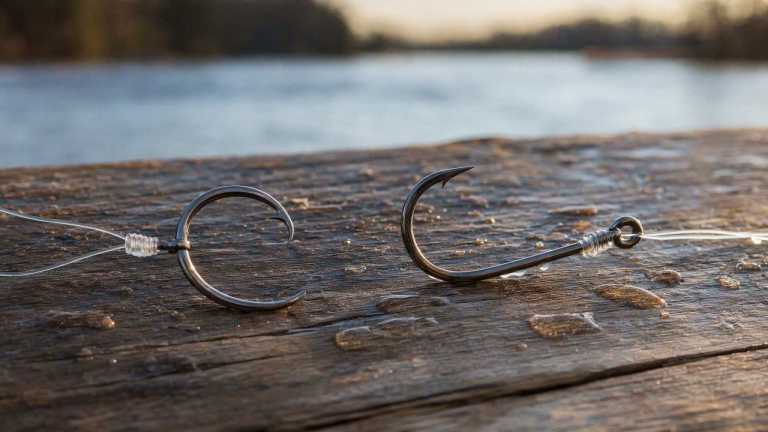
A single Davy on a size 10 foam hopper and 4X is asking a knot built for tiny flies to do a bigger fly’s job, and the pull test is a much better place to find that out than the first fish. The Double Davy is the same skeleton with one more pass through the working loop. That’s the entire difference. The extra pass gives the compact knot more grip as fly size and tippet diameter climb. On a size 18 or smaller, go back to the single Davy, which leaves almost nothing at the eye.
Two passes through one working loop
Nylon or fluorocarbon tippet.
Roughly size 16 and larger flies, where a single Davy starts to feel like too little knot.
Very light 4X–6X tippet on heavy-gauge hooks is a poor geometry match. The knot and the hook end up working against each other.
Two locking passes inside one small knot, not two separate bumps.
The second pass has to stay inside the same lock.
The Double Davy starts exactly like the Davy. The tag then runs through the working loop once more before you seat it. That extra contact buys grip without turning the fly’s nose into a bulky coil. It only pays off when the tippet-to-hook geometry is sensible to begin with, and that caveat does most of the damage around this knot — it’s also the easiest part to skip.
Where the second pass goes
- Pass several inches of tippet through the eye.
- Form a loose overhand knot in front of the fly.
- Pass the tag back through the working loop between knot and fly.
- Pass the tag through that same loop one more time.
- Pull the tag to organize both passes, then the standing tippet to seat it.
- Pull-test and trim.
How the two passes get out of line
The second pass reverses and crosses the first. A heavy-wire hook overmatches light tippet. Both passes cinch down before they’ve aligned with each other. Or the tag gets trimmed before a hard test, which leaves you nothing left to judge.
Use
Larger fly patterns where you want the Davy’s compactness with a little more lock.
Skip
Braid, heavy conventional tackle, or very light tippet on a big heavy-gauge hook.
The rest of the small-knot bench
Davy: the smallest version, and the right call on a size 20, not a size 10 hopper. Orvis: compact and well-tested across a broader fly range. Clinch: simple and fast for light tippet.
HOW I CHECK IT
Slow the video down at the second pass.
NetKnots’ animation, Tightline Productions’ Davy and Double Davy video, Salt Strong’s walkthrough with strength notes, and Orvis News’s Davy and Double Davy segment are worth watching frame by frame right at the second pass, because that’s where this knot usually comes apart before it’s even finished. Then pull-test it hard before the fly gets anywhere near the water. After the first cast is too late to learn anything useful.
Open the deeper knot workflowJob, material, route, dressing, seating, pull-test checks and the standardized comparison record.
THE SIX-MOVE CHECK
Job → Material → Route → Dress → Seat → Test
- Job. Name what the connection has to do before choosing the knot.
- Material. Confirm the line, leader, rope, wire, and hardware actually suit this structure.
- Route. Trace every pass before tightening anything.
- Dress. Put strands, wraps, and loops in their intended order with no accidental crossings.
- Seat. Tighten in the order this knot needs. More force does not repair bad geometry.
- Test. Inspect the finished shape, load it by hand when appropriate, and retie if anything moves or fails the article-specific checks.
Practice / pass test. Tie this knot three clean times without rushing. A tie passes only when it matches this article’s What to check before you trust it geometry, shows none of the listed failure clues, and survives the stated load/inspection test. If you cannot tell why one attempt is better than another, keep practicing—the lesson is recognition, not memorization.
KNOT SPEC
Double Davy Knot — the short answers
- ALSO CALLED
- Double Davy. Sometimes written Davy Knot, double version, on knot charts that treat the two as one entry. Same attribution as the single — Davy Wotton — and no separate regional name. Fly anglers only.
- KNOT TYPE
- Terminal fly knot, tag locked twice through one overhand
- WHAT IT CONNECTS
- Tippet to fly, on the larger flies the single Davy cannot hold. Not a line-to-line knot, not a loop knot, and not a hardware connection.
- LINE TYPES
- Nylon and fluorocarbon tippet across the middle range, broadly 5X up to heavier trout and light bass tippet. Not for braid, not for wire, not tied in fly line. It slips when very light tippet is paired with a heavy-wire hook.
- STRENGTH BAND
- Solid, and meaningfully better than the single Davy on mid-size flies. The second pass buys grip and tag security rather than raw breaking load, so it extends the knot’s working range upward instead of raising its ceiling on fine tippet.
- DIFFICULTY
- Beginner, with one intermediate detail. Anyone who can tie the single Davy can tie this; keeping both passes inside the same lock rather than as two separate bumps is the part that takes attention.
- STEPS AND WRAPS
- Six moves, no wrap count. One overhand, then two return passes through the same working loop, tag pulled first, standing tippet second. No braid variant. The only change from the Davy is that one extra pass.
- TIE TIME
- Fast. Fifteen to twenty seconds once learned — a few seconds slower than the single, and still quicker than any wrapped knot at the same fly size.
- POOR CONDITIONS
- Fine in wind and current. In cold hands and low light the second pass is where it goes wrong, because feeding the tag through the same small loop twice is harder to feel than to see.
- THROUGH THE GUIDES
- Still compact for a terminal fly knot, slightly more mass than the single Davy. It clears guides and the tip-top cleanly and does not disturb how a mid-size fly rides.
- LUBRICATION
- Yes. Wet before the seating pull, and seat unhurried so the two passes align before they tighten. A dry cinch on fluorocarbon tippet does the same damage here as anywhere else.
- TAG END
- Several inches to work with — more than the single Davy needs, because the tag makes two trips. Trim close after testing. Tag security is the point of the second pass, so do not trim before the pull test.
- TOOLS
- None. Nippers to trim. Magnification helps on the smaller end of its range, though far less than on the size 22 water where the single Davy lives.
- BEST SUITED TO
- Trout on larger dries, hoppers and streamers, plus panfish and light bass work on fly tackle. Chosen by fly size rather than species — roughly size 16 and up is where it starts to make sense.
The strength bands are rough on purpose. Published knot tests don’t agree with each other — the same braid-to-leader knot has tested near ninety percent of line strength on one machine and under half on another, because the line brand, its diameter, how fast it got cinched, whether it was wet and whose hands tied it all move the number more than the knot does. Use the band to compare this knot with the others, not as a number to quote.
BIGGER FLIES, MORE BULK
The second pass holds the tag where the single Davy starts letting go, and it adds just enough bulk to be wrong on a size 20. Put that pass in backwards and you have two bumps instead of one lock.
Advantages
- Extends the Davy family upward into flies the single lock cannot hold securely.
- Keeps most of the Davy’s compactness, so a hopper or a bushy dry still sits right on the water.
- The extra pass is real tag security — the tag has far less chance of walking back out under repeated load.
- Learned in seconds by anyone who already ties the single, with no new movement to memorize.
Disadvantages
- The second pass can reverse and cross the first, which builds two bumps instead of one lock.
- It does not rescue a bad geometry match — very light tippet on a heavy-gauge hook still fails.
- Slightly bulkier than the single Davy, so on size 20 and smaller it gives up the reason you were tying a Davy at all.
- Still fly-tippet only; nothing about the second pass makes it usable on braid or hardware.
- The extra pass is harder to feel than to see, which slows it down in the dark.
Use a different knot when
- Davy Knot — when the fly is around size 18 and smaller and every bit of knot mass shows
- Orvis Knot — when you want one compact knot tested across a wider tippet and hook range than either Davy
- Improved Clinch — when the tippet is heavier and you would rather have a familiar wrapped knot
- Non-Slip Loop Knot — when a streamer needs to swing on the tippet instead of being cinched to the eye
WHAT TO CHECK BEFORE YOU TRUST IT
The Double Davy exists for the gap between a size 20 dry and a knot that needs to be genuinely strong. From about size 16 upward, the single Davy runs out of grip, and the second pass gives it back without turning the fly’s nose into a coil. The useful check is whether the finished knot is one lump or two. Two bumps means the second pass reversed and crossed the first, and that knot is weaker than the single it replaced. The real tradeoff is that the extra pass buys tag security, not a higher ceiling — it will not save light tippet on a heavy-wire hook.
What actually makes it fail
- The second pass running the opposite way and crossing the first, so the two work against each other.
- Both passes cinching down before they have aligned, locking a misformed structure.
- A heavy-gauge hook overmatching very light tippet, where the failure is geometry rather than knotcraft.
- Trimming the tag before a hard pull test, which removes the only thing that would have told you the knot was bad.
- Tying it on very small flies, where the added bulk changes how the fly sits and buys nothing.
How to test it, and how it ages
Wet it, draw the tag steadily until both passes seat together, then pull the standing tippet to run the knot to the eye. Look for a single compact lock, not two bumps in a row, and no loose loop standing off the side. Then load it hard against the tippet before the fly goes near the water — the failure this knot is prone to shows up on the first strong pull, not the tenth cast. If it moves at all, cut it off. Trim only after it has passed.
Over a session: Holds up well over a session; the second pass keeps the tag from creeping under repeated casting and fish. Recheck after every fish and after any grinding contact with rock, weed or a landing net.
Troubleshooting
Why do I end up with two bumps instead of one knot?
The second pass went back through the loop the opposite way. Both passes must run the same direction through the same working loop. Cut it and retie.
Why did it slip on a big fly even though I tied it right?
Check the match, not the knot. A heavy-wire hook on 5X or 6X is a geometry problem no version of this knot fixes.
Should I use this instead of the single Davy all the time?
No. On size 18 and smaller the extra bulk costs you the low profile that made the Davy worth tying.
Why is it so much harder in the dark?
Feeding the same small loop twice is a visual move. Give yourself more tag and turn a light on rather than working by feel.
Can I add a third pass for more grip?
Not usefully. Past two passes it stops being compact and you would be better served by the Orvis Knot or a clinch.
FIELD OBJECT
This one should leave the page.
The article is the long version. These are the pieces worth carrying into the next trip.
The 30-second version
The Double Davy is a Davy with one more pass through the loop, and that pass is what a hopper-sized fly asks for. Keep both passes in one lump and pull-test it before the fly sees water.
What to watch
- Two passes through one working loop
- The second pass has to stay inside the same lock.
- Where the second pass goes
- One lump, not two
Field card
- Pass several inches of tippet through the eye.
- Form a loose overhand knot in front of the fly.
- Pass the tag back through the working loop between knot and fly.
- Pass the tag through that same loop one more time.
- Pull the tag to organize both passes, then the standing tippet to seat it.
RIGHT TOOL, NEXT
Knot Analyst
Carry the connection problem into a knot choice built around line, hardware, conditions, and failure mode.