COMMON SNOOK · SPECIES PROFILE
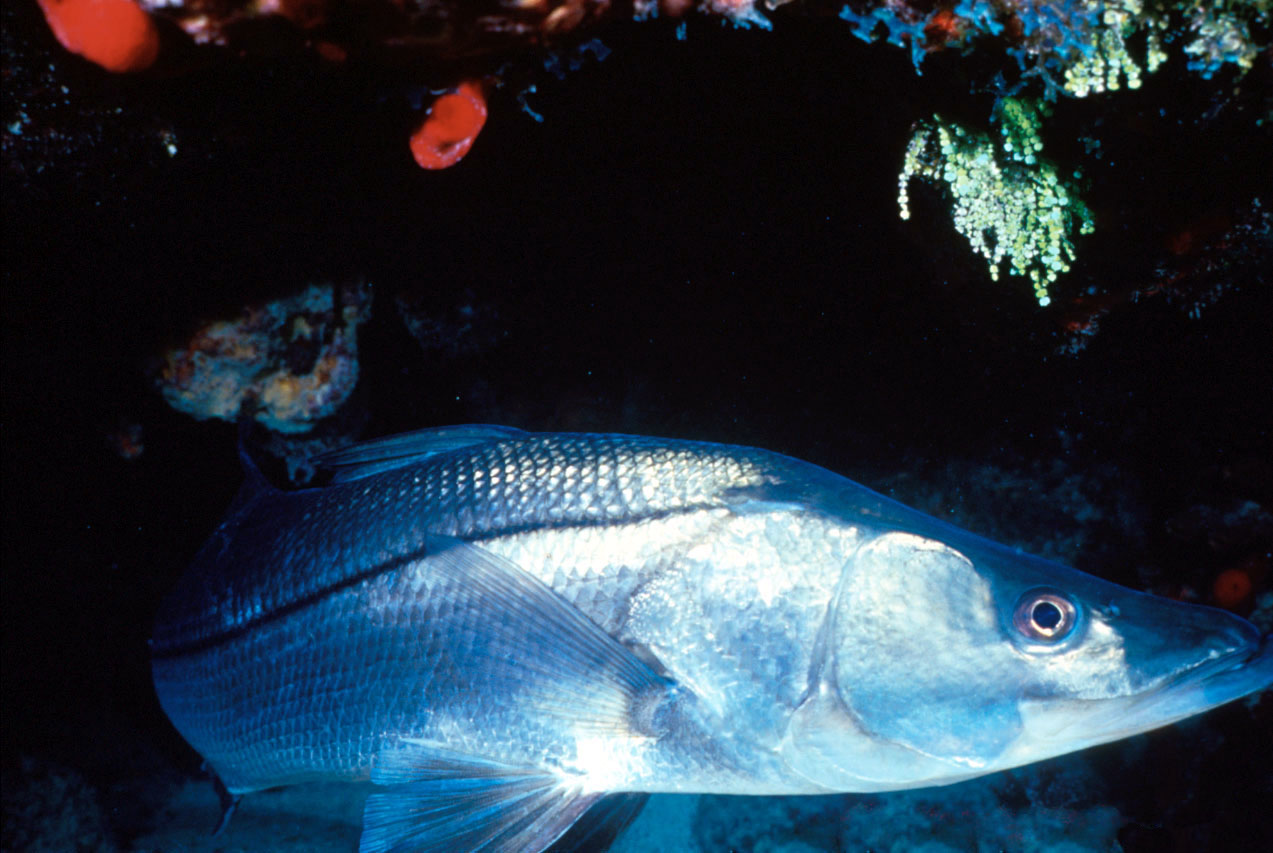
A black line running dead straight down the side names the fish before most of the rest does.
Everything after that comes down to moving water, hard cover and temperature. Snook face current and ambush what it delivers. They live around mangroves, pilings, passes, beaches, river mouths and canals. And a cold front can turn a fish that looked perfectly tropical yesterday into one trying to survive the week.
Profile basis: Florida FWC · Texas Parks and Wildlife · Getz, Rodriguez & Kline 2021
IDENTIFICATION
The black line is the first answer. Florida has more than one snook after that.
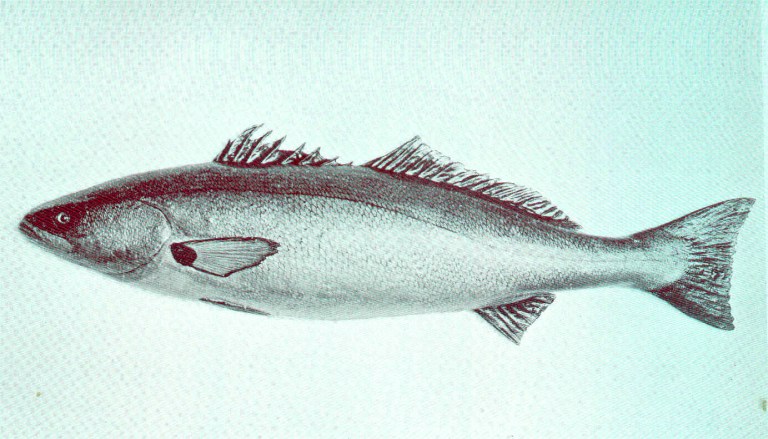
Common snook are long, slender fish with a concave forehead, a large mouth, a lower jaw that sticks forward and two clearly separated dorsal fins. The lateral line is heavily pigmented black and runs straight through the body into the tail. It is visible from a bad photograph and often from a surprising distance in the water.
That line identifies the snook family look better than it identifies common snook by itself, because fat snook, tarpon snook and swordspine snook also live in Florida. Common snook are generally the most slender-bodied. A swordspine has the comically long second anal spine its name promises. Tarpon snook have a longer pelvic fin that reaches to or past the anus. Fat snook are deeper-bodied and, when you really need to settle it, scale counts separate them.
The useful legal part is easier: Florida’s snook rules apply to the genus, so uncertainty among the smaller snook species is not permission to treat the fish as unregulated.
Also watch the gill cover. FWC calls it razor sharp. That sentence becomes much more convincing after the first time one finds your hand.
Sources: Florida Museum · Florida FWC
MOVING WATER
The fish faces the current so dinner has to come past its nose.
FWC’s species description gives the fishing mechanic unusually cleanly: common snook orient into moving water and ambush fish and large crustaceans carried by the current.
That makes structure useful for a physical reason. A mangrove point, bridge piling, oyster edge, seawall corner, jetty, creek mouth or undercut bank can put a slow pocket directly beside faster water. The fish gets cover and a lower-energy place to sit while prey keeps arriving.
Do not reduce that to “fish structure.” The good side of a piling can change when the tide changes. The same mangrove corner can be dead in slack water and useful twenty minutes later when the current starts wrapping around it. A pretty dock with no delivery lane can be worse than an ugly concrete edge with bait moving past it.
Tide direction does not get a universal winner here. The source set supports moving water and current breaks strongly; it does not support “incoming always beats outgoing” or the reverse. Ask where the food is being carried and which side of the object gives the snook a cheap place to intercept it.
COLD SETS THE RANGE
A snook can handle salt, fresh water and a canal. Cold is the thing it cannot simply work around.
Common snook are fully euryhaline. They move between ocean water, estuaries and genuine fresh water; Florida’s management map includes Lake Okeechobee and the Kissimmee River, and juvenile fish have been documented well into freshwater reaches of the lower Rio Grande.
Temperature is much less forgiving. FWC describes snook becoming lethargic below about 65°F / 18.3°C. Experimental work puts feeding cessation lower, with exact values changing by body size, salinity, population and cooling rate. Severe cold can push fish past equilibrium and into mortality.
The exact lethal number is not one clean threshold. Classic Florida work found fingerlings dying around 12.5°C after slow cooling. Newer work at the northern Gulf range edge found a colder-tolerant population with individual lethal temperatures roughly 7.9–10.5°C. Rapid cooling also causes fish to lose equilibrium at warmer temperatures than a slow decline does.
That variability is the interesting part. Northern populations appear to be adapting or sorting toward more cold tolerance as the range expands. The field lesson is still simpler: when water cools hard, look upriver, into canals and creeks, and into deeper thermally buffered channels. When a true cold kill is happening, the fish is no longer solving a presentation problem.
Sources: Shafland & Foote 1983 · Hall-Scharf et al. 2025 · Hall-Scharf et al. 2025
SEASONAL MOVEMENT
Winter pulls them inland. Warm water opens the passes again.
Texas telemetry shows a clean seasonal version of the pattern: tagged common snook moved toward the Gulf and Brazos Santiago Pass during the warm months, peaking in August, then shifted back toward the Brownsville ship channel during November through March. Florida fish use the same broad logic even though the exact geography differs.
Warm months expand beaches, passes, outer estuary shorelines and spawning areas. Cooling sends fish toward rivers, canals, creek systems and deeper refuge. That is better thought of as a seasonal change in where the useful structure is than a generic “summer shallow, winter deep” rule.
Freshwater discharge can move the map too. South Florida acoustic work found snook responding strongly to changes in salinity during high-discharge events; smaller fish sometimes shifted into slower tributary water, apparently reducing the energy cost of fighting the flow.
The snook is built for salinity change. It is not indifferent to how quickly the whole estuary changes around it.
THE SEX CHANGE
The thirty-inch fish may be more biologically different from the twenty-inch fish than the ruler makes it look.
Common snook are protandric hermaphrodites: they mature first as males, and some later transition to female. That is established. The exact size and age of the change are not.
FWC’s public and assessment sources give different maturity and transition figures because they are measuring different populations, different percentiles and different periods. Texas work places the male/female crossover around 670 mm total length in its sample; other Florida sources push common transition sizes larger.
The more interesting result came after Florida’s 2010 cold kill. Tampa Bay lost a large part of its snook population, and researchers later documented a temporary increase in very young females—evidence that the timing of sex change can be plastic rather than fixed like a birthday.
For an angler, the practical conclusion is modest: large snook are disproportionately female and therefore disproportionately important to spawning output. The biology is a good reason the upper end of a slot limit exists, not a reason to pretend we know the exact inch where a male becomes a female.
Sources: Taylor et al. 2000 · Trotter et al. 2025
SPAWNING
The fish gathers where the tide has the most leverage.
Spawning aggregations form around passes, inlets and adjacent beaches in warm, high-salinity water. FWC assessments place the season broadly from spring through early autumn, with peak activity in summer. Tampa Bay work documented spawning concentrated around new and full moons and in the evening, roughly 1700–2000 hours.
That makes the aggregation predictable enough to be both excellent research habitat and dangerous fishing pressure. Hundreds of snook can gather at one site, and males are often more common at the aggregation than females.
FWC work has shown tagged spawning females can still spawn after catch-and-release, but the agency also notes uncertainty about effects on gamete quality. That is a good example of where “the fish swam away” and “nothing biological changed” are not the same claim.
Summer harvest closures make much more sense once you see the fish concentrating at the same passes, on predictable moons, during the reproductive season.
FOOD GROWS WITH THE FISH
Shrimp matters. Then the snook gets big enough that fish matters more.
Charlotte Harbor diet work on hundreds of snook found fish making up about 71% of prey items by number and 90% by weight overall, with shrimp and crabs filling much of the rest. Pinfish were especially important.
Body size changed the menu. Smaller snook ate relatively more shrimp, killifish and mojarras. Above roughly 500–550 mm, fish became much more dominant. Texas data showed the same broad shift: below 500 mm, shrimp dominated more of the diet; above it, fish made up most of what was eaten.
Season changed the local answer too. Charlotte Harbor snook ate far more pinfish in summer than winter, while pink shrimp peaked in winter. The authors tied that shift to prey recruitment and availability rather than a snook changing its personal taste.
That is the fishing version worth keeping: match the prey community around the actual structure. “Snook eat pinfish” can be true and still be a bad reason to ignore the shrimp pouring through a creek mouth in front of you.
Sources: Blewett, Hensley & Stevens 2006 · Getz, Rodriguez & Kline 2021
PRESENTATION
Put it through the ambush lane, not merely beside the object.
FWC and Texas sources name live shrimp, pinfish, mullet, sardines and other baitfish. Artificial lures work too, and FWC’s catch-and-release research gives artificials one practical advantage: live bait showed up more often in hook-related mortality because fish had more opportunity to swallow it.
When a snook follows or strikes from one side of structure, keep the current relationship in the explanation. The fish may have just told you more about the angle than the lure.
HOOKS, GILL PLATES & GETTING IT BACK
The fish is excellent at turning one bad handling choice into several.
Hooked snook jump and make long runs, often straight back toward the structure they came from. The gill covers are sharp. The mouth is large. None of that means the fish should be fought until it is completely spent.
FWC recommends landing snook quickly enough to limit exhaustion, keeping the fish in water during hook removal when possible, using wet hands and supporting it horizontally. A fish held vertically by the jaw can suffer serious internal injury.
The hook location matters a lot. FWC’s snook work found circle hooks lowering hooking mortality relative to J-hooks, and barbless hooks reduced tissue damage without reducing catch rate in the cited study. The most useful deep-hook result is even simpler: in one FWC experiment, four of twelve deep-hooked snook died when researchers removed the hook; none of twelve died when the leader was cut and the hook left in place.
That is not permission to deep-hook fish because the hook may work out later. It is the rescue plan when the mistake has already happened.
For a lethargic fish, FWC advises moving it head-first through cooler, oxygenated water—not pumping it backward and forward. Fish breathe one direction. That part is not negotiable.
Sources: FWC — reducing catch-and-release mortality · FWC — cryptic mortality
FLORIDA RULES · VERIFIED 2026-09-02
Nine regions and two slot widths, so don’t remember this approximately.
Florida manages snook in nine regions and reviews the fishery regionally. Current FWC rules use a one-fish-per-person daily bag in every region, hook-and-line gear only, no commercial harvest or sale, and require a recreational fishing license plus snook permit where applicable. A retained fish must remain whole until landed ashore.
Panhandle, Big Bend, Tampa Bay and Sarasota Bay: 28–33 inches total length; closed December 1 through the end of February and May 1 through August 31.
Charlotte Harbor and Southwest: 28–33 inches; closed December 1 through the end of February and May 1 through September 30.
Northeast, Indian River Lagoon and Southeast: 28–32 inches; closed December 15 through January 31 and June 1 through August 31.
That means the review date matters. On September 2, 2026, east-coast harvest and the Panhandle/Big Bend/Tampa Bay/Sarasota Bay regions are in their fall open period; Charlotte Harbor and Southwest don’t reopen until October 1.
FWC says Gulf and Atlantic snook stocks are currently above its 40% spawning-potential management goal, but the agency still evaluates regional abundance, habitat, harmful algal blooms, effort, temperature and stakeholder information each year. So a date checked on a web page — this one included — isn’t a substitute for looking at FWC again before the trip.
Current rule source: Florida FWC — Snook Management Regions and Regulations
RANGE EXPANSION
The old Florida map is getting old.
Older Florida summaries put the reliable Gulf range around Tarpon Springs. Newer research has documented reproducing snook farther north around Cedar Key, expansion along the Texas coast and increasingly regular fish in coastal Alabama.
A 2026 Alabama paper compiled 147 snook observations there between 2012 and 2025, with 81 of them in 2024 alone, and documented fish surviving the severe January 2025 freeze by using refuge systems.
That does not mean cold stopped mattering. It means a warming coast plus local cold refuge can move the boundary, and the fish at the edge may be different enough physiologically to survive conditions that would have killed older Florida study fish.
The range map is becoming a climate story in real time.
Sources: Purtlebaugh et al. 2020 · Hendrickson et al. 2026
DEEP REFERENCE · THE ARGUMENTS WORTH SAVING
The snook literature disagrees in interesting places.
Maximum age: FishBase says 7; FWC has a 21-year-old fish
FWC’s hard-part aging and tag history support common snook living beyond 20 years, while FishBase still carries a seven-year maximum. The agency evidence is a lot stronger for Florida fish, so I’d treat the FishBase number as stale rather than averaging the two into nonsense.
When does a male become a female?
There is no single answer. Published transition sizes span a large part of the adult range, the 50% transition age differs by population, and post-cold-kill Tampa Bay fish temporarily changed sex younger. The stable fact is protandry; the transition schedule is plastic.
How cold is lethal?
Published lower-lethal values vary by population, body size, salinity, acclimation and the speed of cooling. That variation is biologically useful, and it’s why the cold section talks about refuge and rate of change instead of putting one magic number in the top card.
24°C or 25°C to start spawning?
FWC’s 2020 stock assessment uses 24°C after winter warming; the 2000 assessment used 25°C. One degree, same agency, different assessment. The broad field conclusion—spawning begins after substantial spring warming—is sturdier than choosing a winner.
How bad was the 2010 cold kill?
Very bad in some places and much less severe in others. Southwest Florida barrier-island work measured catastrophic local losses, while five-estuary monitoring found effects ranging from little detectable change to multi-year recovery. The event was not geographically uniform.
Pressure, clouds, wind or tide direction?
Nothing solid in the sources shows a universal snook bite response to barometric pressure, cloud cover, one wind direction or one preferred tide direction. Current, temperature, prey delivery and structure are supported much more directly.
People treat that 65°F (18.3°C) lethargy line like a kill switch. It isn’t one. The northern Gulf fish in Hall-Scharf’s work didn’t reach their individual lethal limits until roughly 7.9–10.5°C, a few degrees colder than the 12.5°C that killed the classic Florida fingerlings, and a long way below the point where snook start getting sluggish. The number worth knowing is which population is under your line, not one reading on a thermometer.
SOURCES
FEEDING · FACING INTO THE FLOW
It points upstream beside hard cover and takes whatever the tide delivers. When a cold front hits, it stops being a question about the bite and becomes one about whether the fish makes it.
Cold-stress and mortality thresholds are kept separate from feeding-temperature claims.
The source shelf.
- Florida FWC — Common Snook
- Florida FWC — current regulations
- Florida FWRI — species sketch
- Florida FWC — 2020 stock assessment
- Texas Parks and Wildlife — Snook
- Florida Museum — Common Snook
- Getz, Rodriguez & Kline 2021 — Texas ecology and life history
- Getz, Rodriguez & Kline 2025 — seasonal movement and residency
- Blewett, Hensley & Stevens 2006 — diet
- Shafland & Foote 1983 — lower lethal temperature
- Hall-Scharf et al. 2025 — northern-range cold tolerance
- Trotter et al. 2025 — sex-change response after cold mortality
- Lowerre-Barbieri et al. 2014 — spawning sites and behavior
- Florida FWC — catch-and-release mortality reduction
- Purtlebaugh et al. 2020 — northward range expansion
- Hendrickson et al. 2026 — common snook in Alabama
Profile reviewed 2026-09-02. Florida regulation details above were checked against FWC on this date. Snook rules are regional and can change; verify the exact management region before harvest.
FIELD OBJECT
This one should leave the page.
The article is the long version. These are the pieces worth carrying into the next trip.
The 30-second version
A black line running dead straight down the side names this fish from a bad photo. Everything after that comes down to current, structure, cold sensitivity, and a strange life history where the biggest fish are mostly females.
What to watch
- A black line running dead straight down the side names the fish before most of the rest does.
- The black line is the first answer. Florida has more than one snook after that.
- The fish faces the current so dinner has to come past its nose.
- A snook can handle salt, fresh water and a canal. Cold is the thing it cannot simply work around.
Field card
- Florida FWC — Common Snook
- Florida FWC — current regulations
- Florida FWRI — species sketch
- Florida FWC — 2020 stock assessment
- Texas Parks and Wildlife — Snook
RIGHT TOOL, NEXT
Tackle Link Analyst
Follow the load path and find the part of the setup that actually limits the rest.