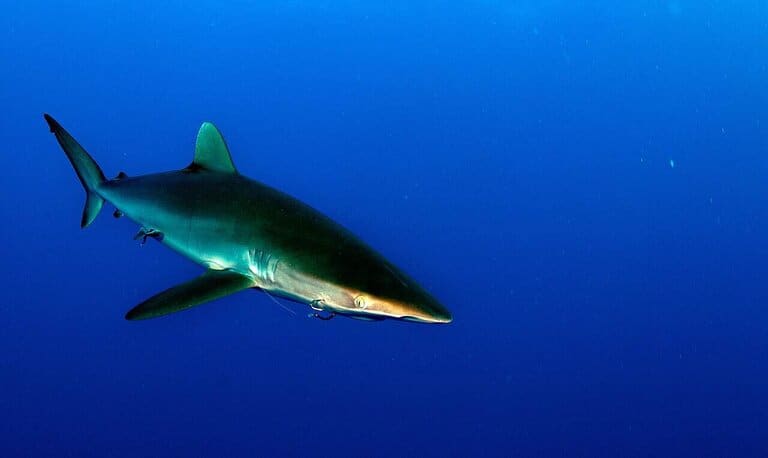
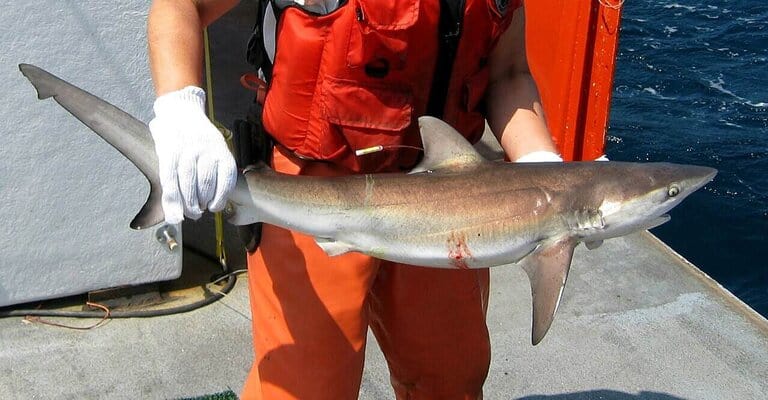
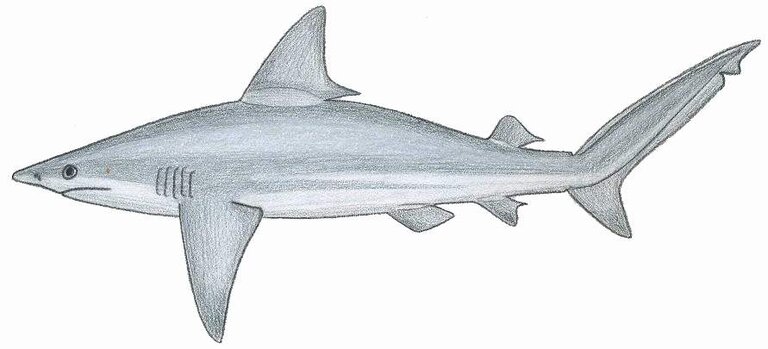
Half the “sharks” cruising under a ray turn out to be cobia. Look for the ray or turtle first and the fish usually turns out to be the second shape you find.
By HunterUpdated September 12, 2026Read 7 min
Cobia (Rachycentron canadum) broodstock. NOAA Photo Library; public-domain U.S. federal source.
Somebody on the boat calls out shark, and half the time it’s a cobia. By most accounts that mistake keeps happening to people who already know better, which is kind of comforting. Sight-fishing Rachycentron canadum starts with silhouette — long dark body, broad flat head, pale stripe down the side — usually cruising next to a ray or turtle, where your brain labels the whole shape before your eyes finish looking. The silhouette gets you the ID. Where that fish spends the winter, and which stock it belongs to, takes more than a good look.
At a glance · The short version
Scientific name
Rachycentron canadum
U.S. range
Most abundant from Virginia south through Florida and the Gulf; seasonally migratory.
Habitat clue
Buoys, debris, wrecks, artificial reefs—and large animals including sharks, turtles and stingrays.
Life history
NOAA: males mature around age 2, females around age 3; lifespan to about 12 years.
The shark mistake is understandable
Identification
Broad flat head
Cobia are long, heavy, dark fish with a broad flattened head and a pale lateral stripe that can be more obvious on some fish than others. At distance, the shape can read like a small shark. Up close, the head and fin layout settle the difference.
NOAA notes that cobia are often mistaken for remoras and that remoras are their closest living relatives. The lookalike problem is therefore more than anglers being careless; these fish actually sit close on the evolutionary tree.
NOAA gives a maximum around six feet and 100 pounds. A fish at that size changes the landing plan. It is no longer just a sight-cast target; it is a large powerful animal entering a small boat.
NOAA lists buoys, debris, shipwrecks and artificial reefs among common cobia associations. Those features interrupt otherwise open water and can concentrate prey or provide a reference point for a roaming pelagic fish.
Sharks, sea turtles and stingrays also carry cobia. This is the part that holds up no matter who is doing the looking: scanning for the ray or turtle is often easier than scanning for a brown fish over brown-green water. The host animal is the larger visual signal; the cobia is the second look.
NOAA describes adults traveling alone or in small groups. A single fish under a ray is therefore not evidence the school is somewhere else; it can be the normal social unit.
Along the Atlantic coast, cobia move south and offshore toward warmer water in late fall and winter. That is the biological reason sight-fishing opportunity can arrive and leave quickly in Mid-Atlantic waters. The “season” follows fish movement, not a guaranteed date on last year’s report.
NOAA reports summer cobia from the northeastern Gulf moving to south Florida waters in winter, possibly near the Florida Keys. A Gulf migration story and an Atlantic migratory-group story overlap around Florida but do not represent one management stock.
ASMFC recognizes Atlantic cobia from Georgia north and the Gulf Migratory Group extending through the Gulf and Florida’s east coast. That stock line matters before regulations are discussed; “Atlantic coast cobia” is not enough precision by itself.
NOAA reports males reproducing around age two and females around age three. That is relatively early for a fish capable of reaching this size and helps explain why cobia population dynamics can look different from slow-maturing billfish or sharks.
Females can spawn several times during the season. NOAA describes spawning from late June to mid-August in the Southeast and from late summer into early fall in the Gulf, with roughly 375,000 to 2 million eggs released each spawning event.
NOAA lists lifespan to about 12 years. That is not a guarantee that a legal fish is old or that every population has the same age structure; it is the current public species benchmark.
NOAA describes cobia as aggressive predators that feed mainly on crustaceans, while also taking fish and squid. That menu explains why a cobia cruising a ray is not necessarily waiting for a baitfish school; mobile animals and bottom-oriented forage can both matter.
Evidence level. The migration, diet and life-history fields above are sourced. The scanning and casting notes below are inference from how cobia use their hosts and from what cobia anglers consistently report, and they’re tagged that way on purpose so you can tell the borrowed parts from the biology.
Find the ray firstinference
Scan for the bigger dark diamond of a ray, a turtle at the surface, a buoy line or something floating by itself, then look around it for the second shape. Sometimes there’s nothing there. Sometimes the cobia only jumps out once the host gives you somewhere specific to look.
The first cast has cleaner informationinference
A fish that hasn’t reacted to the boat is easier to read than one you already spooked. Lead the direction of travel and put the presentation where the fish can intercept it. Dropping something directly on a cobia’s head can turn the sight-fishing problem into an avoidance problem.
A refused fish is not automatically goneinference
The accounts agree that a refusal is rarely final here; a fish that ignores one presentation will often take a different one on a second pass. A fish that slides off without panicking can circle or settle back into the same association. The next cast should be better informed by the first one, not simply harder or closer.
The rail needs a plan
Landing & Handling
Green cobia can wreck the plan
A powerful cobia brought aboard with a lot of fight left can thrash violently. Before the fish reaches the rail, decide whether it is being released or retained, who controls the rod, who handles landing gear and where the fish will go. Do not make the deck plan after the fish is already on the deck.
One fish, one crew plan
Clear loose tackle and keep unnecessary people out of the landing zone. A fish does not need to be record-sized to turn hooks, rods and gaffs into hazards in a confined space.
Not established here
What this profile will not claim
one fixed migration date every year
that every ray or turtle carries cobia
that the first cast is always the only chance
— · Sources
FEEDING ECOLOGY · STANDARDIZED
How this fish gets fed.
Primary prey
Crabs are especially important, along with fishes, shrimp, squid, and other large mobile prey.
Feeding mode / location
A mobile opportunistic predator that patrols buoys, rays and sharks, wrecks, reefs, channel markers, current lines and open-water bait. It can feed near the surface or close to structure depending on where prey is concentrated.
Diel / seasonal pattern
The profile does not establish one universal daily feeding window. Seasonal migration, warm water, current and prey distribution determine where cobia are available more reliably than a fixed clock.
Ontogenetic diet shift
Young cobia use smaller crustaceans and fishes; larger fish broaden toward larger crabs, fishes and squid.
Association with rays, sharks or buoys is a search clue; the actual feeding target remains the prey concentrated around them.
Primary References
NOAA Fisheries — Cobia — identification, life history, migration, habitat associations, diet and federal management structure.
Compiled 2026-09-11. Limits and advisories are set per water and per state and change between seasons — the managing agency for wherever you are fishing has the current answer.
The cobia clue anglers repeat most is a little backwards: quit staring for cobia. Find whatever is giving the fish a reason to be there, and let the brown shape show up second. What no amount of staring will tell you is which of the two management stocks that fish belongs to, and that’s the first question the regulations ask.
Saltwater & CoastalSurf, shoreline, nearshore, offshore, and deep-sea fishing — technique, gear, and safety content spanning the full range from the beach to blue water.103 articles
Species & BehaviorFish behavior, habitat, depth, forage relationships, and species-specific field decisions. Start with the Freshwater Fish Species field guide.159 articles
Cookie Consent
We use cookies to improve your experience on our site. By using our site, you consent to cookies.
Contains information related to marketing campaigns of the user. These are shared with Google AdWords / Google Ads when the Google Ads and Google Analytics accounts are linked together.
90 days
__utma
ID used to identify users and sessions
2 years after last activity
__utmt
Used to monitor number of Google Analytics server requests
10 minutes
__utmb
Used to distinguish new sessions and visits. This cookie is set when the GA.js javascript library is loaded and there is no existing __utmb cookie. The cookie is updated every time data is sent to the Google Analytics server.
30 minutes after last activity
__utmc
Used only with old Urchin versions of Google Analytics and not with GA.js. Was used to distinguish between new sessions and visits at the end of a session.
End of session (browser)
__utmz
Contains information about the traffic source or campaign that directed user to the website. The cookie is set when the GA.js javascript is loaded and updated when data is sent to the Google Anaytics server
6 months after last activity
__utmv
Contains custom information set by the web developer via the _setCustomVar method in Google Analytics. This cookie is updated every time new data is sent to the Google Analytics server.
2 years after last activity
__utmx
Used to determine whether a user is included in an A / B or Multivariate test.
18 months
_ga
ID used to identify users
2 years
_gali
Used by Google Analytics to determine which links on a page are being clicked
30 seconds
_ga_
ID used to identify users
2 years
_gid
ID used to identify users for 24 hours after last activity
24 hours
_gat
Used to monitor number of Google Analytics server requests when using Google Tag Manager
1 minute
Jetpack's built-in visitor analytics. It records page views, referring sites, search terms, and outbound link clicks, and also carries the shared visitor-tracking library used by Jetpack Instant Search and WooCommerce Analytics.