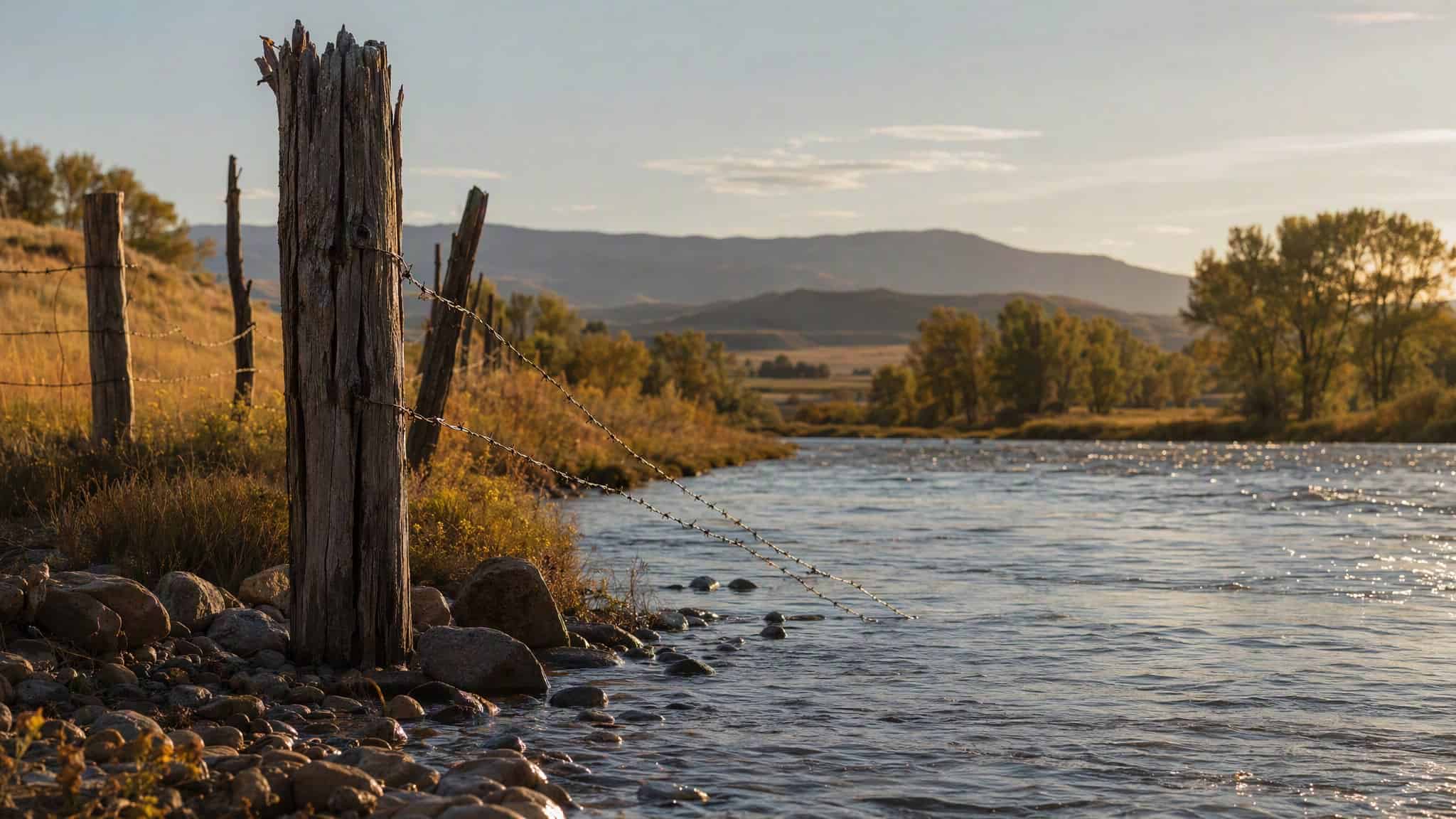
Two anglers, same river size, same kind of ranch on both sides, two hundred miles apart. One is standing in the water legally and the other is committing a trespass.
The water isn’t different, and neither is the federal law. The only thing that changed is which state line they’re inside, and that turns out to be the whole question.
None of this is legal advice. It’s why the answers differ, and where to go for the one that applies to the river in front of you.
What the federal rules settle, and what they leave alone
Under the equal-footing doctrine, a state takes title to the beds of waters that were navigable in fact when it became a state — used or usable as highways for commerce, in their ordinary and natural condition. Beds of non-navigable waters generally stayed federal and passed into private hands through patents.
The Supreme Court sharpened this in PPL Montana v. Montana (2012), and three things in that decision matter here.
Navigability for title is decided segment by segment, not river by river. The Court found a 17-mile reach of the Missouri non-navigable even though the river is navigable elsewhere.
Navigability for title isn’t the same as navigability for regulation. Clean Water Act reach is broader.
And then the sentence that explains everything else: “The public trust doctrine remains a matter of state law.”
Federal law decides who owns the bed, and state law decides what the public may do on top of it. That’s how two identical rivers end up with opposite answers.
Montana, which is the most permissive
Montana’s Stream Access Law, enacted in 1985 and codified at Title 23, Chapter 2, Part 3 of the Montana Code, permits public recreational use of all surface waters capable of recreational use up to the ordinary high-water mark — regardless of who owns the streambed.
That covers fishing, wading, floating, swimming, waterfowl and upland bird hunting, and related incidental uses. It came out of the 1984 Curran and Hildreth decisions, and it’s about as angler-friendly as American stream law gets.
The statute defines the ordinary high-water mark as the line water impresses on land by covering it long enough to leave physical characteristics that distinguish below from above. Adjacent floodplain is expressly excluded.
What it doesn’t permit is the part people get wrong. It doesn’t let you cross private land to reach the water or enter posted land, and it doesn’t cover big game hunting, permanent structures, or using a dry streambed as a right-of-way. Lawful entry comes from public land, a public easement, or a public bridge or county road right-of-way, and FWP’s stream access page lays it out.
So in Montana you can float and you can wade. The hard question is how you got to the water.
Wyoming, next door, opposite answer
Wyoming Game and Fish states that the land under most Wyoming streams belongs to the adjacent landowner. You can float through private land, but you can’t wade, anchor, or get out of the boat without permission. Portaging around a logjam or a fence is allowed, and you’re expected to do it efficiently.
The federal baseline hasn’t moved and the river looks the same, but the state rule is different, so a Montana angler who steps out of the boat here is in a different legal position than they were yesterday.
Colorado, where it’s genuinely unsettled
Colorado’s the one to be careful with, because the practical norm rests on thinner ground than most people realize.
People v. Emmert (1979) held there’s no public right to float non-navigable streams through private land without consent. A 1977 amendment brought non-navigable stream beds and banks inside the criminal trespass statute.
The widespread “float but don’t touch” practice traces to a 1983 Attorney General opinion — advisory, not binding — concluding that floating without touching bed or banks isn’t criminal trespass. Touching the bed is the contested zone.
In 2023 the Colorado Supreme Court decided an angler lacked standing to establish that an Arkansas River segment was navigable at statehood, which means it declined to reach the underlying question. Legislative efforts have repeatedly stalled.
So treat Colorado as an open question. If somebody tells you confidently what the rule is there, they’re describing a practice rather than a settled holding.
Utah, where the answer changed and then held
Utah’s the clearest example of an access rule changing within a lot of anglers’ lifetimes.
Conatser v. Johnson (2008) held the public could touch privately owned beds of public waters incident to lawful recreation. In 2010 the legislature passed HB 141, the Public Waters Access Act, which reversed that.
A district court first held HB 141 unconstitutional. The Utah Supreme Court threw that out in 2019 and sent the case back, and in May 2023 it upheld the ruling against the anglers, finding no public recreational easement arose at statehood. HB 141 stands, and the Court pointed at the legislature rather than the courts for any further change. The Utah Attorney General’s office puts it at over 2,700 miles of rivers and streams.
Utah’s Division of Wildlife Resources now says you may fish while floating over a private bed and incidentally touch it as required for safe passage, but you may not walk, stand or anchor on a private bed without permission. Their stream access page is where the current rule lives.
Virginia, and the colonial paperwork
The eastern version is stranger. In Kraft v. Burr (1996) the Virginia Supreme Court held that riparian owners holding a colonial King’s Grant own the riverbed and the fishing right, and may bar wading and fishing — though they cannot stop passage along navigable water.
That closed roughly three miles of the Jackson River to wading and fishing while leaving float-through intact. The grant has to be proved, and other Virginia reaches with colonial grants are still unresolved, parcel by parcel.
A three-hundred-year-old land grant deciding whether you can stand in a river is the kind of thing that sounds made up until you’re the one being told to get out.
The three questions to ask in any new state
Not one question. Three, because states answer them separately.
May I float through? Usually yes, almost everywhere, for genuinely navigable water.
May I touch the bed or wade? This is the one that varies, and it’s the one that gets people in trouble.
How do I lawfully get to the water? Public land, public easement, bridge right-of-way, or permission — and this is a separate question from the first two even where the first two are yes.
Montana answers yes, yes, and bridge-or-easement. Wyoming answers yes, no, and permission. Utah mostly lands there too, apart from the incidental touching it allows for getting around safely.
Two practical notes
Ordinary high-water mark is a physical line, not today’s water line. It’s read off vegetation and soil — evidence of sustained inundation. It isn’t the floodplain and it isn’t wherever the river happens to be this morning.
A sign isn’t the whole answer, in either direction. In Montana a posted sign can’t revoke a statutory right below the high-water mark, though it absolutely controls the upland you’d cross to get there. In Utah, Wyoming and Virginia an unposted bank can still be private bed where wading is unlawful. No sign isn’t the same as permission.
Before you fish new water, read the state wildlife agency’s own access page. That’s the page enforcement works from, and it takes ten minutes. The rest of the homework is a water-specific regulation check.
Nobody’s asking you to become a lawyer. You just need to know which of the three questions you haven’t answered yet.
FIELD OBJECT
This one should leave the page.
The article is the long version. These are the pieces worth carrying into the next trip.
The 30-second version
Wading a river through private land is a legal right in Montana and a trespass in Wyoming. The federal rules don't change at the border, but state law does, and that's the whole difference.
What to watch
- What the federal rules settle, and what they leave alone
- Montana, which is the most permissive
- Wyoming, next door, opposite answer
- Colorado, where it's genuinely unsettled
Field card
- What the federal rules settle, and what they leave alone
- Montana, which is the most permissive
- Wyoming, next door, opposite answer
- Colorado, where it's genuinely unsettled
- Utah, where the answer changed and then held
RIGHT TOOL, NEXT
Field Sense Navigator
Take the article’s water or access question into a place-specific conditions and route check.