Shoal Bass Need Rock and Current in the Same Spot, and Rivers Don’t Have Much of It
Shoal bass live in one river basin and only in the stretches where rock breaks fast current. That’s why one hurricane could knock the Chipola population down by about 90 percent.
By HunterUpdated September 12, 2026Read 8 min
Image: river rock shoal, backlit spray
It’s easy to write a shoal bass off as a smallmouth with a Southern address. That shortcut skips the most interesting thing about the fish, which is how little of its own river it can actually use. Micropterus cataractae is a current specialist native to the Apalachicola-Chattahoochee-Flint system, and suitable shoal habitat can be sparse enough that losing a short stretch of rock and flow can remove a meaningful share of the usable habitat in an entire river.
At a glance · The short version
Scientific name
Micropterus cataractae
Native range
Apalachicola-Chattahoochee-Flint river basin in Alabama, Georgia, and Florida.
Habitat
Flowing freshwater with moderate to fast current, rocky shoals, riffles, runs, boulders, and deeper limestone or rock pools near shoal habitat.
Adult size
Georgia DNR lists roughly 12–24 in as the adult size range.
Primary forage
Crayfish are especially important; fish and insects also matter.
Conservation status
A narrow-range habitat specialist and Species of Greatest Conservation Need in Florida; local rules can require immediate release.
What fish is this?
Identification
Jaw and dorsal fins
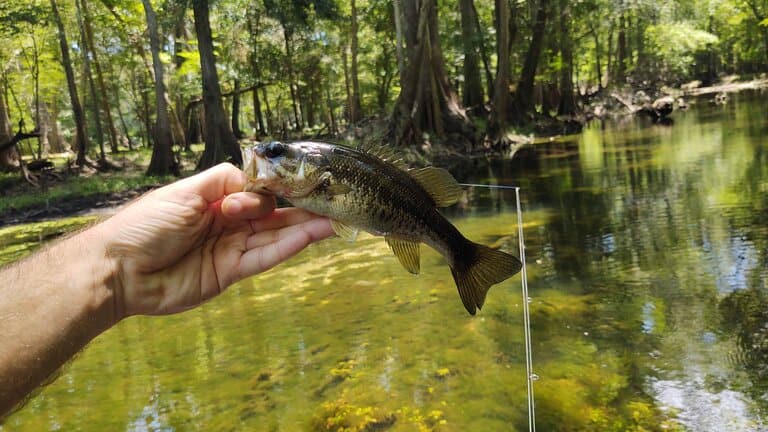
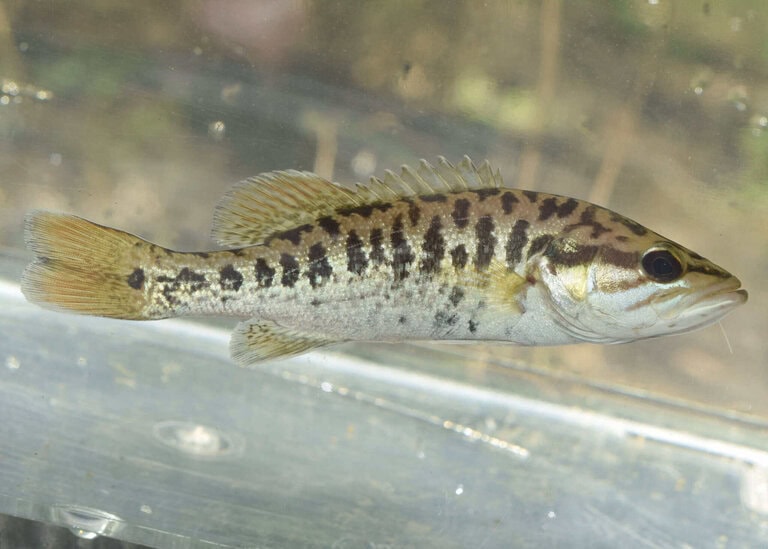
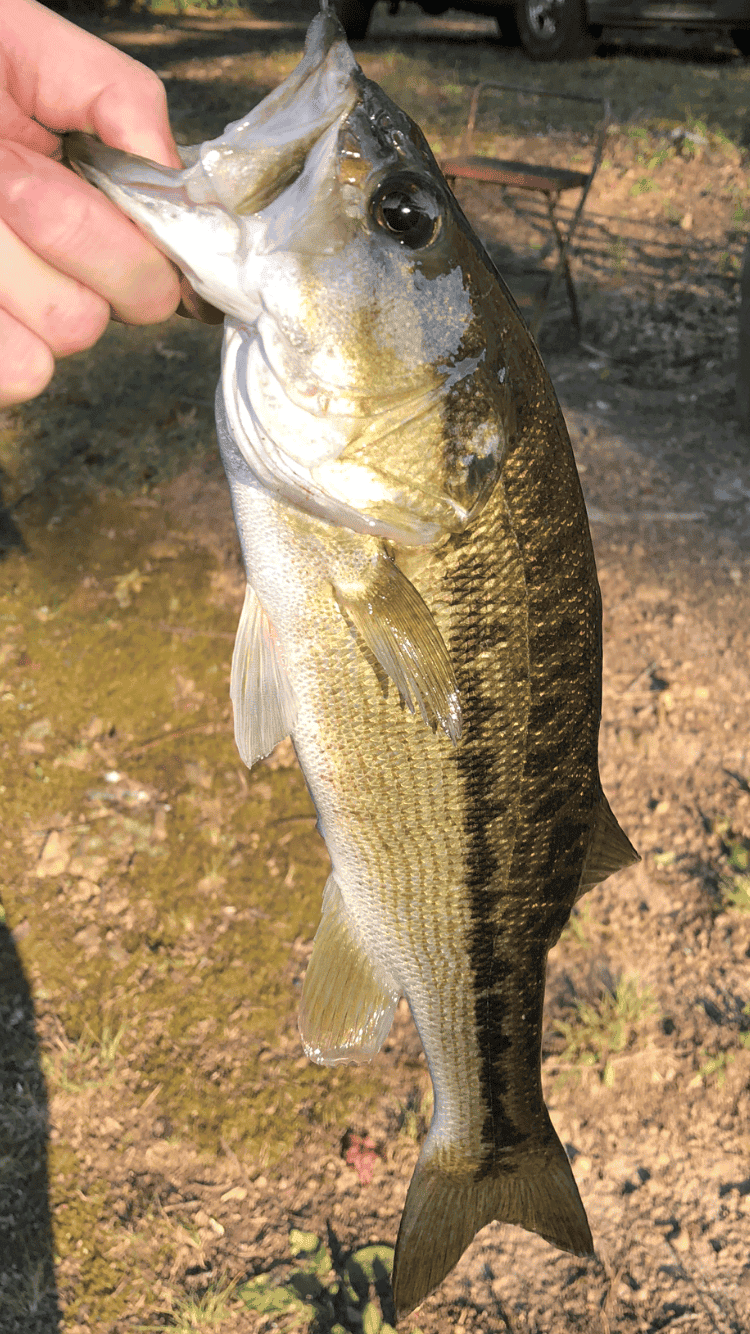
Unlike largemouth bass, a shoal bass does not have an upper jaw extending beyond the eye, and the first and second dorsal fins are connected rather than separated by a deep notch.
Florida describes vertical striping above the midline; a largemouth carries a strong continuous lateral band instead. Georgia notes that shoal bass resemble members of the redeye-bass complex but lack the red fin coloration and pale tail margins used to separate those fish.
Georgia DNR notes that shoal bass usually show a large dark spot at the base of the tail, a useful clue when separating them from smallmouth and some redeye-bass forms.
Drainage matters. A bass from native ACF shoal habitat belongs in a different identification problem than a similar-looking fish outside that basin, and introduced shoal bass also occur in Georgia’s Ocmulgee and Oconee systems. Location narrows the possibilities; it does not replace structural identification.
FWC describes shoal bass as endemic to the Apalachicola-Chattahoochee-Flint basin. Florida’s naturally reproducing population is concentrated in the Chipola River, while Georgia holds important native populations in the Chattahoochee and Flint systems.
This is a true flowing-water species. FWC describes typical habitat as lotic systems with moderate to fast velocities and rocky substrate. Georgia puts the fish around current breaks near flowing water: in the middle of shoals, behind trees, around boulders, and in deeper river bends where hard structure breaks the flow.
The word shoal is not branding. Limestone, boulders, riffles, and rocky runs are core habitat. Larger fish can use deeper pools above and below shoals, but those pools still sit inside a river reach structured by rock and current.
Because suitable shoal habitat is patchy, population density can remain low even in a river where shoal bass are present. Florida monitoring specifically links low density in the Chipola to limited suitable habitat. That means absence from one apparently good bank does not tell you much if the actual rock-and-flow sequence is somewhere else.
Florida identifies crayfish as a primary food and also lists fish and insects. That fits the habitat almost too neatly: crayfish live in the same rock a shoal bass uses as current shelter, while drifting insects and small fish are delivered through the same seams.
A current specialist still avoids paying full price for current. Georgia’s examples repeatedly put fish behind or beside current-breaking structure. None of those examples show a fish sitting out in open, featureless heavy flow. The fish wants delivery plus a place to hold.
Both Georgia and Florida characterize shoal bass as exceptionally strong river fish. The important practical point is not a ranking against other black bass. It is that a hooked fish gets the river for free, so a fish of ordinary weight can feel much heavier once it turns broadside in fast water.
How to read this section. Lure and tackle guidance comes from state agency angling guidance where noted. The positioning logic is an inference from the species’ documented habitat and diet.
First water to checkinference
Start on the downstream and lateral edges of hard current: boulder pockets, tongues beside a shoal, the head of a deeper pool, the tailout where a run accelerates, or wood that creates a clean soft pocket within moving water. What you are actually looking for is rock that creates a feeding lane, which is a much smaller share of the rocky water in front of you than it first looks.
Luresconvention
Florida recommends soft-plastic crayfish imitations and grubs, and also lists spinnerbaits, jerkbaits, and small crankbaits. Georgia says standard black-bass lures will catch the species. The useful common denominator is a presentation that can stay controlled around rock and current.
FWC suggests medium-action tackle with roughly 8–12 lb line. That is enough to fish common black-bass lures while still giving some control when a fish turns into the current.
Do not make every cast fight the river. Quarter upstream or across, let the bait enter the seam, then use just enough retrieve to keep it working without ripping it out of the soft pocket. For a crayfish imitation, contact with bottom matters more than speed. For a moving bait, deflection and a momentary stall behind rock are often the useful part of the retrieve.
Seasonconvention
FWC identifies spring and fall as particularly good shoal-bass seasons while noting summer can also fish well. Use that as a starting window, not a guarantee; discharge and river temperature can change access to shoal habitat faster than a calendar does.
A species concentrated in one native river basin has less geographic backup when habitat is fragmented, degraded, or physically altered. FWC lists shoal bass as a Species of Greatest Conservation Need in Florida and describes the fish as a habitat specialist.
In Florida’s Chipola River, Hurricane Michael in 2018 caused catastrophic habitat damage and FWC reported an approximately 90% decline in the shoal-bass population. That is an unusually clear example of how a narrow-range fish can take a basin-scale hit from one event.
Florida developed hatchery spawning methods and began releasing shoal-bass fingerlings into the Chipola after the decline. FWC’s 2022 sampling found hatchery-origin fish making a measurable contribution to the recovering population, which is a restoration story rather than ordinary sport-fish stocking.
FWC also identifies hybridization with other black bass as a threat. In a narrow-range species, losing genetic identity can matter even when a river still appears to contain plenty of bass.
Agency guidance identifies spring as a prime fishing period and black bass move toward spawning habitat.
Flow stability, accessible shoal edges, and whether local rules or conservation concerns change how spawning fish should be handled.
Summer
Fish remain catchable, but warm water and discharge can change which current breaks remain comfortable.
Deeper rock, shaded runs, oxygenated current, and the cost of fighting fish in hot water.
Fall
FWC again rates fall highly; cooling water can expand daytime feeding opportunities.
Crayfish activity, baitfish movement, and current seams beside deeper wintering water.
Winter
Lower metabolism generally increases the value of deeper, slower, more stable holding water adjacent to shoals.
Pool-shoal transitions rather than the shallowest, fastest water by default.
— · Where the sources are not tidy
Open Questions
Native versus introduced shoal bass
The species is native to the ACF basin but has been introduced into other Georgia rivers. A catch outside the native basin is therefore a different conservation context even when the fish itself is correctly identified.
River-specific vulnerability
The Chipola example is unusually well documented, but it should not be copied wholesale onto every shoal-bass river. Habitat extent, storm damage, dams, hybridization pressure, and local population trends differ by drainage.
— · What we are not filling with guesses
Not Established Here
a universal preferred temperature band
a single spawning-temperature trigger across the range
barometric-pressure response
cold-front response
a universal depth by month
a single catch-and-release mortality threshold for all shoal-bass rivers
— · Sources
FEEDING ECOLOGY · STANDARDIZED
How this fish gets fed.
Primary prey
Crayfish, fishes, aquatic insects and other river invertebrates are the core prey categories supported for Shoal Bass.
Feeding mode / location
A river predator built around rocky shoals, runs, current seams and the softer pockets immediately beside hard flow. Productive feeding positions combine prey delivery with reduced swimming cost.
Diel / seasonal pattern
The profile does not establish one universal daily feeding window. Flow, temperature, prey movement and spawning-season habitat shifts provide stronger context than a fixed clock.
Ontogenetic diet shift
Young Shoal Bass rely more heavily on aquatic insects and small crustaceans; larger fish broaden toward crayfish and fishes.
Current is part of the feeding system because it delivers prey and defines holding cost; it is not a guarantee that the fastest water is best.
Compiled 2026-09-11. Limits and advisories are set per water and per state and change between seasons — the managing agency for wherever you are fishing has the current answer.
Plenty of fish like rocks, so that part isn’t news. A shoal bass needs rock and moving water arranged a particular way, and that arrangement only shows up in patches. For a fish with one native basin, those patches aren’t scenery — they’re most of what the species has to work with.
I haven’t caught one. Everything here leans on the Florida and Georgia agency work linked above rather than my own time on those rivers, and the fishing rows marked as inference are exactly that. If I ever get to stand in a Flint River shoal, the first thing I’d want to check is whether the fish sit where the rock says they should.
River FishRiver-fish species profiles covering habitat, behavior, seasonal movement, fishing approaches, conservation status, and regional variation across the United States.49 articles
Species & BehaviorFish behavior, habitat, depth, forage relationships, and species-specific field decisions. Start with the Freshwater Fish Species field guide.159 articles
Cookie Consent
We use cookies to improve your experience on our site. By using our site, you consent to cookies.
Contains information related to marketing campaigns of the user. These are shared with Google AdWords / Google Ads when the Google Ads and Google Analytics accounts are linked together.
90 days
__utma
ID used to identify users and sessions
2 years after last activity
__utmt
Used to monitor number of Google Analytics server requests
10 minutes
__utmb
Used to distinguish new sessions and visits. This cookie is set when the GA.js javascript library is loaded and there is no existing __utmb cookie. The cookie is updated every time data is sent to the Google Analytics server.
30 minutes after last activity
__utmc
Used only with old Urchin versions of Google Analytics and not with GA.js. Was used to distinguish between new sessions and visits at the end of a session.
End of session (browser)
__utmz
Contains information about the traffic source or campaign that directed user to the website. The cookie is set when the GA.js javascript is loaded and updated when data is sent to the Google Anaytics server
6 months after last activity
__utmv
Contains custom information set by the web developer via the _setCustomVar method in Google Analytics. This cookie is updated every time new data is sent to the Google Analytics server.
2 years after last activity
__utmx
Used to determine whether a user is included in an A / B or Multivariate test.
18 months
_ga
ID used to identify users
2 years
_gali
Used by Google Analytics to determine which links on a page are being clicked
30 seconds
_ga_
ID used to identify users
2 years
_gid
ID used to identify users for 24 hours after last activity
24 hours
_gat
Used to monitor number of Google Analytics server requests when using Google Tag Manager
1 minute
Jetpack's built-in visitor analytics. It records page views, referring sites, search terms, and outbound link clicks, and also carries the shared visitor-tracking library used by Jetpack Instant Search and WooCommerce Analytics.