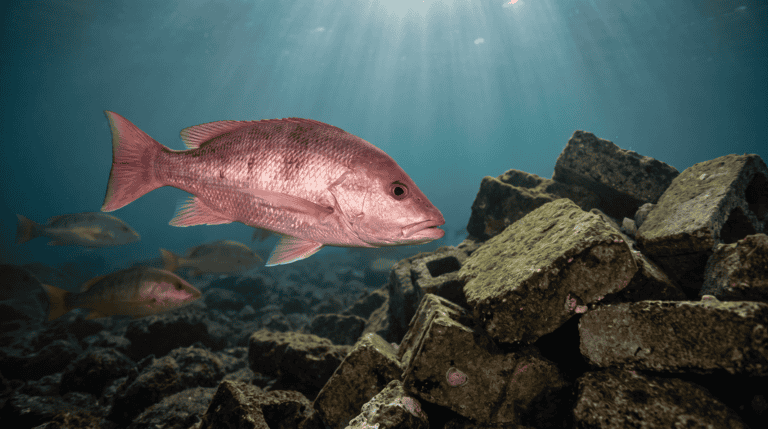
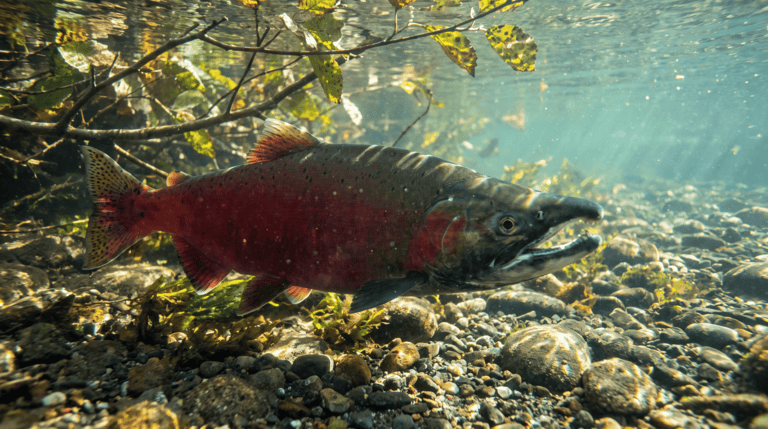
Chop doesn’t stop at a seawall. On a windy afternoon it slaps right back off the wall at whatever’s idling along it.
FIELD PLATE · THE EDGE
The shallow edge is doing work you cannot see.
That bounce is the easiest part of shoreline armor to notice from the water, and it’s a decent clue to the rest. A seawall, bulkhead or riprap edge can genuinely protect a house or a road from erosion. It can also swap a marsh, a shallow slope, roots or oyster shell for one flat hard face — and a lot of fish spend the early part of their lives in exactly the kind of skinny edge water most of us idle past on the way to the “real” spot.
The edge is doing two jobs
Shallow shoreline water holds juvenile fish, shrimp, crabs, insects and small forage, plus the plants and structure they hide in. It’s also where land and water trade material back and forth through tides, floods and runoff. Turn that edge into a vertical wall and the shoreline is still on the map. A lot of the gradual, complicated habitat just isn’t there anymore.
NOAA researchers have found fewer small fish and invertebrates along some hardened shorelines than along more natural ones nearby. “Some” is doing real work in that sentence. Not every wall has the same effect, and not every natural-looking edge is healthy. The site matters.
The walls aren’t there by accident, either. Homes, roads, utilities and marinas sometimes really do need protecting, and on a high-energy coast, a narrow developed lot, a navigation channel or a spot with real public-safety constraints, hard structure may be necessary. The mistake is armor as the default everywhere. A sheltered cove and an exposed coast aren’t the same engineering problem just because both have water touching land.
What a living shoreline actually is
Living shorelines stabilize a bank with natural or nature-based materials — marsh plants, oyster structure, coir, sand, sometimes limited stone — where conditions allow. Tidal range, wave energy, sediment, slope, existing habitat, boat wakes, ice, salinity and permitting all change what’s practical, so the design looks different from one region to the next. The point isn’t making every shore look natural. It’s protecting the shore while keeping as much habitat as that site can honestly support.
For fish, the payoff is mess. Roots, stems, shells, small channels and uneven bottom give little animals places to feed and hide, and those animals are part of the food web bigger fish depend on. A gradual edge also packs several depths and currents into a short distance: high tide floods the grass, low tide exposes another band, a creek mouth cuts through the marsh, oyster shell bends the current and adds surface for things to live on. You already fish transitions like that. A shoreline project either keeps them or erases them.
A wall doesn’t make wave energy disappear, either. It reflects and redirects it differently than a sloped or planted bank, and the exact effect depends on design and setting. So the questions reach past one property line. What happens at the base of the wall? Does erosion shift next door, or the shallow shelf get narrower, or the bounce rework the bottom nearby? Shoreline protection gets judged better across a connected stretch of shore than behind one house.
Runoff, rising water, and upkeep
Shoreline plants and wetlands can trap sediment and process some pollutants before they reach open water. A hard edge tied straight to lawns, pavement, roofs and drains delivers runoff with less filtering in the way. A living shoreline isn’t a substitute for decent stormwater management, but it can be one piece of treating the yard and the water’s edge as one problem. The property line stops on paper. The runoff doesn’t.
Rising water makes a fixed edge harder to defend. Coastal wetlands can sometimes migrate inland as water levels shift, but only if there’s room, and development, roads, walls and steep ground can block that. A fixed hard shoreline can pinch habitat between rising water on one side and infrastructure on the other. The wetland and floodplain piece follows that squeeze farther inland. Nobody’s saying sacrifice houses to marsh — planning just has to look past the next high tide, including which assets really need permanent protection.
And “living” doesn’t mean plant it and walk away. Plants die, storms tear structures up, invasive species show up, sediment goes somewhere nobody predicted. A project may need monitoring, replanting, repair or a redesign. Good ones use local engineering and ecological expertise and follow current permits. Dumping rocks and plants into public water on a Saturday doesn’t count, and “natural” isn’t a permit exemption.
The site picks the answer, not the slogan
The useful questions about a shoreline project are physical ones. How much wave energy actually reaches it? What’s eroding, and why? What infrastructure needs protecting, what habitat is there now, and is there room for a slope or a marsh? How do wakes, storms, ice, tides or a reservoir that rises and drops change this particular edge? What will upkeep take?
Neighboring lots can get different answers. One supports plants and a low-profile structure. The next needs a stronger engineered edge. A third might be better off moving a vulnerable building back from the water than armoring the whole bank. Where harder infrastructure really is required, there can still be ways to cut the damage, hold onto the shallow habitat that’s left and connect living edges nearby.
The permit notice for one of these projects can read like it was written in a language nobody speaks at the boat ramp. You don’t need the vocabulary to ask what happens to the shallow water. That’s the question the rest of the stewardship writing keeps circling back to anyway.
Reading it from the water
None of this shows up as a bigger fish next Saturday. Habitat works through survival, food, shelter, movement and reproduction over time, which is less exciting and more true. The better question is whether a shoreline supports more life stages and more of the food web a fishery needs to keep running.
You can still see some of it from the boat. Put a walled stretch next to a marsh point, a sloped riprap bank, an oyster edge, a shaded root system or a shallow weedy cove and compare current, clarity, bait, juvenile fish, how the chop bounces and how much usable shallow structure there is. That won’t prove the wall caused every difference — plenty else changes between two banks. It does earn shoreline shape a spot on the list of things to look at before the first cast.
It’s also a fair reason to care about a stretch of “nothing but marsh.” A lot of the fish you meet in deeper water later depended on nursery water like that earlier in life.