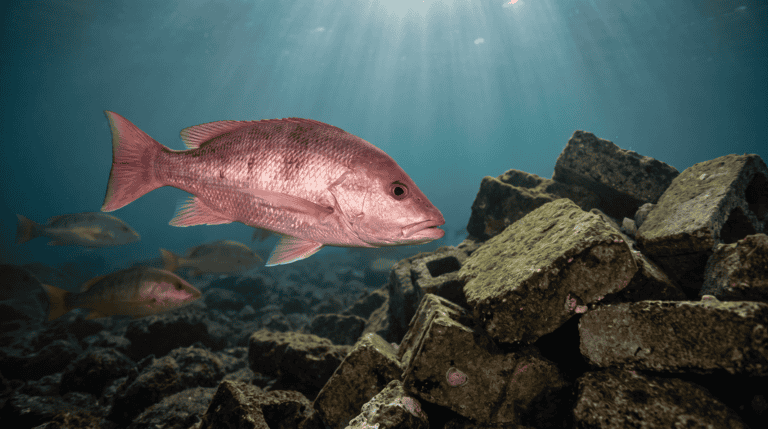
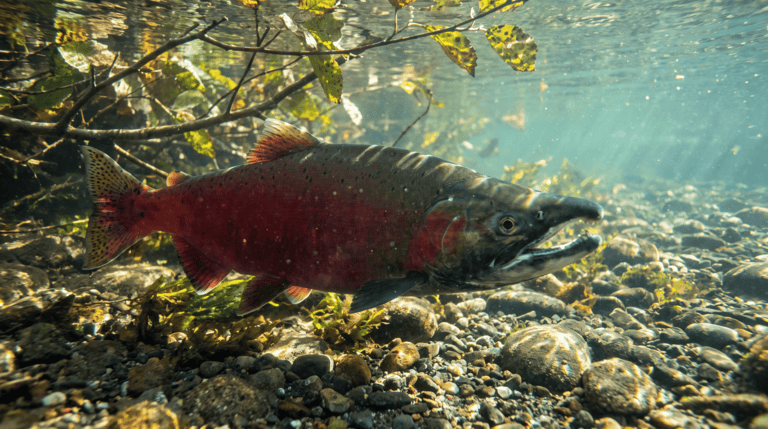
The same slab of concrete can make a good walleye reservoir above it and cut off the salmon run that used to come through it.
SYSTEM PLATE · PASSAGE
A river is a route, not a pond.
Which is why “dams are good” versus “dams are bad” goes nowhere. A barrier can give you hydropower, water storage, flood control, navigation, or a reservoir worth fishing. It can also change flow, temperature and sediment, and decide whether fish can reach the water they need to spawn or wait out the heat.
The arguments worth having are narrower. Which dams still earn their keep, which ones need better passage, and which rivers would come out ahead if an obsolete one came out entirely?
Fish don’t see a reservoir the way anglers do
A reservoir can be a great fishery for species built for still water, and I’m not going to pretend otherwise. A migratory fish hits the same structure and gets a completely different deal. It might need to move between ocean and river, mainstem and tributary, or one season’s habitat and the next, and a dam can cut that single route into pieces that don’t connect anymore.
The reservoir is real habitat. The dam just got to decide which habitat still exists and who’s allowed to reach it.
Passage is more than just clearing the concrete
Fish ladders, lifts, bypasses and screens can help fish get past some dams. How well depends on the species, the design, the flow, whether fish can even find the entrance, whether they survive the route, and what’s waiting at the next barrier. A fish that clears one dam and runs into five more hasn’t had its problem solved. It’s had it postponed.
The trip downstream counts just as much. Young fish headed for the ocean or the lower river can run into turbines, spillways, predators, and reservoirs that stretch a migration out way longer than it should take.
The river changes even when passage works
Blocking migration is only part of it. Reservoirs trap sediment that would’ve kept moving. Release schedules rewrite the seasonal flow a river used to run on, and water pulled from different depths of a reservoir can change the temperature of everything below it. Floodplains connect to the river less often. Spawning gravel can get scarce below a dam because nothing’s coming down from upstream to replace it.
If you’ve fished a tailwater, you’ve felt some of this without thinking about it: water running colder or warmer than that river would on its own for the season, on a schedule somebody at the dam sets.
Some projects can be operated in ways that ease a piece of that. Others are stuck with what their design and purpose allow, and a nice photo of a fish ladder won’t tell you which kind you’re looking at.
Cool water can end up on the wrong side of the wall
NOAA has documented how dams affect Atlantic salmon by blocking access to spawning habitat and cool-water areas. The same logic holds for other migratory fish that lose access to water they need at a particular life stage.
During a hot stretch, reaching a cold tributary or an upstream reach can matter more than almost anything else. A barrier that looked like a distance problem in spring turns into a temperature problem once summer gets hot, and habitat on a map doesn’t do much for a fish with a wall in the way.
Removing a dam isn’t erasing a river with one excavator
Taking a dam out can reconnect habitat and get sediment and flow moving again, but the transition has to be planned carefully. Reservoir sediment, infrastructure, water supply, cultural resources, downstream communities, invasive species and basic public safety all have to be worked through.
Some dams are still active and worth keeping. Others are old, obsolete or unsafe, or just don’t provide enough anymore to justify what they cost the river. Telling those apart is an engineering and watershed decision, even when people shout it like a slogan.
The Elwha shows how much river can be waiting on the other side
Taking out the Elwha and Glines Canyon dams in Washington reopened most of a watershed that had been cut off from migratory fish for around a century. NOAA has been tracking salmon moving back in, and their life-history patterns changing, since removal.
Not every dam is an Elwha. What it did show is that reconnecting a river can open up habitat on a scale way bigger than the footprint of whatever was blocking it. You could stand at the old dam site and still not see most of what it had been holding back.
The Klamath makes the scale even harder to ignore
Removal of four large dams on the Klamath River system finished in 2024, reconnecting hundreds of miles of habitat for migratory fish. It’s a massive, long-term experiment in what a big river network does once it gets its connections back.
I want to know how it turns out now, and the river has zero interest in my schedule. Fish response, habitat change, sediment movement and what happens to the communities along it all need years of measuring, not a victory lap the day the last chunk of concrete leaves.
Small barriers matter too
Not every migration problem is a giant hydroelectric dam. Perched culverts, low-head dams, irrigation diversions, road crossings and old mill structures can block fish on a small stream as effectively as a big dam blocks a big river. A perched culvert is exactly what it sounds like — the pipe’s outlet hangs above the water, and a fish would have to jump into a pipe to keep going upstream.
Fixing one of those can reconnect spawning water or a cold-water refuge without ever making the news. In a lot of watersheds the real progress probably comes from hundreds of those unglamorous little projects, not one big headline.
What I’d ask about a barrier
A dam built eighty years ago might be doing a different job today than the one it was built for. That’s worth checking instead of assuming in either direction.
I’d start with what the project still provides and which fish movements it blocks. Then whether better operations or passage could fix enough without removal, and what removal would really cost — what infrastructure depends on the dam, where all that trapped sediment goes, and who uses the reservoir versus who depends on the river below it. An argument for keeping or pulling a dam that can’t get through those isn’t finished yet.
The future river probably has fewer unnecessary doors on it
Some dams will stay important, and some will get modernized or finally get real fish passage. Some obsolete ones will come out. That’s a less satisfying answer than a bumper sticker, but rivers are mixed-up systems and I’d rather have the honest answer than the simple one.
A river doesn’t have to be untouched to be healthier. It needs enough open doors for fish to finish the trips their life cycle asks of them.