Guadalupe Bass Get Identified by the River as Much as the Jaw
A Guadalupe bass can look right and still carry smallmouth genes, so the river it came from matters almost as much as the jaw and the broken stripe. What Texas Parks and Wildlife says about ID, habitat and hybrids.
By HunterUpdated September 12, 2026Read 9 min
Image: public-domain species reference
In some Texas Hill Country rivers the question isn’t whether you caught a bass. It’s whether the fish in your hand is still genetically a Guadalupe bass. Micropterus treculii is a Texas endemic built for flowing, rocky water, and where it came out of the river counts toward identifying it almost as much as its jaw does. I’ve never had one on the line, so what’s below about the water, the hybrids and the genetics comes from Texas Parks and Wildlife.
At a glance · The short version
Scientific name
Micropterus treculii
Range
Endemic to central Texas, especially Edwards Plateau and Hill Country river systems.
Habitat
Flowing, rocky, often spring-influenced rivers and streams; much more current-oriented than largemouth bass.
Spawning
Primarily spring; gravel nests in shallow water, often in higher flow than largemouth use.
State significance
Official state fish of Texas.
Main conservation problem
Hybridization and introgression with introduced black bass, historically especially smallmouth and now also a subject of spotted-bass research.
What fish is this?
Identification
General appearance
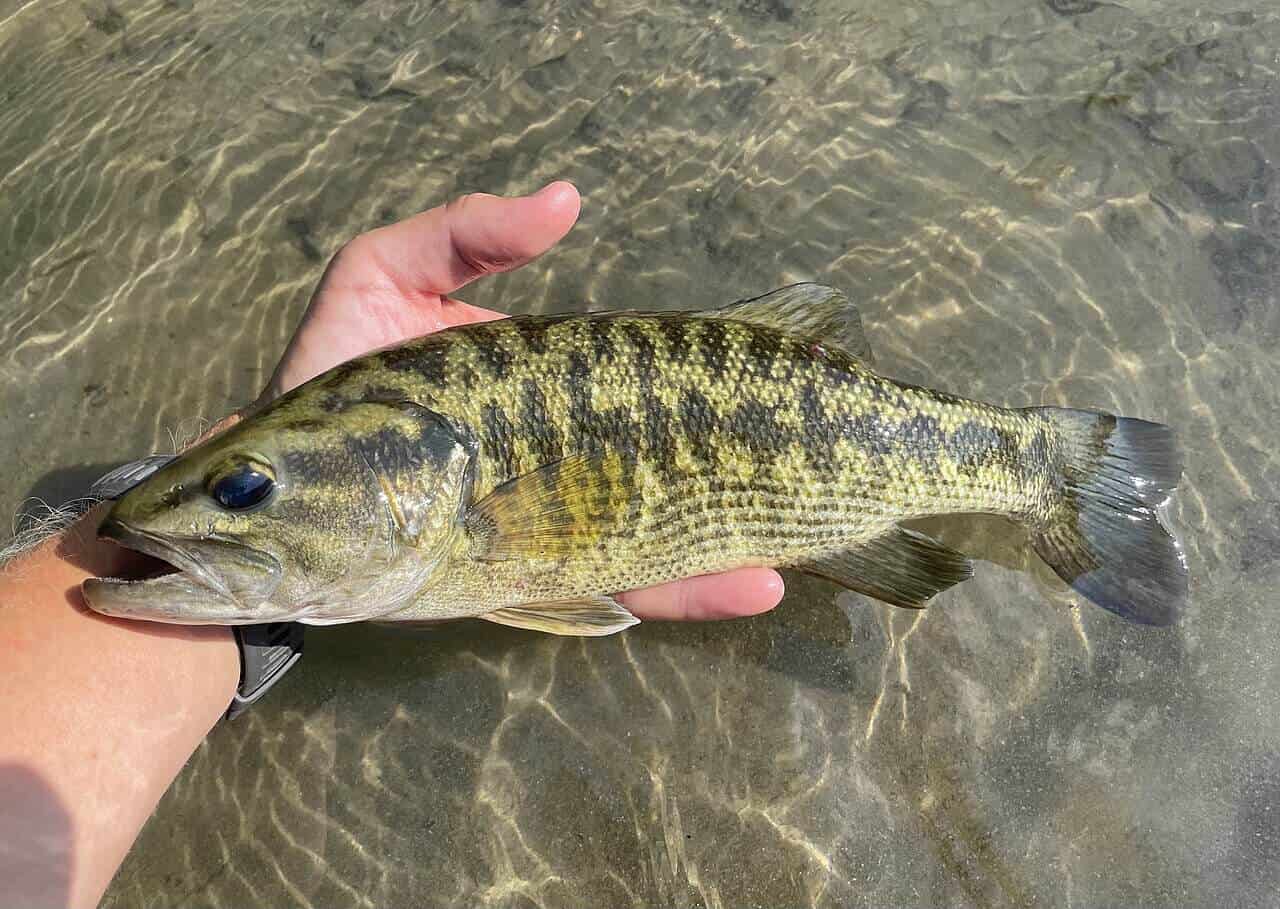
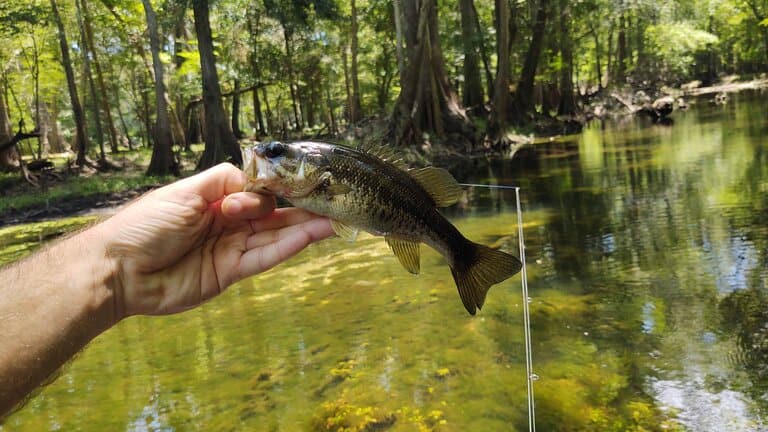
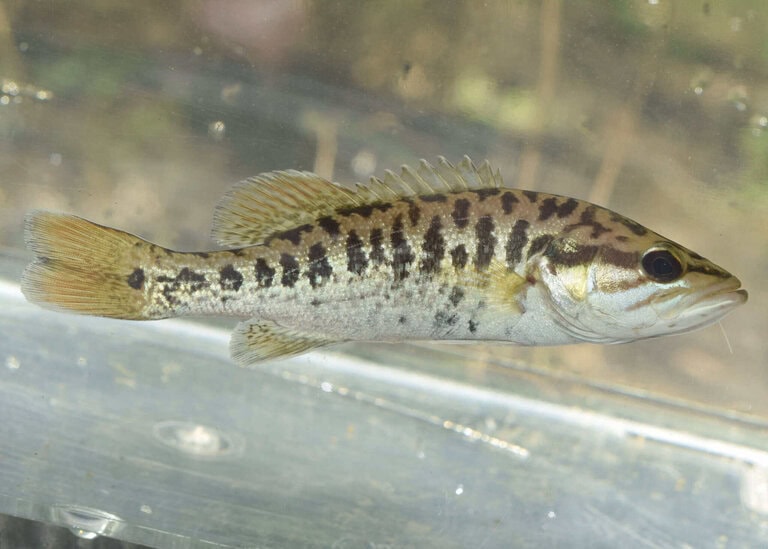
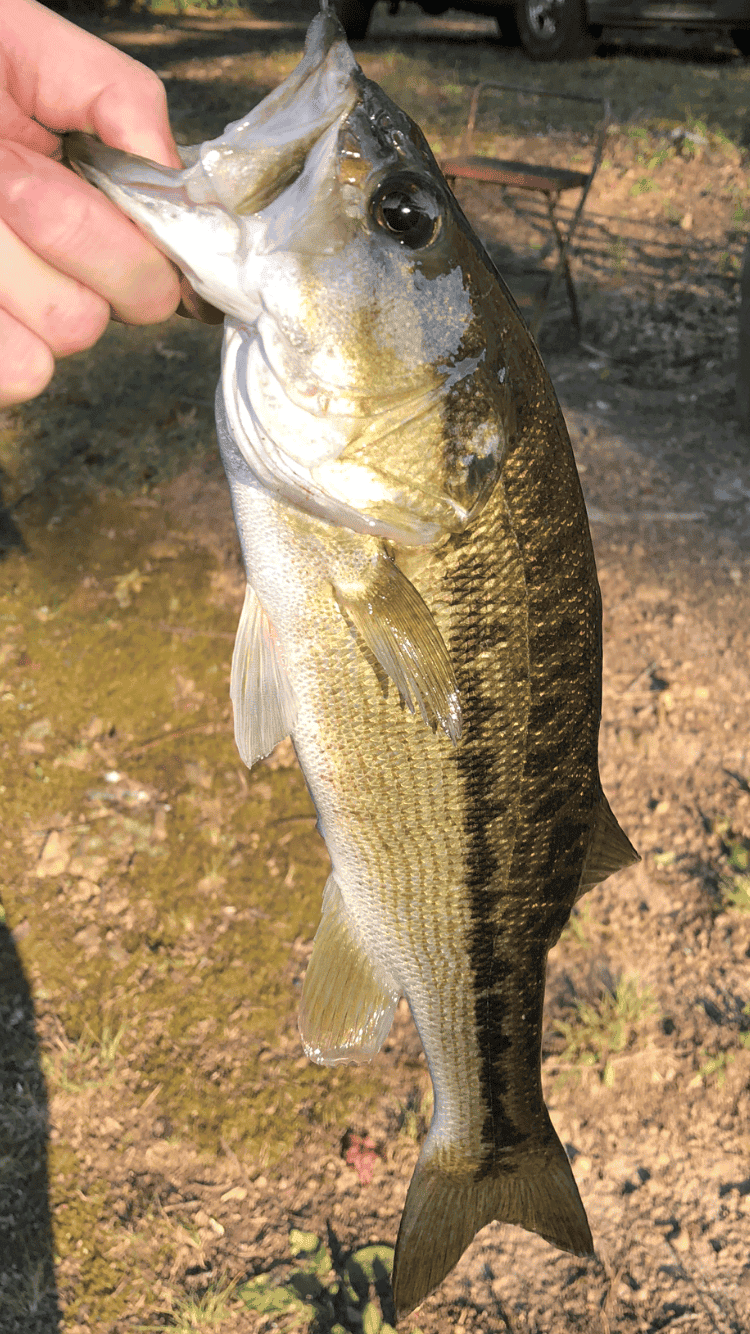
Guadalupe bass are generally green, with a broken or irregular lateral pattern. Texas uses three useful field traits in its bass comparison: the lateral stripe is more broken than a largemouth’s, the jaw does not extend beyond the rear margin of the eye, and spots on the scales form rows on the pale lower side.
A largemouth’s upper jaw reaches well behind the eye. Guadalupe bass do not. The Guadalupe pattern is also less like one clean dark stripe and more broken and mottled.
This is the harder field problem. Texas notes that Guadalupe coloration extends lower on the body than spotted bass, while both can show rows of spots below an irregular stripe. Drainage, habitat, and where the fish was caught matter because visual identification alone can be complicated by hybridization.
Guadalupe bass are adapted to small rivers and do not normally reach largemouth size. TPWD notes specimens over 3.5 lb have been landed; the point is not that they are tiny, but that their body size fits a current-oriented stream fish rather than a trophy-lake largemouth strategy.
A hybrid cannot always be solved with a field checklist. Where genetic integrity is the management issue, a photograph and a confident guess are not the same thing as genetic identification.
Where does it live?
Range & Habitat
Native distribution
TPWD describes the species as endemic to the northern and eastern Edwards Plateau, including headwaters and tributaries in the San Antonio, Guadalupe, Colorado, and Brazos drainages, with smaller populations outside that core and an introduced population in the Nueces system.
The simplest habitat distinction Texas makes is also the most useful: Guadalupe bass are typically found in flowing water, while largemouth bass are more associated with quiet water. This fish belongs in a river-reading system, not a generic bass-cover system.
Rock and gravel are recurring habitat elements, especially around spawning. In practical terms, that makes riffle-run-pool sequences, current breaks beside rock, ledges, boulders, and the softer water immediately downstream of hard structure more important than weedlines or dead-flat backwaters.
The Hill Country setting matters because many of these rivers are spring-influenced. Calling it a bass that likes current gets the habit right and the stakes wrong. This is a narrow-range species tied to specific central-Texas river systems whose flow, riparian condition, and habitat connectivity are conservation concerns in their own right.
Spawning can begin as early as March and continue through May and June. TPWD also notes that a secondary spawn may occur in late summer or early autumn. That makes a single spring-date rule less useful than watching actual water conditions and local spawning restrictions.
Like other black bass, males build nests, favoring gravel in shallow water. Texas specifically notes that Guadalupe, spotted, and smallmouth males tend to nest in areas with higher flow than largemouth bass.
Young fish begin on invertebrates and become more piscivorous as they grow, but TPWD notes an interesting contrast with largemouth: very young fish and older adults include more invertebrates in their diets, while juveniles and younger adults can take more fish. Crayfish and aquatic insects therefore remain relevant forage even when the bass is large enough to eat fish comfortably.
Evidence level. Habitat and life-history fields are agency-sourced. Tackle and positioning guidance below translates those biological constraints into a starting plan; it is field convention and inference, not a claim that one lure has been experimentally proven best.
First water to checkinference
Look for usable current rather than trying to escape current entirely: the soft shoulder of a riffle, a seam behind a boulder, the head or tail of a pool, a rocky bank where depth touches flow, or a run with enough broken water to deliver food without forcing the fish to spend all day in the heaviest push.
Forage cueinference
Because insects and crayfish remain important, do not assume the correct answer is always a shad imitation. If the river bottom is alive with crayfish and drifting aquatic insects, a bottom-oriented craw or small natural profile may match the system better than a fast baitfish retrieve.
Tackleconvention
The fish’s modest size and current-oriented habitat argue for light to medium tackle that can still control a fish around rock. The goal is not to overpower a trophy largemouth. It is to keep a lure tracking naturally in moving water and still have enough authority to turn a bass before it gets behind a boulder or wood.
Presentationinference
Quarter casts and controlled drifts make more sense than repeatedly sweeping a lure straight across the strongest current. Let the presentation enter the feeding lane, slow as it reaches the seam, and stay near rock long enough to be intercepted.
What is the conservation story?
Genetics, Restoration & Access
Smallmouth hybridization
Beginning in the 1970s, smallmouth bass were stocked in Texas Hill Country waters for sport fishing. The two species hybridized, and the hybrids were fertile. In some rivers pure Guadalupe bass became difficult or impossible to find. That’s why an introduced black bass in these rivers isn’t just one more thing to catch.
TPWD reports that since 1991, the agency and partners have restored or conserved fishable Guadalupe-bass populations in 14 central-Texas rivers, stocked more than 2.4 million Guadalupe-bass fingerlings for conservation purposes, and completed nearly 50 habitat restoration or preservation projects. Additional assessment and restoration work continues.
The genetics story didn’t end with smallmouth. TPWD currently lists research on spatial patterns of Guadalupe Bass × Spotted Bass hybridization in Texas rivers, another reason identification and fish movement matter.
TPWD’s restoration program also manages public river access areas that create legitimate places to fish for Guadalupe bass while tying angling to river stewardship. The access list changes, so use the agency’s current restoration page rather than an old blog map.
Fish begin moving toward spawning habitat as conditions warm.
Which gravel and rock areas have usable flow plus nearby holding water?
Spring
Primary spawning window, with males nesting in shallow gravel and guarding eggs.
Am I fishing a feeding lane, or repeatedly targeting a visible nest-guarding fish?
Summer
Flow, depth, shade, spring influence, and oxygen become increasingly useful ways to separate productive water from simply pretty water.
Where can the fish feed in current without paying the full energy cost?
Late summer / fall
TPWD notes that a secondary spawn can occur. Cooling can also reopen shallower feeding water.
Is the fish using current to feed, or is local reproductive behavior changing how I should handle it?
Winter
Slower metabolism generally puts more value on stable depth and efficient holding water.
Which pool or channel feature offers food delivery without constant hard swimming?
— · Where the sources are not tidy
Open Questions
Pure fish versus field-identified fish
Hybridization means a fish that looks right can still carry introgressed genetics. Treat your eyes as a field tool, not a stand-in for the genetic work managers use.
One river is not the whole range
The Hill Country label is useful but broad. Spring influence, discharge, substrate, reservoir connection, and hybridization history differ by river. Local management pages outrank a generic species rule.
— · Nobody has pinned these down
Not Established Here
a universal preferred-temperature band for angling
a single depth range that applies to every Hill Country river
barometric-pressure response
wind response
a universal cold-front rule
a single best lure independent of flow, forage, and access
— · Sources
FEEDING ECOLOGY · STANDARDIZED
How this fish gets fed.
Primary prey
Aquatic insects, crayfish, and small fishes are the core prey categories supported for Guadalupe bass.
Feeding mode / location
A river predator feeding around rocky runs, pools, riffle edges, boulders, and current breaks where drifting or swimming prey meets lower-velocity holding water.
Diel / seasonal pattern
No universal diel feeding window is established in this profile. Seasonal position is driven primarily by flow, temperature, spawning activity, and access to suitable current-and-rock habitat.
Ontogenetic diet shift
Not established with enough species-specific detail in this profile’s cited source set to state a fixed juvenile-to-adult sequence.
Feeding ecology is kept drainage-specific rather than borrowed from other black bass.
Compiled 2026-09-11. Limits and advisories are set per water and per state and change between seasons — the managing agency for wherever you are fishing has the current answer.
The easiest way to misunderstand Guadalupe bass is to call them Texas smallmouth and stop thinking. The resemblance in habits is real. The joke goes sour once you know stocked smallmouth are the reason pure Guadalupe bass got hard or impossible to find in some rivers, which means a bass that looks perfectly healthy in your hand can still be part of a genetic loss. That’s worth a look at the local rules before you decide it’s just another fish in fast water.
River FishRiver-fish species profiles covering habitat, behavior, seasonal movement, fishing approaches, conservation status, and regional variation across the United States.49 articles
Species & BehaviorFish behavior, habitat, depth, forage relationships, and species-specific field decisions. Start with the Freshwater Fish Species field guide.159 articles
Cookie Consent
We use necessary cookies to operate the site. With your choice, we may also use analytics and advertising cookies. Choose Accept All, Reject, or Preferences.
Used to distinguish new sessions and visits. This cookie is set when the GA.js javascript library is loaded and there is no existing __utmb cookie. The cookie is updated every time data is sent to the Google Analytics server.
30 minutes after last activity
__utmc
Used only with old Urchin versions of Google Analytics and not with GA.js. Was used to distinguish between new sessions and visits at the end of a session.
End of session (browser)
__utmz
Contains information about the traffic source or campaign that directed user to the website. The cookie is set when the GA.js javascript is loaded and updated when data is sent to the Google Anaytics server
6 months after last activity
__utmv
Contains custom information set by the web developer via the _setCustomVar method in Google Analytics. This cookie is updated every time new data is sent to the Google Analytics server.
2 years after last activity
__utmx
Used to determine whether a user is included in an A / B or Multivariate test.
18 months
_ga
ID used to identify users
2 years
_gali
Used by Google Analytics to determine which links on a page are being clicked
30 seconds
_ga_
ID used to identify users
2 years
_gid
ID used to identify users for 24 hours after last activity
24 hours
_gat
Used to monitor number of Google Analytics server requests when using Google Tag Manager
1 minute
_gac_
Contains information related to marketing campaigns of the user. These are shared with Google AdWords / Google Ads when the Google Ads and Google Analytics accounts are linked together.
90 days
__utma
ID used to identify users and sessions
2 years after last activity
__utmt
Used to monitor number of Google Analytics server requests
10 minutes
Jetpack's built-in visitor analytics. It records page views, referring sites, search terms, and outbound link clicks, and also carries the shared visitor-tracking library used by Jetpack Instant Search and WooCommerce Analytics.