Ask somebody where the fish are on a lake in winter and they’ll tell you where the fish were, on that lake, during whichever three weeks they fished it. Then they’ll say it like a permanent fact.
It isn’t their fault. Ice makes the surface look static, and it’s very easy to assume the thing underneath it matches. But a lake in late December and the same lake in early March are working by different rules, and the second one has been shut in the dark for two months.
First ice
The best fishing of the winter comes in a short window, and it’s also when the most people get hurt.
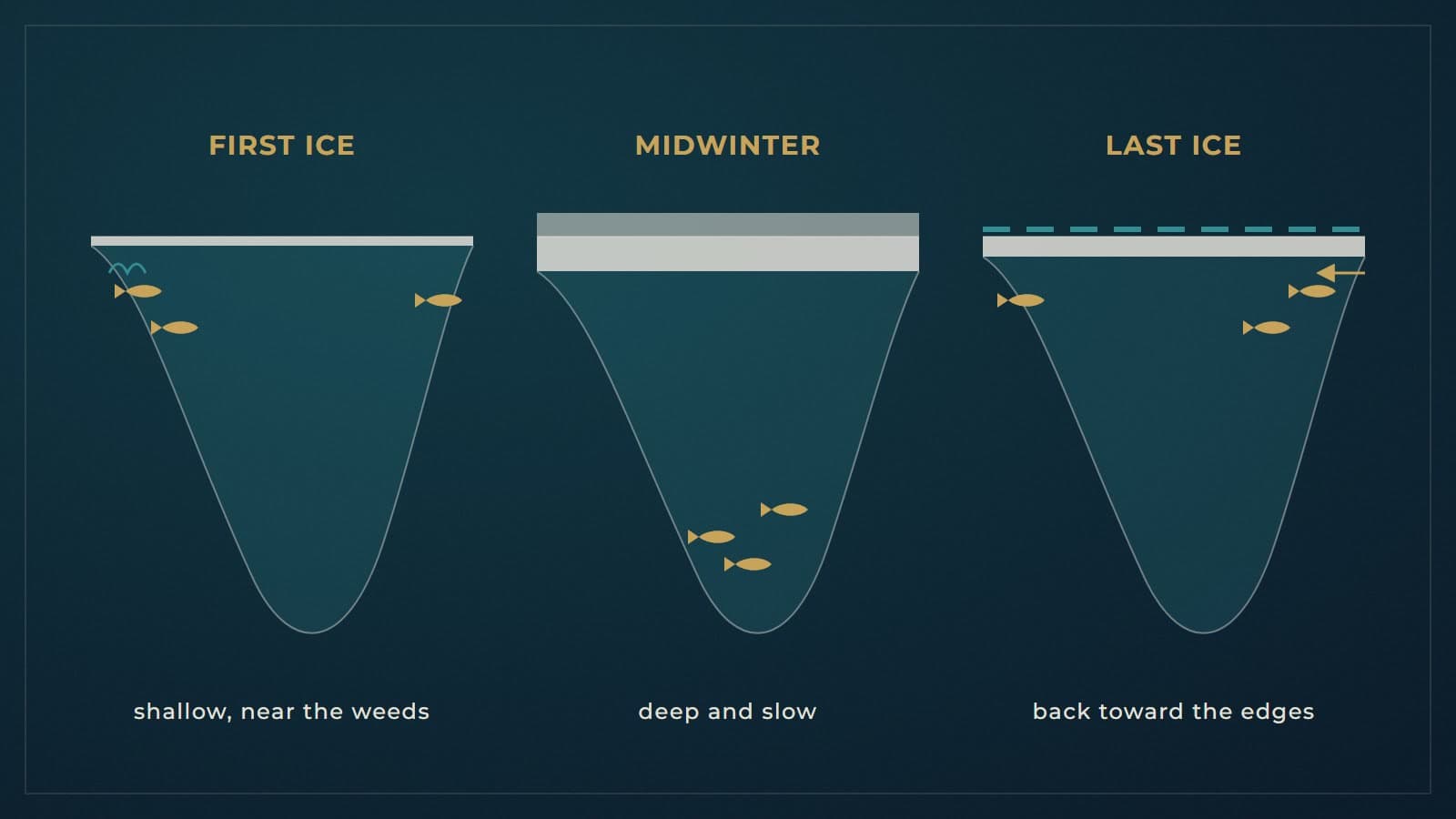
The vegetation is still alive, still producing oxygen and full of invertebrates, and the water hasn’t stratified into whatever it becomes later. So fish are shallow near green weeds, behaving a lot like they did in fall. The piece on weed dieback in fall is the direct prequel to this.
Practically: five to fifteen feet, weed edges, points with cover on them, the first break off a flat. Aggressive presentations get looked at. Fish move.
The problem is that first ice is exactly when the ice is thinnest and least uniform, which is a genuinely bad combination with the best bite of the year. It’s not a coincidence that the reports and the incidents show up in the same week. Minnesota DNR’s thickness guidance starts at four inches of new clear ice for foot travel and says plainly that the agency doesn’t measure ice for anyone. New ice can also be uneven in ways that don’t announce themselves. Measure repeatedly as you walk out, not once at the edge.
Midwinter
This is the long middle, and it’s where most people’s ice-fishing opinions get formed, which is unfortunate, because it’s the hardest stretch.
The weeds have mostly died back and decomposition has been eating oxygen for weeks. Snow on top has cut the light going in, which slows what photosynthesis was left. In a shallow, fertile lake this can get serious; in a deep, clean one it barely registers. Either way the general direction is the same — habitat contracts, and fish concentrate into whatever is left.
Where that leaves them depends on the lake. Often it’s the deeper basin edges, the remaining green cover if there is any, or the area near an inflow that’s bringing in fresh water. Sometimes it’s a specific band of the water column and nothing above or below it.
The fishing also gets slower in the literal sense. Cold water means less willingness to chase. The presentation that killed in December — big lift, fast fall — starts drawing lookers instead of biters. Smaller and quieter with a longer pause is usually the adjustment, and the pause is doing more work than the motion. When doing less changes the presentation makes that case for open water, and it transfers cleanly.
Midwinter is also when a deadstick next to your jig rod stops being optional and starts being the thing that saves the day.
Last ice
Everything reverses, and it reverses fast.
Meltwater starts coming in and oxygen goes up, and light gets back through as snow leaves the surface. Fish that spent two months compressed in the basin start moving toward shallow water again, and in a lot of systems they’re staging for the spawn on top of that — perch moving toward vegetation, pike pushing into shallow bays and creek mouths.
So the shallow water that was dead in January turns on. Inflows, the first warm mud flat, back bays that catch afternoon sun. The fishing can be as good as first ice and it lasts longer.
The ice, meanwhile, is going the other way. Late-season ice can be honeycombed and spongy from repeated thaw and refreeze cycles, and Michigan DNR notes that ice weakened that way does not refreeze to its original strength. Thickness measured with a tape can read fine on ice that has lost most of what made it hold. This is the stretch where the number lies to you.
Shore ice goes first, which is a specific problem, because it’s between you and the truck.
Snow is the variable nobody watches
Worth pulling out on its own, because it changes all three periods.
Snow insulates. A heavy early snow on thin ice slows the freezing and keeps the sheet weaker, longer. It also cuts light, which shortens the productive life of the weeds and pulls the midwinter oxygen problem forward. And its weight reduces what the sheet can support.
A low-snow winter and a high-snow winter on the same lake aren’t the same season. If you fish one lake regularly, the snow is one of the few things you can actually watch from the road.
What to do with this
Mostly it means dating your own information.
The note that says “twelve feet off the second point, brush” is worth much more if it also says “January 14, four inches of snow on the ice.” Without that it’s a rumor you told yourself, which is the whole case for logging the decision rather than the fish.
And it means being suspicious of confident seasonal advice that doesn’t say when. Somebody telling you the fish are deep isn’t wrong — they’re answering a question you didn’t ask, about a week that may already be over.
If you only get out a handful of times a winter, aim at the ends. First ice and last ice are more forgiving of not knowing the lake, because the fish are in places you can reason your way to. The middle rewards familiarity, and familiarity takes a couple of seasons to build. That’s not a knock on you. It’s just what the lake charges for the information.
FIELD OBJECT
This one should leave the page.
The article is the long version. These are the pieces worth carrying into the next trip.
The 30-second version
Advice that works the week the lake locks up will get you nothing in February. The ice looks the same all season, but the lake underneath it keeps changing.
What to watch
- First ice
- Midwinter
- Last ice
- Snow is the variable nobody watches
Field card
- First ice
- Midwinter
- Last ice
- Snow is the variable nobody watches
- What to do with this
RIGHT TOOL, NEXT
Field Sense Navigator
Take the article’s water or access question into a place-specific conditions and route check.