American Shad Aren’t Feeding, and They Still Eat the Dart
American shad come into rivers to spawn, not to eat, and they still grab a swung dart. Where the moving school is right now matters more than the color you tie on, and on the Atlantic side, so does whether the fish can get past the dam.
By HunterUpdated September 12, 2026Read 8 min
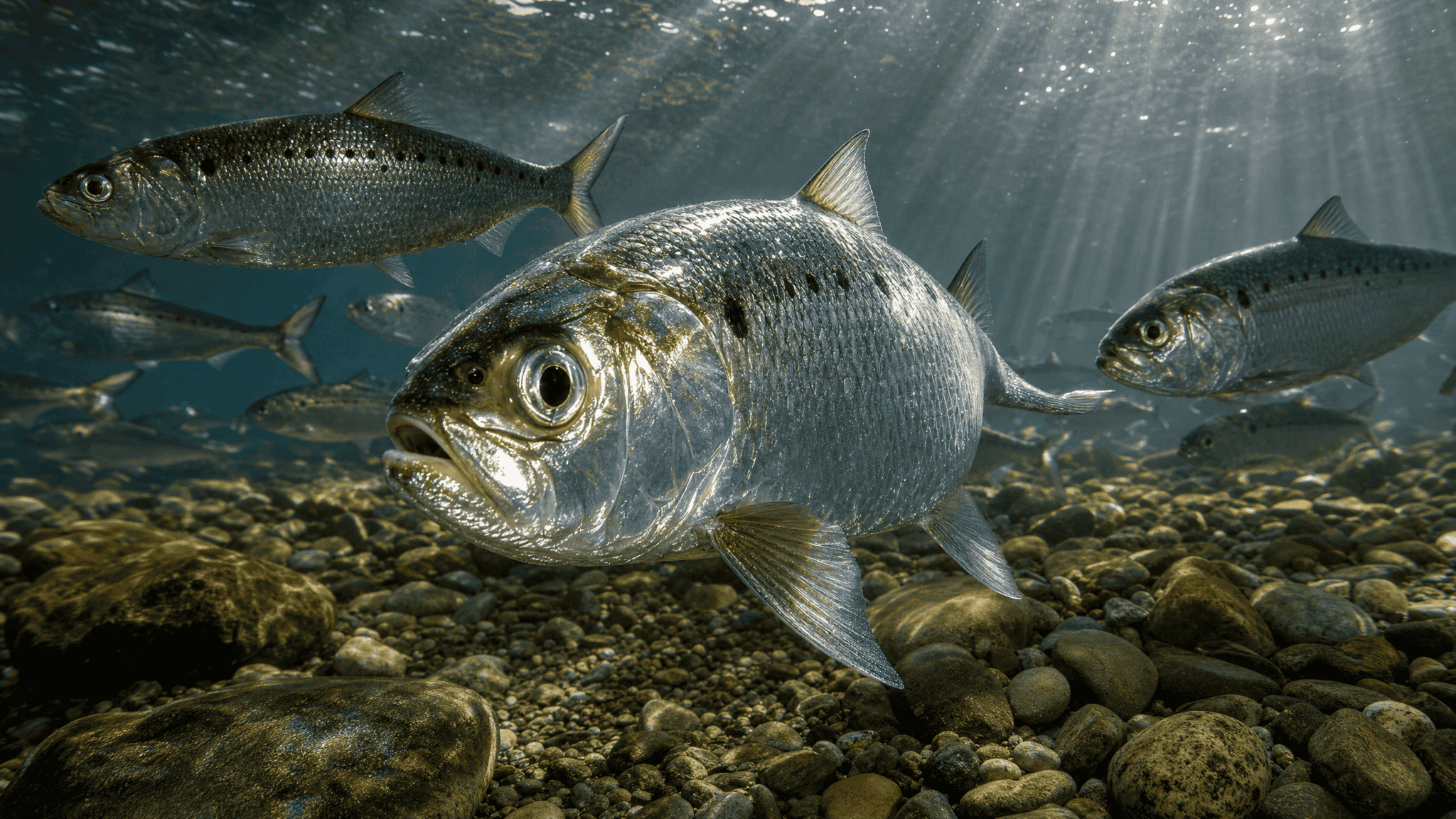
Image: spring river run, sunbeams
A shad run has a contradiction built into it. The fish are headed upriver to spawn, not settling in somewhere to eat, and they still smack a little dart or spoon swung through the lane they’re traveling. Whatever that strike is, it isn’t a bass eating a crawfish. Alosa sapidissima is an anadromous herring, meaning it does its growing at sea and comes into rivers to spawn, so its spring behavior runs on migration, temperature, flow and getting past whatever’s in the way. The shad running the Columbia out west are introduced. The Atlantic rivers where the species actually belongs are the ones still fighting over blocked spawning habitat.
At a glance · The short version
Scientific name
Alosa sapidissima
Migration type
Anadromous: most growth in the Atlantic Ocean, spawning migration into freshwater rivers.
Native range
Atlantic coast of North America from Newfoundland south to Florida.
Introduced range
Established along the Pacific coast after 19th-century introduction, including the Columbia system.
Peak spawning temperature
USFWS: about 65.3 F (18.5 C), with run timing shifting from winter in the South to late spring/early summer in the North.
What fish is this?
Identification
Body
American shad are deep-bodied, laterally compressed, bright silver fish with a blue-green or greenish back, a deeply forked tail, and large scales that shed easily.
A large dark spot occurs behind the gill cover and is usually followed by a row of smaller spots along the upper side. Pattern strength varies, so spots belong in a multi-trait identification rather than acting as a one-feature test.
USFWS gives common adult female length around 24.3 in and male length around 19.7 in, with a reported maximum around 29.9 in. Females are commonly the larger fish.
Hickory shad are generally smaller and show a more projecting lower jaw. Where both species run together, local agency identification material should outrank a shortcut based only on size because young American shad can overlap a large hickory shad.
The river is a migration corridor
Run Timing & Spawning
Geographic timing
Adults can enter southern rivers as early as November, while northern runs may not arrive until May or June. The calendar therefore moves with latitude and river temperature rather than following a national spring date.
USFWS reports a peak spawning temperature around 65.3 F / 18.5 C. Treat that as a biological reference point, not a button that turns every river on at once; discharge, access, sex-specific arrival, and local stock timing still matter.
American shad do not build nests. Several fish release eggs and milt into the water column, commonly from sundown into the night. Females may release up to roughly 600,000 eggs over a spawning season.
USFWS notes an important latitude effect: in southern rivers, adults commonly spawn once and die, while farther north some survive, return to sea, and repeat the migration in later years. A shad run is therefore not demographically identical from Florida to New England.
Latitude does most of the calendar work here — a run peaking in the Carolinas can be weeks from even starting on a river four hundred miles north. The question worth asking is whether this particular river has hit its window yet, not whether the calendar says shad season.
This section is field logic, not a claim that shad establish feeding territories. A migrating school uses current, depth, and temporary resting water while continuing upstream.
Path of lower costinference
Inside bends, current seams, the soft side of bridge pilings, tailouts, and moderate-current lanes can all become travel corridors. The heaviest current may be passable without being the best place for a school to hold between movements.
Barriers
Dams and other barriers can concentrate adults below structures and also remove historic spawning habitat upstream. A crowd of fish below a dam can therefore represent a fishing opportunity and a habitat-connectivity problem at the same time.
Whether a dart swings through the migration depth matters more than finding a magical paint scheme. When a producing countdown quits, changing weight or cast angle one variable at a time tells me more than cycling colors above the school.
What are they doing with a lure?
Presentation
Feeding assumption
Adult shad feed primarily at sea; the spawning run is not best understood as an ordinary freshwater feeding migration. Anglers still get strikes on small darts, spoons, flies, and similar presentations, usually interpreted as reaction, interception, or other non-feeding responses rather than proof of active feeding.
Dartsconvention
A compact shad dart lets an angler tune sink rate to current. Too heavy and it can fall below or deaden the swing; too light and it can ride over fish. Productive weight can change within the same day as discharge or boat position changes.
Flutter spoonsconvention
Thin spoons remain useful because they flash and move at relatively low speed. The point is to cross the migration lane while preserving action, not retrieve so fast that the lure leaves the depth immediately.
Hook pressureconvention
American shad have relatively delicate mouths. A softer rod section and restrained drag can reduce tearing compared with trying to overpower a fish that is already using current against the hook.
Native Atlantic fish versus Pacific introduction
Range Context
Atlantic coast
The historic native range extends from Atlantic Canada to central Florida. Adults home to freshwater spawning systems after years in the Atlantic, producing river-specific runs inside a coastwide species distribution.
American shad were introduced to the Pacific coast in the 1800s and are now established from California north through the Pacific Northwest and beyond. A Columbia River shad is therefore not evidence that the species was historically native to western rivers.
ASMFC identifies restricted access to spawning habitat as a major recovery limit. USFWS likewise ties historic decline to overfishing, pollution, and migration barriers. Fish passage can therefore be as central to recovery as harvest regulation.
A river with a healthy run twenty miles away doesn’t tell you anything about the water in front of you. This is a fishery managed one river at a time, and the closed system next door and the open one you’re standing on can be separated by nothing but a state line.
Seasonal working map
What Changes
Period
Atlantic biological pattern
Field question
Winter / earliest spring
Southern runs begin first; northern fish remain at sea.
Has the local river actually reached its run window, or am I importing a report from another latitude?
Spring
Schools move upstream as water warms; spawning occurs in flowing freshwater.
Where is the migration lane relative to current, depth, and barriers?
Late spring / early summer
Northern rivers reach peak run and spawn later.
Are fish arriving, actively spawning, or already dropping back?
Summer / fall
Juveniles develop in river/estuary habitat before seaward migration; surviving adults from northern runs return to sea.
Adult run tactics no longer describe the dominant fish in the river.
— · What we are not filling with guesses
Not Established Here
a universal run-start temperature for every river
a claim that spawning adults are actively feeding on lures
a rule that every cold front pushes fish downstream
a fixed holding depth independent of discharge
an assumption that Pacific introduced abundance reflects Atlantic native recovery
— · Sources
FEEDING ECOLOGY · STANDARDIZED
How this fish gets fed.
Primary prey
Juveniles use zooplankton, aquatic insects and other small invertebrates. At sea, American Shad feed on planktonic crustaceans and other small pelagic prey, with small fishes also taken.
Feeding mode / location
A schooling anadromous herring. Juveniles feed in river and estuary nursery habitat and adults feed primarily at sea. Returning freshwater adults are on a spawning migration rather than occupying ordinary resident feeding stations.
Diel / seasonal pattern
The dominant adult river pattern is seasonal migration controlled by temperature, flow and spawning access—not a feeding clock. A shad striking a dart during the run should not automatically be interpreted as solving the same feeding problem as a resident predator.
Ontogenetic diet shift
Freshwater juveniles begin on zooplankton and small invertebrates, then transition to marine planktonic and small pelagic prey. Returning adults reduce normal feeding as they enter the spawning migration.
The published spawning-temperature value remains a migration/reproduction anchor, not a feeding-temperature band.
Primary References
U.S. Fish & Wildlife Service — range, identification, spawning temperature, run timing, fecundity, and latitude-related repeat spawning.
Compiled 2026-09-11. Limits and advisories are set per water and per state and change between seasons — the managing agency for wherever you are fishing has the current answer.
The mistake the biology keeps warning about is fishing a migration like it’s a fish holding in one spot. You can get the dart weight exactly right and still come up empty, because the school slid deeper or went through that seam twenty minutes ago. The Atlantic rivers have the same problem at a scale that isn’t funny: if shad can’t get up the river, the rest of the habitat map doesn’t matter.
River FishRiver-fish species profiles covering habitat, behavior, seasonal movement, fishing approaches, conservation status, and regional variation across the United States.49 articles
Species & BehaviorFish behavior, habitat, depth, forage relationships, and species-specific field decisions. Start with the Freshwater Fish Species field guide.159 articles
Cookie Consent
We use cookies to improve your experience on our site. By using our site, you consent to cookies.
Contains information related to marketing campaigns of the user. These are shared with Google AdWords / Google Ads when the Google Ads and Google Analytics accounts are linked together.
90 days
__utma
ID used to identify users and sessions
2 years after last activity
__utmt
Used to monitor number of Google Analytics server requests
10 minutes
__utmb
Used to distinguish new sessions and visits. This cookie is set when the GA.js javascript library is loaded and there is no existing __utmb cookie. The cookie is updated every time data is sent to the Google Analytics server.
30 minutes after last activity
__utmc
Used only with old Urchin versions of Google Analytics and not with GA.js. Was used to distinguish between new sessions and visits at the end of a session.
End of session (browser)
__utmz
Contains information about the traffic source or campaign that directed user to the website. The cookie is set when the GA.js javascript is loaded and updated when data is sent to the Google Anaytics server
6 months after last activity
__utmv
Contains custom information set by the web developer via the _setCustomVar method in Google Analytics. This cookie is updated every time new data is sent to the Google Analytics server.
2 years after last activity
__utmx
Used to determine whether a user is included in an A / B or Multivariate test.
18 months
_ga
ID used to identify users
2 years
_gali
Used by Google Analytics to determine which links on a page are being clicked
30 seconds
_ga_
ID used to identify users
2 years
_gid
ID used to identify users for 24 hours after last activity
24 hours
_gat
Used to monitor number of Google Analytics server requests when using Google Tag Manager
1 minute
Jetpack's built-in visitor analytics. It records page views, referring sites, search terms, and outbound link clicks, and also carries the shared visitor-tracking library used by Jetpack Instant Search and WooCommerce Analytics.