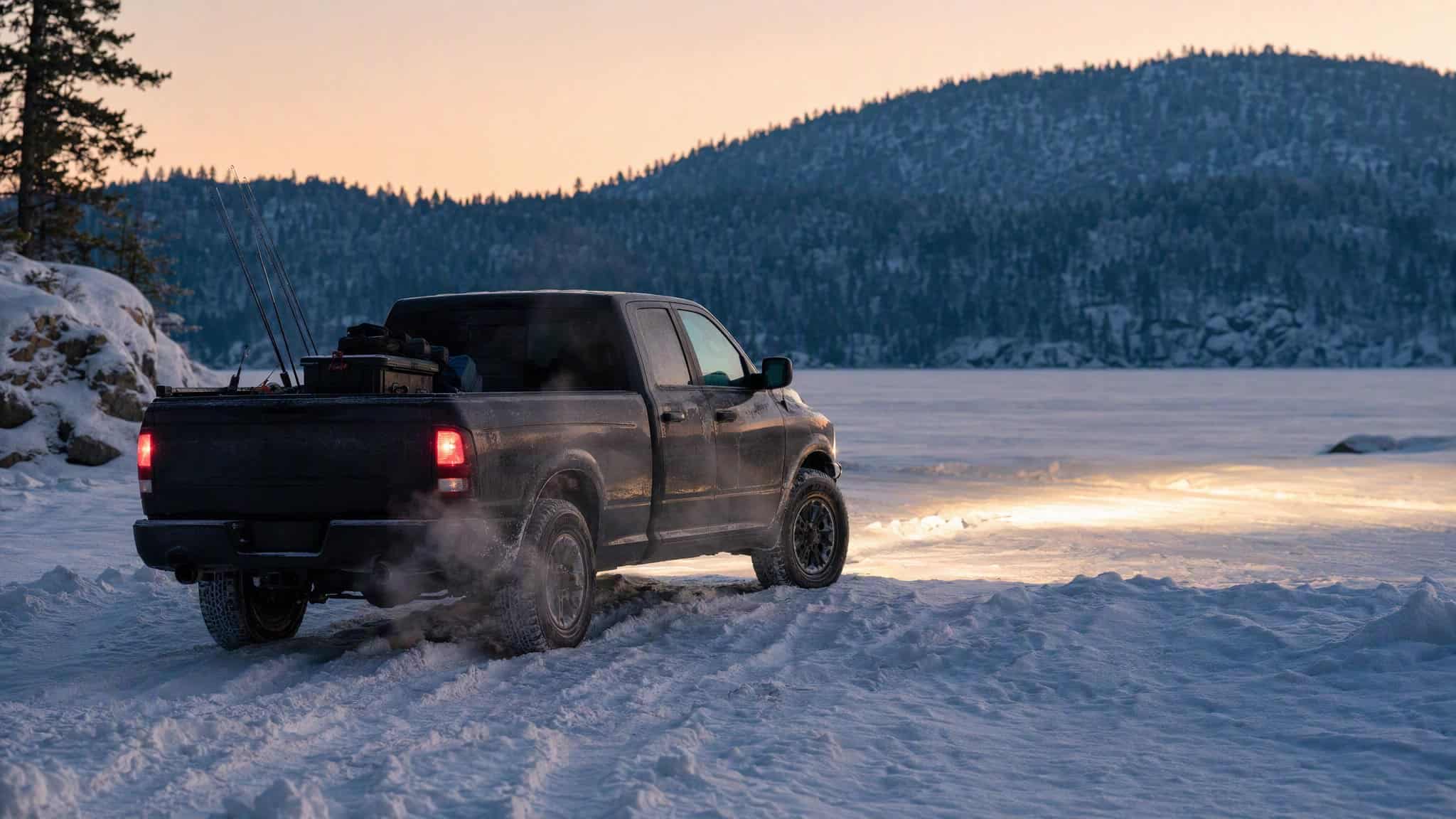
The ice report was good and the forecast was fine. You checked thickness and the bite, and you packed the night before.
Then you turn off the highway onto the access road and find eight inches of unplowed snow with one set of tracks in it, going away from the lake, made by somebody who apparently had second thoughts.
Now you’re making a decision in the dark, in the cold, with a truck, about something you never planned for.
The part of the trip nobody plans
Ice anglers do an enormous amount of preparation about the ice. Thickness, structure, bite windows, which jig, whether to bring the shelter.
Almost none of that preparation is about the forty miles of road or the last two miles of access, let alone the parking area. Which is strange, because those are the parts that most often decide whether the trip happens at all, and they’re also the parts with actual risk in them.
A lake with marginal ice, you can turn around at the edge and go home mildly disappointed. A truck in the ditch on a county road at six in the morning in January is a different kind of afternoon.
What to check before you leave
Most states run a road conditions service — a phone line, a website, a map with plow status and camera feeds. Use it, and use it for the county roads rather than only the interstate, because the interstate is usually fine and the last six miles are what matters.
Recent snowfall, and when. Snow from two days ago on a main route is probably cleared. Snow from last night on a secondary road isn’t.
Plow priority. Access roads to boat ramps and recreation areas are often near the bottom of the list, and a lot of them aren’t plowed at all in winter.
Warm-then-cold. A thaw followed by a freeze is the worst combination — meltwater refreezes as sheet ice and a road that was fine yesterday is a skating rink today. Parking areas are especially bad for this because they’re flat and they hold water.
Wind. Open country between fields drifts shut fast, and a road that’s clear at noon can be blocked at four.
The parking lot is its own problem
There are two problems people tend to meet exactly once.
The unplowed lot. You drive in confidently, the snow is deeper than it looked, and now you’re parked in a place you can’t get out of. If you’re not sure, park at the entrance and walk the extra distance. Carrying gear an extra hundred yards is a cheaper problem than a tow at nine at night.
The ramp. Boat ramps in winter are frequently sheet ice on a slope, which is a set of conditions engineered specifically to send a vehicle into a lake. Every winter somebody finds this out. If you’re not launching, don’t drive on it.
And on driving onto the ice itself: Minnesota DNR’s thickness guidance climbs fast for vehicles — 9 to 10 inches of new clear ice for a small car or SUV, 11 to 12 for a medium SUV or small truck, 13 for a medium truck, more for heavier loads — and you double every number for white ice. They also advise parking vehicles at least 50 feet apart and moving them every two hours.
The one people don’t know: MN DNR says do not wear a life jacket inside a vehicle on ice, because it makes escaping a sinking vehicle harder. Roll the windows down and unlock the doors when you drive on ice.
What lives in the truck from November to March
Not fishing gear. The other list.
A shovel that isn’t the small one. Traction — sand, cat litter, or traction boards. A tow strap, and some idea of where a recovery point on your vehicle actually is. Jumper cables or a jump pack, because cold kills marginal batteries and yours will pick the coldest morning.
A real blanket or sleeping bag. Extra dry clothes in a bag, separate from what you’re wearing. Water and food that won’t freeze solid, which rules out most of what you’d otherwise bring. A headlamp with fresh batteries.
A phone charger that works off the vehicle. Winter fishing routinely happens where there’s no signal, and a dead phone in a place with no signal is the same as no phone.
And a full tank, because idling is how you stay warm if the trip goes sideways, and idling uses fuel you didn’t budget. If you’re stuck and running the engine for heat, keep the tailpipe dug clear of snow and crack a window. A buried exhaust fills the cab with carbon monoxide, and you won’t smell it.
Tell somebody
The simplest and most-skipped item.
Where you’re going, which access, and when you expect to be back. NY DEC calls the buddy system out for the ice itself and it applies to the drive too — if the truck is in a ditch on a road nobody uses, the only thing that gets you found is somebody knowing where to look.
Text it before you lose signal. It takes eleven seconds.
The decision to turn around
Worth thinking about in the kitchen rather than on the road, because on the road you’ve already put two hours into the trip, and that bends your judgment.
Set the condition in advance: the access road is unplowed, the lot is ice, visibility drops below something specific, or you’d be arriving after dark on a road you’ve never driven.
Then when you meet the condition, you’re following a decision rather than making one. That’s a much better position to be in at six a.m. with a truck full of gear and a strong feeling that you didn’t come all this way to look at a road.
The road is part of the trip
In ice fishing the driving is a real part of the day, and it gets treated like overhead.
So the preparation ends up lopsided. People will spend an hour reading about jig cadence and zero minutes finding out whether the county plows the road to the access. The second one has a higher chance of affecting the day, and a much higher chance of affecting the week after.
Check the road the way you check the ice. You’re trusting it with more than you think.
FIELD OBJECT
This one should leave the page.
The article is the long version. These are the pieces worth carrying into the next trip.
The 30-second version
Nobody plans a winter fishing trip around the access road. Then the plow hasn't been through and the lot is a sheet of glare, and the fishing starts to look like the easy part.
What to watch
- The part of the trip nobody plans
- What to check before you leave
- The parking lot is its own problem
- What lives in the truck from November to March
Field card
- The part of the trip nobody plans
- What to check before you leave
- The parking lot is its own problem
- What lives in the truck from November to March
- Tell somebody
RIGHT TOOL, NEXT
Field Sense Navigator
Take the article’s water or access question into a place-specific conditions and route check.