Tautog Eat Crabs Off the Rock That Keeps Your Sinkers
Tautog crush crabs and mussels right off the rock, so the bait has to go where rigs get stuck. They also hang onto one piece of structure for years, which matters more than the coastwide numbers suggest.
By HunterUpdated September 12, 2026Read 6 min
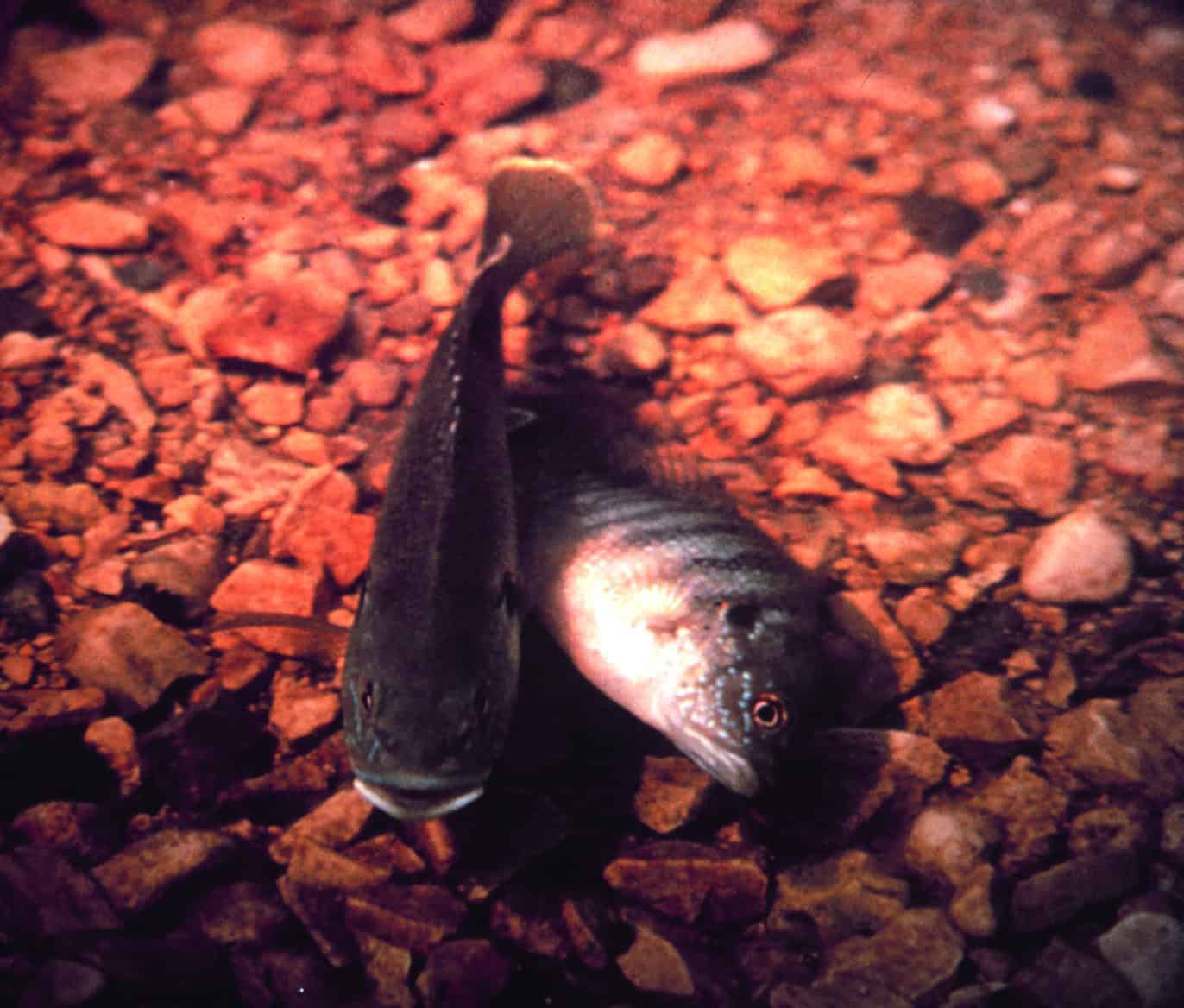
Tautog (Tautoga onitis), Narragansett Bay, Rhode Island. NOAA Estuarine Research Reserve Collection; public domain.
Tautog fishing has a running cost, and it gets paid in sinkers. Every account of it lands on the same awkward trade: the bait has to go into the rock, not beside it, so the rigs you lose are basically the fee for being in the right spot. That sounds like a bad deal until you look at what the fish eats and where that food lives.
At a glance · The short version
Scientific name
Tautoga onitis
Range
Nova Scotia to Georgia; most abundant from Cape Cod through Chesapeake Bay.
Adult habitat
Rock, boulders, wrecks, jetties, reefs, shellfish beds and other hard structure.
Juvenile habitat
Shallow vegetated estuaries and nursery habitat before shifting into deeper structure.
Life history
Mature around age 3–4 and can live more than 30 years.
The head tells you what the bait should be
Identification & Feeding Hardware
Built to crush
A blunt head, thick lips and conspicuous front teeth are only the first part of the feeding system. Tautog also carry crushing structures farther back that let them break shellfish prey. ASMFC describes adults feeding heavily on oysters, blue mussels and other shellfish. The fish is not waiting for a fast baitfish to make a mistake; it is built to work armored food off hard bottom.
Young tautog use smaller benthic and pelagic invertebrates such as amphipods and copepods. That life-stage diet fits the nursery habitat: little fish in shallow vegetation are solving a different food problem from adults crushing crabs and mussels on a wreck.
ASMFC places the range from Nova Scotia to Georgia, with strongest abundance from Cape Cod to Chesapeake Bay. North of Long Island, rock and boulder habitat is prominent; farther south, wrecks, jetties, natural and artificial reefs, and shellfish beds become increasingly important.
Shallow vegetated inshore areas function as juvenile nurseries. Larger juveniles progressively share deeper habitat with adults. That makes eelgrass and shallow estuarine structure part of a tautog profile even if most anglers picture a December wreck.
Adults show strong site fidelity. ASMFC notes that fish can move away from a preferred home site to feed during the day, then return to the same general area and become dormant at night. That is more specific than saying “tautog like structure.” Some pieces of structure function as home range, not merely a place fish pass through.
In the northern part of the range, adults move from offshore wintering grounds toward nearshore spawning and feeding areas in spring, then reverse as water cools in fall and winter. That is the biological reason the classic fall/early-winter fishery works in some places, but it is not a coastwide calendar.
Farther south, seasonal movements are shorter and some populations can remain either inshore or offshore year-round. A Chesapeake or Virginia tautog should not be assigned a Rhode Island movement schedule because the common name is the same.
When water gets very cold, adults can become torpid or lethargic. That is a real physiological behavior, not just anglers saying the bite “shuts off.” It also explains why an increasingly cold season can concentrate fish while simultaneously making them less willing to feed.
Tautog become sexually mature around three to four years and can live more than 30 years. That is not rockfish-slow, but it is slow enough that repeated removal from a resident aggregation can outpace replacement locally.
Management-plan syntheses describe spawning concentrated roughly from spring into midsummer, often around estuary entrances and nearshore areas. Exact timing shifts by latitude and year, so this page will not turn an older April–July synthesis into a universal date rule for the entire coast.
Evidence level. The biology is sourced. The rig and bite notes below come from how tautog anglers consistently describe it, checked against what the teeth and the habitat would predict. They’re tagged inference because I haven’t fished for tautog myself.
Put the crab in the ugly partinference
Crab fished near the structure and crab fished in the structure are not the same presentation. The accounts are consistent that clean sand two feet off a rockpile stays dead while a bait tucked into the rock gets eaten. The habitat and diet explain why: the fish and its food are both tied to the hard edge.
The taps are not all hooksetsinference
The bite often begins as little taps while the fish works the bait, then changes into weight and movement when it commits. The failure this sets up is easy to picture: you swing at the tap, describe the fish perfectly afterwards, and never had it on. Swinging at every tap removes the bait from a fish that was still working on it.
Design the rig to fail where you chooseinference
Hang the sinker from a dropper lighter than the main leader. When the weight wedges into rock, the sinker is the thing you want to lose, rather than the whole rig or a hooked fish. Tie spares at home, because the structure—not just the fish—is testing every knot.
Late-season accuracyinference
As cooling water concentrates fish more tightly onto heavy structure, careful placement should beat covering six mediocre pieces of bottom. That local observation should stay local; the ASMFC movement data are the reason not to present it as the same seasonal pattern from Massachusetts to Virginia.
Cold-water access is part of the fishery
Jetty & Shore Safety
The old warning stays
A good late-season tautog bite can overlap with cold water, short daylight, algae-coated rock, ice and swell. Boots with real traction, two free hands while moving, watching sets instead of only the rod, and refusing exposed rock alone are not side notes. The water that makes the fishery productive can make a fall dangerous fast.
Not established here
What this profile will not claim
one coastwide peak month
that every tap means the same thing on every rig/current
that all tautog move offshore at the same temperature
that a productive wreck can absorb unlimited repeated harvest
— · Sources
FEEDING ECOLOGY · STANDARDIZED
How this fish gets fed.
Primary prey
Crabs, mussels, clams, barnacles, snails and other hard-shelled benthic invertebrates dominate, with worms and other bottom prey also taken.
Feeding mode / location
A structure-bound crusher and picker using rocky reef, jetties, wrecks, pilings and shell-covered hard bottom. Strong incisors and pharyngeal teeth let tautog pry and crush prey directly off structure.
Diel / seasonal pattern
Tautog are primarily daytime feeders and commonly shelter in structure at night. Seasonal water temperature drives major inshore/offshore and depth shifts, with cold water greatly reducing activity.
Ontogenetic diet shift
Juveniles use smaller crustaceans and mollusks; larger tautog increasingly exploit larger crabs, mussels, clams and other hard-shelled prey.
The teeth are feeding equipment first and a tackle problem second.
Compiled 2026-09-11. Limits and advisories are set per water and per state and change between seasons — the managing agency for wherever you are fishing has the current answer.
Tautog keep coming back to the same wreck or rockpile, and they take three or four years to mature. Put those two facts together and a favorite pile can get fished down while the coastwide numbers still look fine. That’s worth thinking about the second time a spot gives you a limit.
Saltwater & CoastalSurf, shoreline, nearshore, offshore, and deep-sea fishing — technique, gear, and safety content spanning the full range from the beach to blue water.103 articles
Species & BehaviorFish behavior, habitat, depth, forage relationships, and species-specific field decisions. Start with the Freshwater Fish Species field guide.159 articles
Cookie Consent
We use cookies to improve your experience on our site. By using our site, you consent to cookies.
Contains information related to marketing campaigns of the user. These are shared with Google AdWords / Google Ads when the Google Ads and Google Analytics accounts are linked together.
90 days
__utma
ID used to identify users and sessions
2 years after last activity
__utmt
Used to monitor number of Google Analytics server requests
10 minutes
__utmb
Used to distinguish new sessions and visits. This cookie is set when the GA.js javascript library is loaded and there is no existing __utmb cookie. The cookie is updated every time data is sent to the Google Analytics server.
30 minutes after last activity
__utmc
Used only with old Urchin versions of Google Analytics and not with GA.js. Was used to distinguish between new sessions and visits at the end of a session.
End of session (browser)
__utmz
Contains information about the traffic source or campaign that directed user to the website. The cookie is set when the GA.js javascript is loaded and updated when data is sent to the Google Anaytics server
6 months after last activity
__utmv
Contains custom information set by the web developer via the _setCustomVar method in Google Analytics. This cookie is updated every time new data is sent to the Google Analytics server.
2 years after last activity
__utmx
Used to determine whether a user is included in an A / B or Multivariate test.
18 months
_ga
ID used to identify users
2 years
_gali
Used by Google Analytics to determine which links on a page are being clicked
30 seconds
_ga_
ID used to identify users
2 years
_gid
ID used to identify users for 24 hours after last activity
24 hours
_gat
Used to monitor number of Google Analytics server requests when using Google Tag Manager
1 minute
Jetpack's built-in visitor analytics. It records page views, referring sites, search terms, and outbound link clicks, and also carries the shared visitor-tracking library used by Jetpack Instant Search and WooCommerce Analytics.