
Description
Most go/no-go thinking is additive. You total up the good things — the tide looks right, the wind has dropped, you have the day off — and somewhere in the adding up the drive becomes inevitable. But a day is not made of reasons to go. It is made of hours, and conditions never add hours to it. They only take them away.
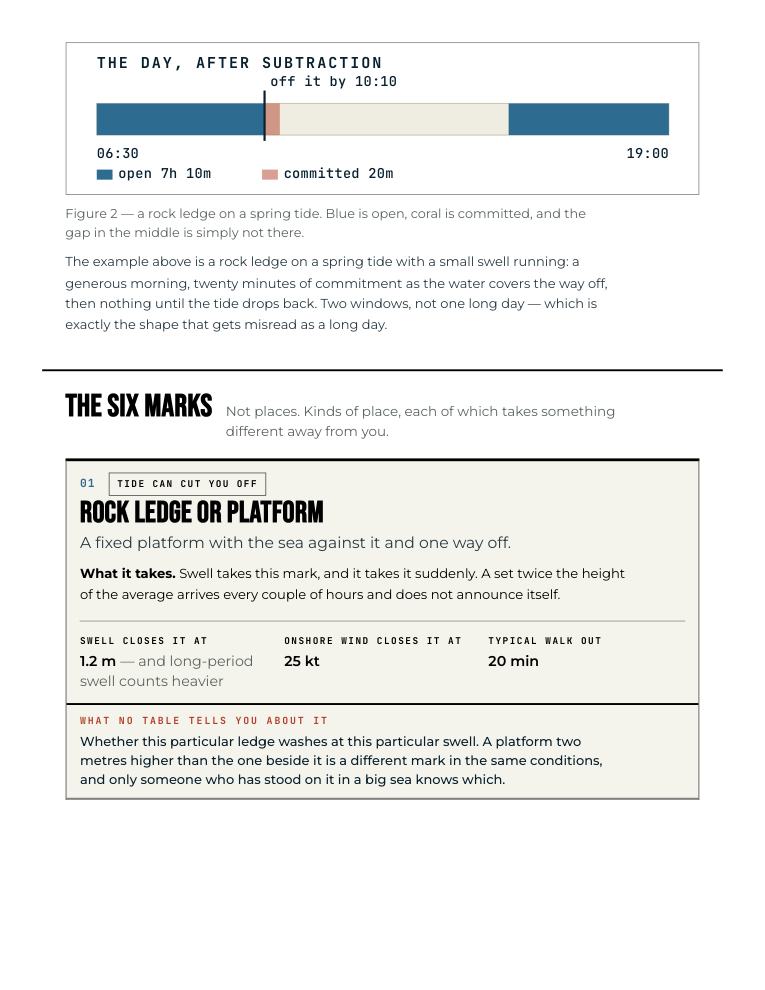
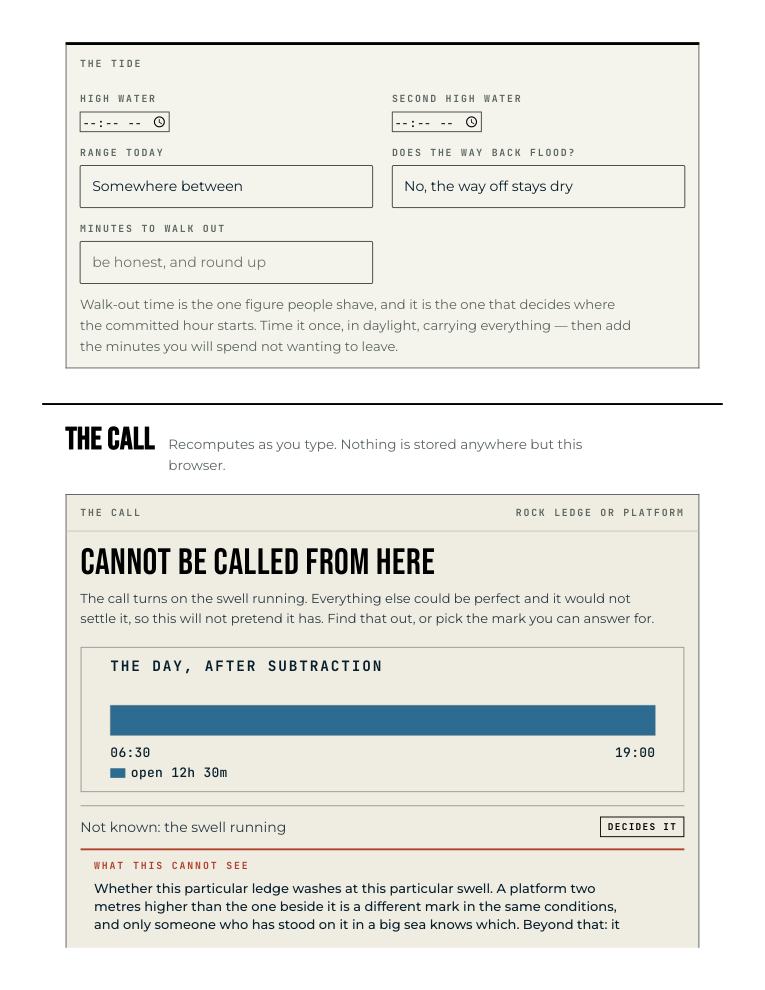
So this starts with the daylight you actually have and removes from it. Swell takes what it takes. An onshore blow takes what it takes. The tide takes the hours your way back is under water, and — this is the part that gets people — the hours before that too, because it takes time to walk out. What survives is the window. When nothing survives, DO NOT GO is not a judgement anyone made. It is an empty bar with the condition that emptied it written on it.
Three kinds of hour
- Open — fishable, and the way back is still there.
- Committed — fishable, and the way back has closed behind you. This is the hour nothing else counts, because it does not look like anything while it is happening.
- Closed — taken by a condition. Not a risk you are weighing; hours you do not have.
Committed hours are not forbidden. People fish them deliberately and come home. But they are a different decision from the one you think you are making, and they should be made on purpose at the kitchen table rather than discovered.
Six marks, and what each takes from you
A rock ledge, sand or mud flats, a jetty or breakwater, an open surf beach, an estuary mouth, and a small boat off a ramp. Each one closes for a different reason and commits you at a different moment, with the swell height, onshore wind and walk-out time that a careful angler starts removing hours at.
It brings nothing of its own
There is no forecast in this and no tide data. It has no connection to anything and runs with the signal off on a headland. Every figure it reasons about is one you read off the official source for your coast and typed in — deliberately, because a tide table that is wrong because a page cached it is a worse failure than no tide table at all.
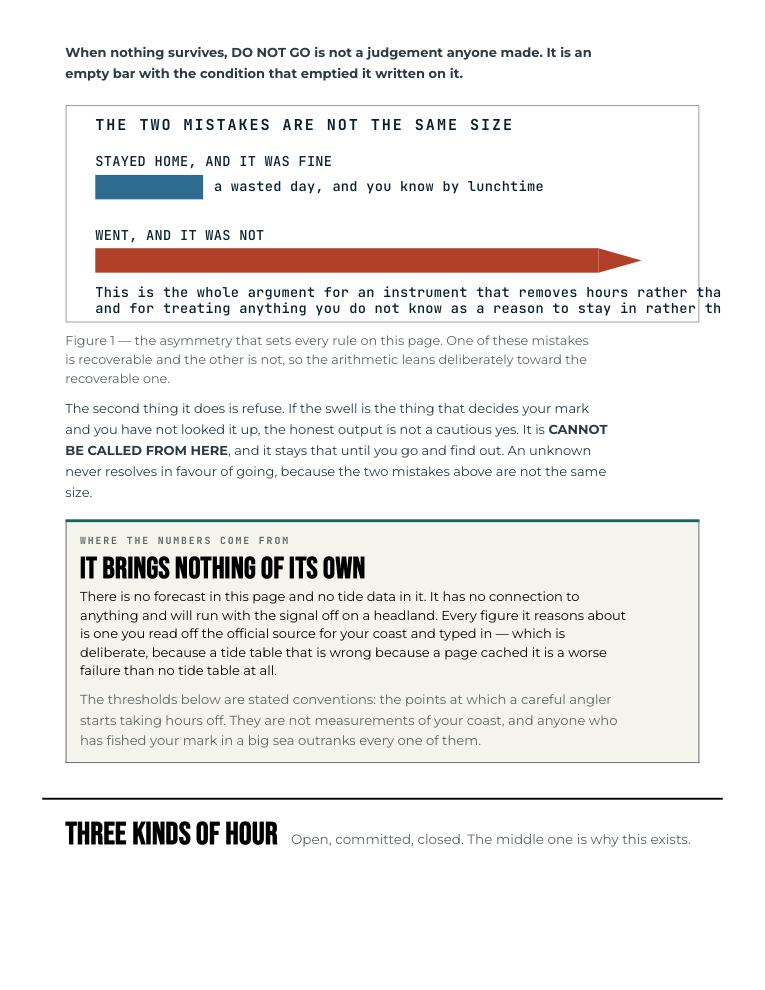
It also refuses. If the swell decides your mark and you have not looked it up, the output is not a cautious yes; it is CANNOT BE CALLED FROM HERE, and it stays that until you find out. An unknown never resolves in favour of going, because a wrong no-go costs a wasted drive and a wrong go costs considerably more.
What you get
- A self-contained offline browser edition — no account, no server, nothing uploaded, no location asked for or recorded.
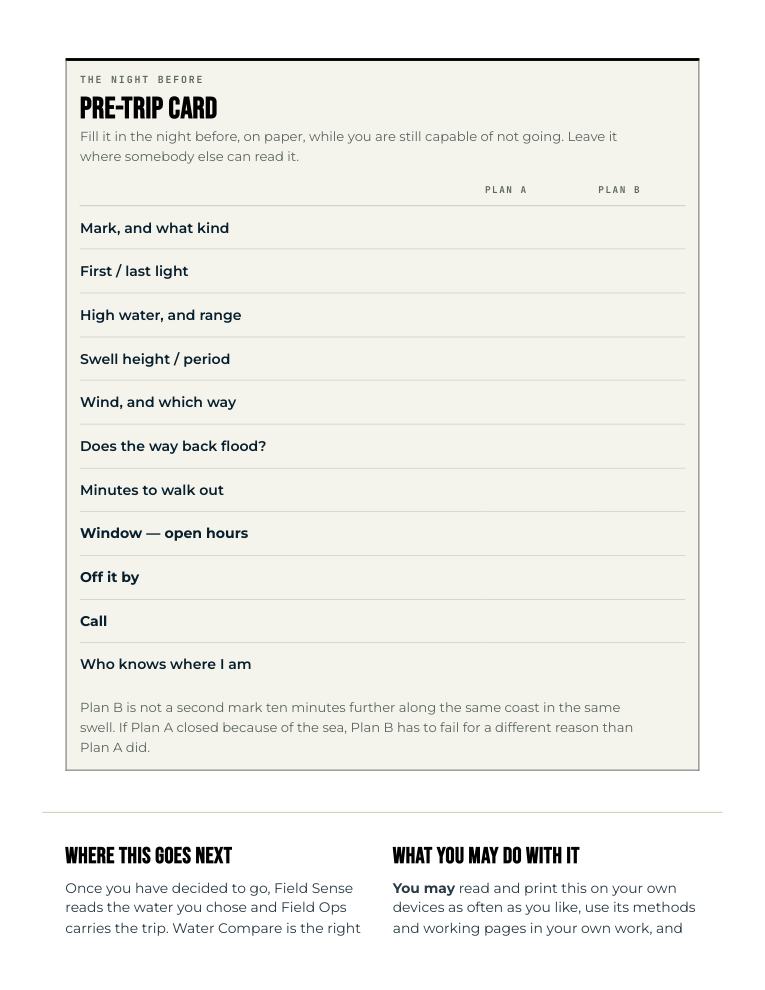
- A 13-page Letter print edition, legible in grayscale, with a pre-trip card for the night before.
- A local working record on your own device, with JSON export and import.
Poor fit
This is not a tide table, a forecast, or a rulebook, and it never names a mark or tells you where the fish are. If that is what you want, this will be no use at all.
Your purchase includes the browser edition and the print edition, and any corrected release of this edition at no further cost.
You may read and print this on your own devices as often as you like, use its methods and working pages in your own work, and — if you work with clients — use it while serving them and hand a client a completed output you produced with it.
You may not redistribute the publication itself, the blank working masters or the print file; resell or republish it; put the complete work in a shared library or community drive; or share your purchase credential in place of a purchase. It may not be used for model-training ingestion.
Refunds: fourteen days, no reason required. A broken, missing or materially misdescribed file is corrected or refunded without relying on that cutoff.
This is a way of organizing what you already found out. It is not a forecast, a safety service or a substitute for the official source for your coast, and it cannot see the sea. Conditions on the day outrank it. Tell somebody where you are going and when you will be back.