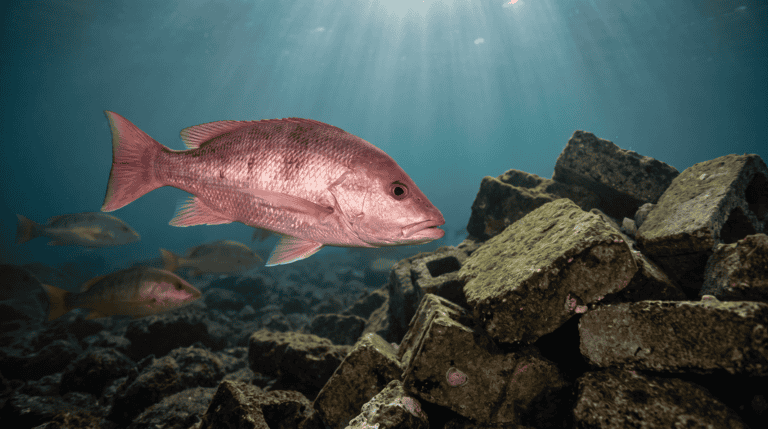
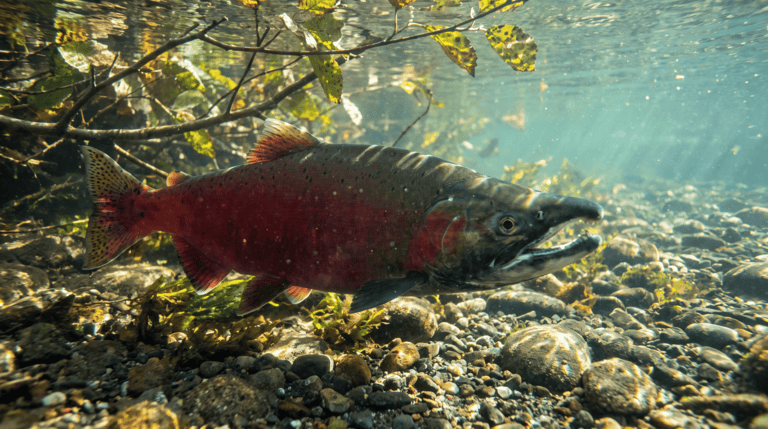
Run a hundred miles offshore and the water stops giving you clues. No bank, no weed line, just blue that looks exactly like the blue from the last trip. That’s what makes ocean acidification hard to think about: none of it shows up in the color, and the first animals to feel it are too small to see from the rail.
The chemistry, short version. The ocean takes in carbon dioxide from the air, seawater chemistry shifts, and average pH goes down. (pH is the scale for how acidic or alkaline water is.) The name makes it sound like the ocean’s turning into acid. It isn’t. Seawater is still alkaline on average — it’s just becoming less alkaline.
What I actually care about, as somebody who fishes, is what that does to the things building shells and skeletons, and to everything that eats them.
One number doesn’t make a story
What the carbon dioxide actually does
When carbon dioxide dissolves in seawater it sets off reactions that add hydrogen ions and leave less carbonate available in the water. Carbonate is part of the building material a lot of shell-forming animals use to make their calcium-carbonate structures.
That doesn’t mean every shell just dissolves. Species, life stage, temperature, food, local chemistry and adaptation all shape how it plays out. The chemistry is the comparatively simple half. The biology is where it gets messy.
pH is one gauge on the dash
Scientists also measure alkalinity, dissolved inorganic carbon, the partial pressure of carbon dioxide, temperature and salinity. Put together, those readings show how the carbonate system is behaving and how much building material is actually available to something trying to grow a shell. If that list reads like a chemistry test you didn’t study for, you don’t need it memorized. You just need to know pH is one reading out of several, not the verdict.
Two waters with similar pH can still differ in ways that matter. So when one dramatic reading makes the rounds, it hasn’t told you what the shellfish or plankton were actually living in — about like judging a whole river off one gauge reading taken at noon.
It depends who’s exposed, and when
Start with the shellfish
Oysters, clams, mussels, scallops, pteropods (small swimming sea snails) and other shell builders make their shells from calcium carbonate. They can be sensitive to shifting carbonate chemistry, especially early in life.
NOAA research and monitoring programs work directly with shellfish growers. Hatcheries can see poor larval survival when the chemistry of their intake water turns unfavorable, and monitoring lets operators time when they pull seawater in instead of treating every bad production year like an unsolved mystery. Conservation and adaptation, meeting in the same intake pipe.
Fish don’t need a shell to be in it
Most sport fish aren’t building shells, but they’re eating things tied to plankton, shellfish, reefs and seafloor food webs. A change lower down can work its way up the chain.
Researchers also study direct effects of acidification on fish development, behavior, physiology and senses, and the results vary by species and study conditions. A headline like “acidification makes fish do X” isn’t much use until somebody attaches the species and the exposure conditions. The fish at the end of your line is the last link in a chain you mostly never see.
Some coasts get it sooner
Upwelling cuts both ways
On some coasts, wind and currents bring deeper water up toward the surface, and that deep water already carries more dissolved carbon dioxide from natural respiration. Freshwater input, nutrient pollution, algae growth and local currents push coastal chemistry around further. Stack the long-term rise in ocean carbon dioxide on top and some coastal water runs into difficult chemistry sooner, or harder, than a global average would suggest.
Here’s the catch. Upwelling is also why a lot of that water is productive in the first place — it brings up the nutrients that feed plankton and the food web above them. The same process can support a fishery while delivering water with lower oxygen and tougher carbonate chemistry. “Acidification equals bad water” is too blunt to do anything with.
Nutrient pollution stacks on top
Extra nutrients boost algae growth. When that organic matter breaks down, respiration releases carbon dioxide and can drop both oxygen and pH in bottom water. In some coastal systems hypoxia — too little oxygen — and acidification show up together, so one animal can be dealing with both at once. Problems don’t line up politely and take turns.
What local fixes can and can’t do
Cutting nutrient pollution won’t stop atmospheric carbon dioxide from changing ocean chemistry. What it can do is remove one local source of oxygen loss and carbon dioxide production in bays, estuaries and bottom water. Protecting seagrass and wetlands, restoring shellfish habitat and improving water quality work the same way: none of it stops global acidification by itself, but it takes extra local stress off and makes coastal ecosystems more resilient.
A lot of conservation works like that — keeping margin instead of fixing everything. A shellfish bed or nursery area can’t escape a global chemical trend, but with less avoidable stress piled on, it has more room to cope with what’s coming from elsewhere. Just don’t let anybody sell a local restoration project as fixing ocean chemistry. It can strengthen the local fishery while the larger carbon-dioxide problem gets dealt with at a much broader scale.
Watching the chemistry move
Long-term monitoring stations, hatchery sensors, research cruises and repeated coastal measurements all do the same basic job: show how the chemistry moves through seasons, tides, upwelling events, storms and years. A pH measurement can be perfectly accurate and still say almost nothing about what larvae went through the week before somebody took it. The trend is the useful part, and whether it lined up with the weeks those organisms were most vulnerable.
Adaptation is already part of the fishery
Some of these changes are already being measured, so fisheries, hatcheries, restoration programs and coastal communities need practical responses now. Better monitoring, selective breeding in aquaculture, habitat protection, water-quality improvements and flexible management can all help in the right setting.
A hatchery timing its intake around a bad water mass is smart adaptation. It isn’t proof acidification stopped mattering, and adaptation shouldn’t turn into an excuse to ignore where the changing chemistry comes from.
Make the claim specific enough to check
None of this is a reason to stare at clear water and imagine a disaster nobody has evidence for. It’s a reason to take measurements seriously when they’re about something your eyes can’t pick up.
When a claim comes by, look for the species, the life stage, the location, the chemistry actually measured and how long the exposure lasted. Then check whether it came from a lab experiment, a field observation, a hatchery record or a long-term monitoring program, because those support very different sized conclusions.
“Ocean acidification affects fish” is too broad to build a decision on. “Larval shellfish in this hatchery had poor survival when intake water crossed these measured chemical conditions” is something you could actually go check.
Warm water is the other change you can’t see from the boat — marine heatwaves can move fish before the shoreline looks any different. Agricultural nutrient runoff is one of the local pathways that makes coastal oxygen and chemistry problems worse, and Stewardship pulls that thread closer to home.
So the water off the stern can look exactly like it always has while the baseline underneath it shifts, and a serious change doesn’t need dead fish or dirty water to count. A lot of what saltwater fishing turns into is getting decided in carbonate chemistry, plankton and shell formation, well below whatever you’re dropping over the side.