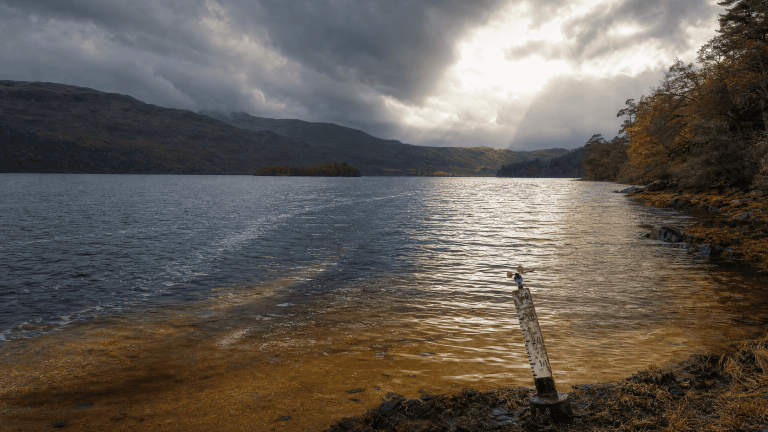
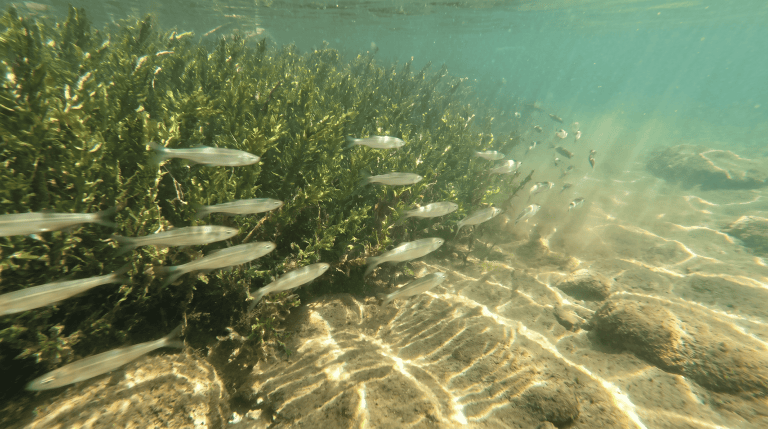
Polarized glasses don’t turn a lake into glass. They cut the glare off the surface, and that’s all they do. In clear or fairly clear water, though, that’s enough to start seeing the weed edges, rocks, sunken wood and bottom changes you’d otherwise be casting blind over — and now and then a fish moving through them.
Why they work, which explains when they don’t
Light bouncing off flat water comes back mostly polarized one way, horizontally. A polarized lens is a filter turned the other way, so it blocks that reflected light and lets through the light coming up from under the surface. Glare goes away. Everything else stays.
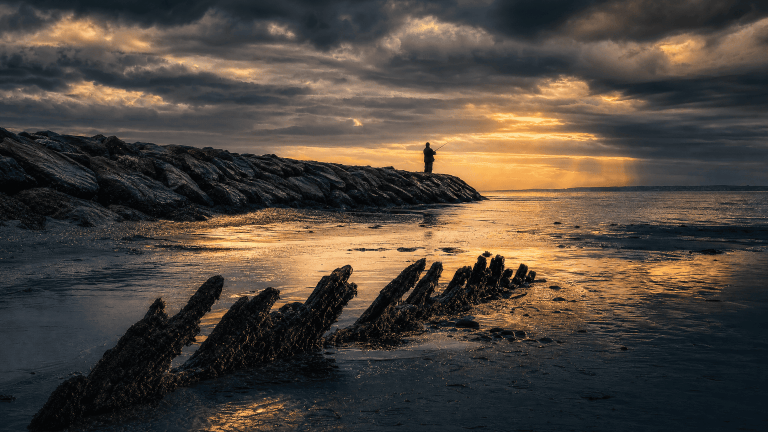
The part people don’t always connect is that the effect depends on the angle. It works best with the sun high or behind you and the water out in front. It works worst with the sun low and dead ahead, because that reflection isn’t arriving at the angle the filter is built to reject, and no amount of lens quality fixes geometry. If you can’t see into a stretch of water, walking around to the other side of it will often do more than a nicer pair of glasses would.
Lens color
I don’t think there’s one tint that’s simply correct for fishing, whatever the rack at the tackle shop implies. Roughly, amber and copper lift contrast in low light and stained water, which is why they feel good on a dim morning, and neutral gray keeps colors honest in bright, open conditions without flattening anything. Those are preferences with a little reasoning behind them, not a ranking.
What’s actually worth checking is that polarization and UV protection are two different features. A lens can be polarized and still let UV through, and the UV is the part that matters for your eyes over years of looking at light coming off water. Check for it on purpose instead of assuming the polarized part covers it.
And when the water’s stained, quit trying to see into it. Fishing stained water comes down to a different set of senses entirely.
What to do with what shows up
Seeing it was the easy half, and it took me a lot longer to figure that out than it should have. The glasses hand you a picture. Reading it is a separate skill. The most useful thing to find first is a change in bottom color, because that’s usually a change in bottom hardness, and hard bottom holds fish. After that, the spots where the water steps darker into depth, and the outside edge of the weeds. Once you can see a transition like that, the edge itself becomes the fishing question, not the glasses.
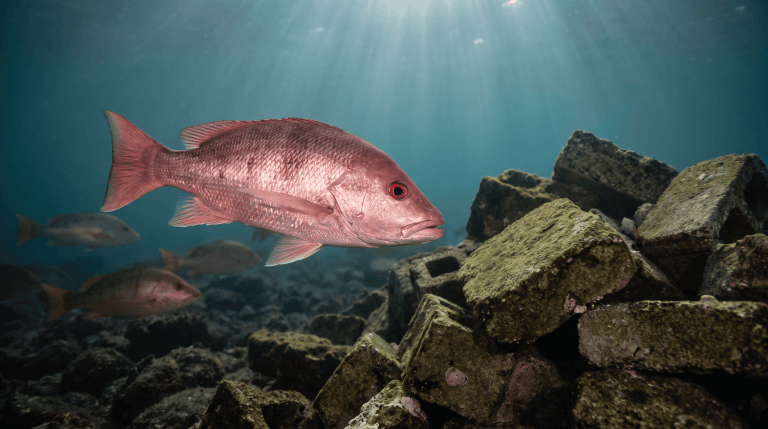
Fish come last, and they hardly ever look like fish. They’re a shape, or a shadow that doesn’t quite match the bottom around it.
FIELD OBJECT
This one should leave the page.
The article is the long version. These are the pieces worth carrying into the next trip.
The 30-second version
Polarized lenses take the glare off the water, not the water itself. Whatever shows up underneath is just a picture, and reading it is still on you.
What to watch
- Why they work, which explains when they don't
- Lens color
- What to do with what shows up
Field card
- Why they work, which explains when they don't
- Lens color
- What to do with what shows up
RIGHT TOOL, NEXT
Field Sense Navigator
Take the article’s water or access question into a place-specific conditions and route check.