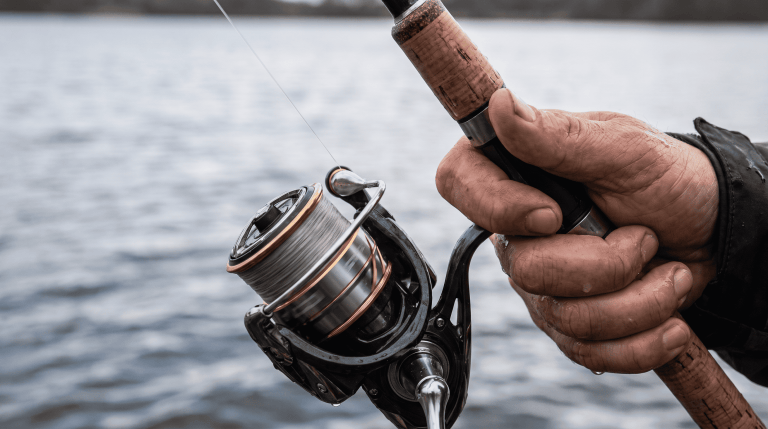
The lure comes back off the rock ledge looking perfect, and that’s the trap. It’s metal and plastic. The line isn’t. When a lure, leader or line drags across rock, shell, concrete, dock hardware, barnacles or a boat trailer, the damage lands in whatever gives, and on your setup that’s the line.
So before the next cast, pinch it lightly between thumb and forefinger and run it through in both directions, from the knot back four or five feet. Both directions matters — a nick lifts a little burr you’ll feel going one way and slide right over coming back. Keep the pressure light. You’re feeling for a catch, a flat spot, or a stretch that suddenly feels wider than the rest. Obvious fuzz is the easy case.
Each line hides it differently. Mono goes cloudy and fuzzy where it’s hurt, so mono is the honest one: if you can see it, it’s real. Fluorocarbon is the liar. It’s harder and stiffer, abrasion leaves flat scuffs that nearly vanish against clear line, and it’s the one where I trust my fingers over my eyes. Braid doesn’t really scuff, it cuts — fibers part, and the tell is a section gone slightly fluffy or flattened out of its normal round feel. Braid that looks hairy has already lost strength it isn’t getting back.
Then cut past the last thing you can feel, plus a foot. Damage is usually a zone, not a point, and the spot your fingers found is more likely the middle of it than the edge. Cut right at the nick and retie, and you can meet that same weak spot again twenty minutes later on the fish you actually cared about. Line is the one thing in this whole setup you can afford to be wasteful with.
Salt has its own version of this with oyster and barnacle contact, and Getting Broken Off in Salt reads the broken end to tell you which of the four failure points actually went. When the question is the whole spool instead of the last few feet, line doesn’t have to break before it’s done is the longer call.
The knot gets its own look. It carries the highest load in the whole setup, so a nick there is worth more than a nick anywhere else, and a hard pull can shift or scorch a knot without leaving anything you can see. If I had to really lean on a snag to get free (the snag-recovery note is about never loading it that hard), I retie either way, whatever my fingers found.
FIELD OBJECT
This one should leave the page.
The article is the long version. These are the pieces worth carrying into the next trip.
The 30-second version
The lure survives the rock ledge just fine, which is exactly why you’d skip checking the line above it. Your fingers find what your eyes miss, and fluorocarbon hides it best.
RIGHT TOOL, NEXT
Tackle Link Analyst
Follow the load path and find the part of the setup that actually limits the rest.