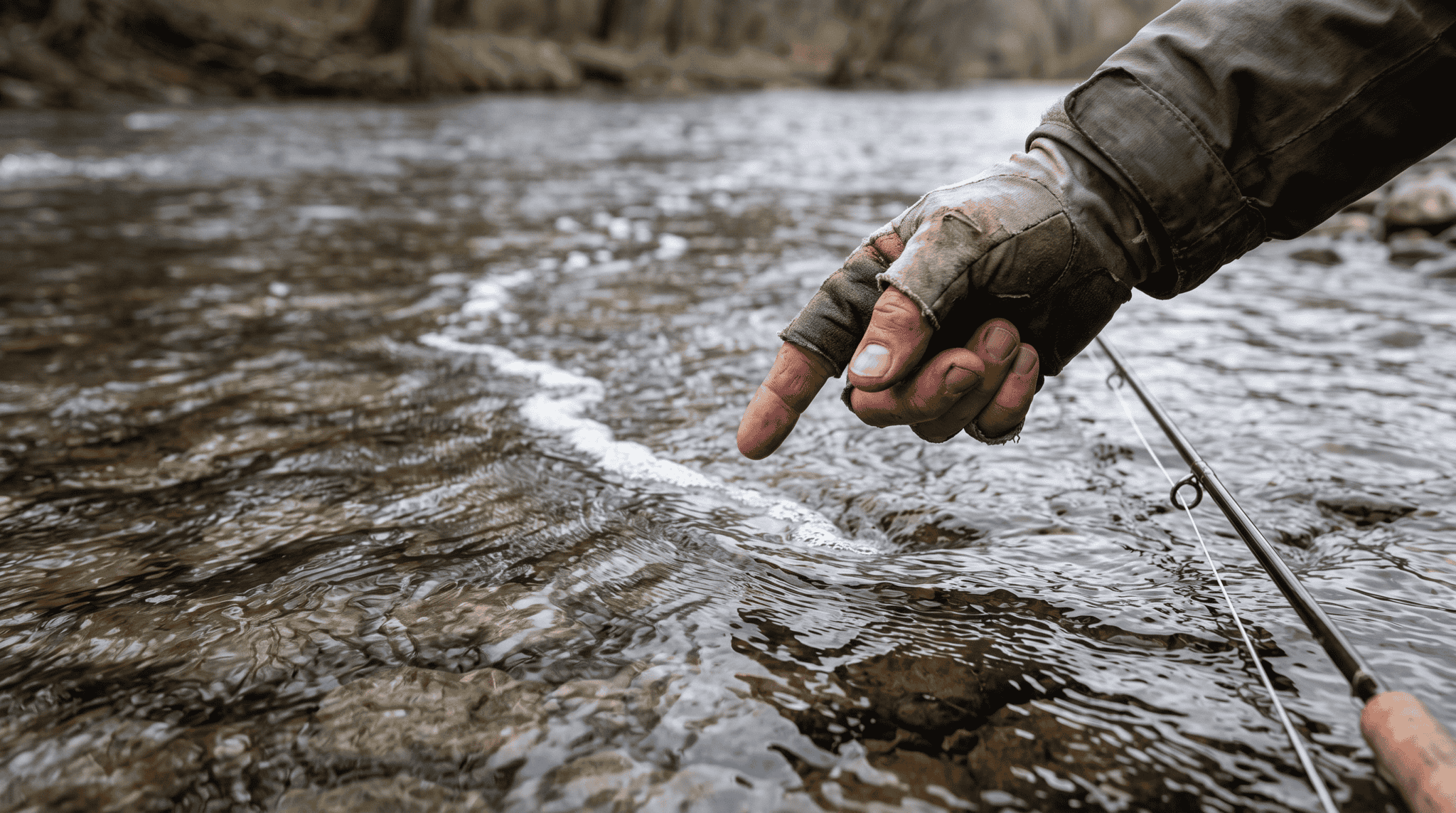
Water-type frame · flowing river and stream. Current sorts everything in a river, but “fast” and “slow” aren’t places a fish lives. The water worth fishing usually lets a fish hold without burning more energy than it can afford, close enough to food, cover, depth or a travel route that the spot pays for itself.
So read the relationship instead of the hole: a feeding lane beside velocity refuge, depth next to shallow current, or cover beside open drift. The named hole can fill in after one big runoff. Those relationships just show up again somewhere else.
Start where the current gives a fish a break
Velocity refuge next to delivery
A seam, an eddy edge, a boulder pocket, the soft cushion along a bank, a wood break or a depth change can let a fish sit in easier water while food rides past. The seam you can see is only the clue. The real work is figuring out which side gives the fish the better deal between effort and food.
Depth and cover that still connect to current
The deepest hole isn’t automatically the best room. Ask whether it gives the species a decent feeding angle, security, a temperature break or a migration route. Undercut banks, wood, ledges and boulders matter because of what they do to current and cover. “Fish like structure” is a bumper sticker, not a reason.
When the flow changes, the map does too
When discharge rises or falls, the whole velocity picture shifts. A bank edge, side channel, pocket, inside bend or tributary seam can get better or worse, but nothing says rising water sends every fish to the bank. Look again at where your species can get out of the push.
Clarity without the muddy-water slogan
Rain can change the flow and the visibility at the same time. Keep those two apart in your head. If sediment cuts how far a fish can see, it may lean on its other senses more, depending on species. Get control of your presentation back first; then test whether the fish can find it, or whether it’s sitting somewhere new.
What the fish is doing decides where it sits
Feeding in current
Look for a spot where the current delivers food and the fish can grab it without living in the hardest flow. The line that matters might be a velocity edge you can see, one you feel through the lure, or one you read off the surface texture.
Resting or conserving energy
Soft water behind structure, deeper pools, bank cushions and back-eddies can all work as places to rest. A resting spot is worth more when the fish can slip out of it quickly to eat.
Using temperature or oxygen refuge
Tributary mouths, springs or shaded stretches can make a real temperature difference in some rivers. That’s something to measure with a thermometer, not a “cold-water spot” you get to keep forever.
Moving through the system
Riffle-to-pool transitions, channel margins, floodplain connections and tributary junctions can become travel routes. Which one matters depends on species, flow and season.
Before you change flies, check what the line is doing
In moving water, your line and your lure can be doing two different things. Drag, bow, belly, current shear and changing depth can pull a presentation out of the lane while it still looks fine from the bank. Before you swap anything, ask whether you can tell where it is and how fast it’s moving compared to the fish.
Fix that first: change your casting angle, line management, weight, mend, float depth, or where you’re wading or holding the boat, until the presentation comes through the lane you picked the same way every time.
Soft edge, then fast edge
Pick one velocity boundary you can reach that has a believable resting spot beside it. Run one presentation family at one depth through the soft edge, then through the faster edge or at a second depth. Hold enough steady that a bite actually tells you something.
Say it goes like this: nothing in the fast tongue → same presentation on the soft seam with clean line control → a fish. That doesn’t mean “all the fish were in slow water.” It means this fish, today, was using the slower side enough to earn another pass.
Ways a river beats you before a fish does
- Fishing dramatic whitewater without figuring out where a fish could actually hold in it.
- Wading straight through the bank cushion, tailout or soft edge before you’ve fished it.
- Changing flies or lures when drag or line angle is what’s really wrong.
- Assuming high water means “fish the bank” everywhere.
- Assuming dirty water just means a bright color, instead of testing control, distance, profile and position.
- Treating where one fish was sitting as a law for the whole river.
What to sort out next
If the water or access is changing fast, settle that first in Field Sense. If you understand the current but don’t know what kind of holding water makes sense for your fish, go to Species & Presentation. Hatch Match is for when you’ve seen something getting eaten and honestly can’t name it.
Before you decide the bass in your hand is a spotted bass, it’s worth knowing three river fish that get mixed up with it. Alabama Bass ended up with a species name of its own. Call something a Redeye Bass and you might mean more than one fish, depending on which upland drainage you’re standing in. And the Suwannee Bass lives in a range you could drive across in an afternoon.
All Water-Type Frames · Working current seams · Read water and find fish · Response → adjustment