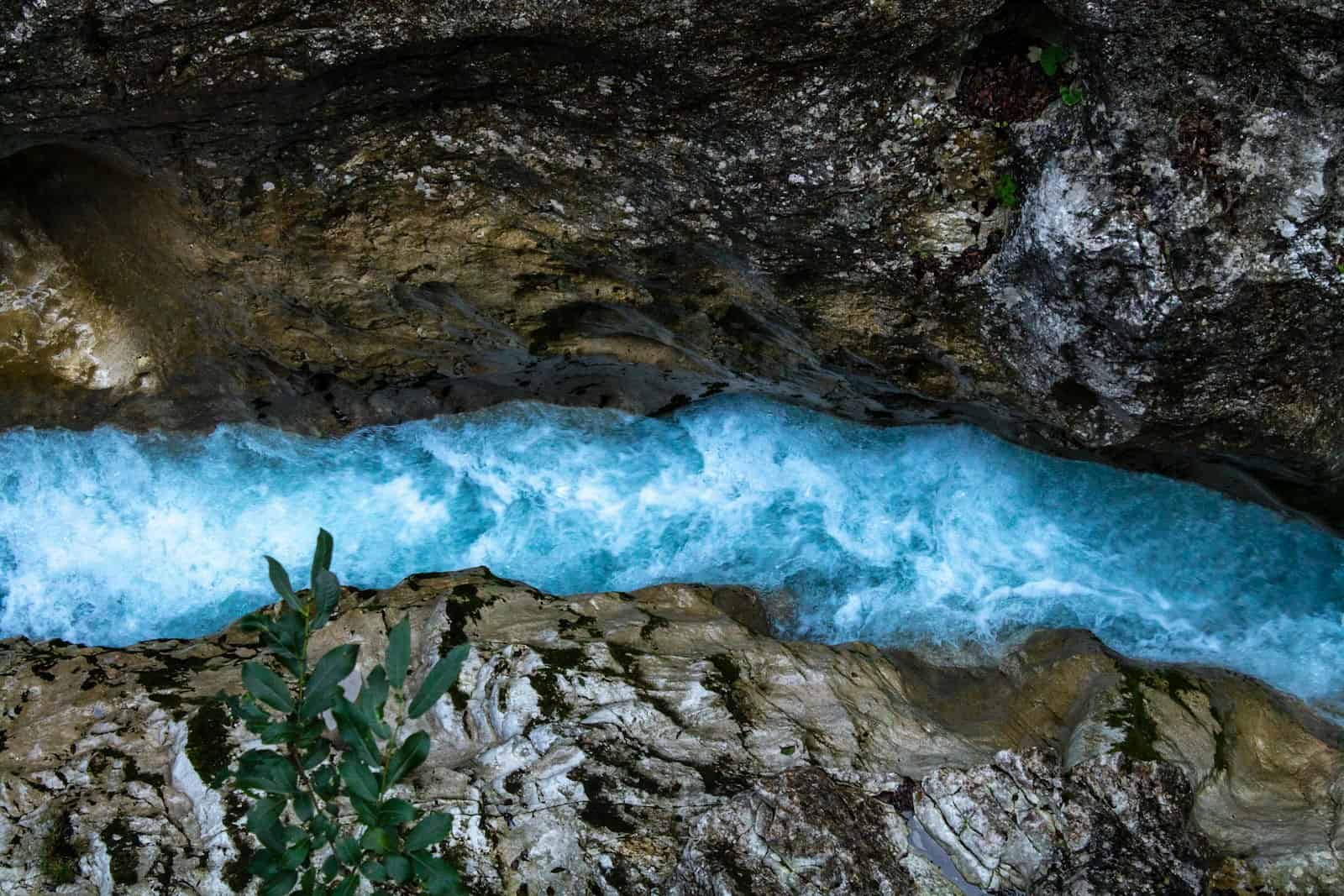
Foam gathers on it, leaves ride down it, the surface goes from glassy to pebbled — and you can stand there feeding cast after cast straight down the middle of that line, feeling pretty sharp about your water reading, and catch nothing at all. Seams get credit for a lot of fish they aren’t holding.
The line is still worth something. It’s telling you two bodies of water are moving at different speeds, and that difference is the whole engine: the fast side hauls food past a fish sitting in the soft side spending almost nothing to stay put. But the stripe isn’t the spot. The spot might be a few feet to either side of it, or underneath it, or behind a rock you can’t see from where you’re standing, or downstream where the two speeds start trading places.
Treat it as structure that moves. That’s the whole shift.
Two speeds, touching
Seams form wherever neighboring currents disagree. Beside a bank. Behind a boulder, below a bridge support, along an outside bend, at the mouth of an inflow, around a point, beside submerged grass, or where a shallow shelf falls off into deeper water. One side can be shoving hard while the other one is basically loafing.
A fish doesn’t have to park under the foam to use any of that. It can hold on the soft side and make a short move to intercept something. It can sit lower in the column where the current is already reduced. It can tuck into a pocket behind cover and only slide into the fast lane when something worth the trip comes through.
Which is why two seams can look like twins and fish nothing alike. One has depth under it, cover beside it, and a steady lane feeding into it. The other is two speeds meeting over flat gravel. Nice line. No reason for anybody to live there.
Trace it upstream and find out what made it
Look for the object or the shape that caused the speed change. Foam, bubbles, pollen, leaves, sediment and ripples all show you movement, but movement is evidence, not an explanation. Follow the line up. Somewhere above it there’s a rock, a bend, a bar, a point, a channel edge, a current break or a depth change doing the actual work.
Then look for the second thing. A seam gets a lot more interesting when it’s attached to something else a fish can use — deeper water, shade, cover, a drop, an undercut bank, an oxygenated inflow, an escape route close by, a pocket where the food slows down. The good ones hand out delivery and relief at the same address.
Give it thirty seconds before the first cast. Thirty seconds of watching beats ten minutes of putting the same drift through the wrong lane with steadily increasing confidence.
Three lanes
Nobody walks up to a river and sees lanes. You see a river. They show up once you make yourself pick one strip of water and fish only that, and after a few sessions of doing it on purpose the water starts arriving pre-divided. A visible seam is at least three pieces: the soft side, the boundary, the fast side. Where there’s depth, there’s a fourth one sitting under the surface line that most people never bother with.
Start soft. Fish can hold there cheap, which matters more the heavier the main current runs. Then work the boundary, where the food and the speed change stack up together. Then the fast side, which earns its turn when fish are willing to move for a meal or when the current is running forage tight along cover.
Keep the passes far enough apart that you can tell them apart. One cast that starts in the soft water, crosses the seam, swings through the fast lane and finishes somewhere downstream covers a lot of river and teaches you almost nothing. A fish eats and you’ve got no idea which part of it did the work. You ran four presentations and only got to count one.
Where you stand changes what the lure is doing
Same lure, same fly, same rig — it moves at a different speed and a different depth depending on where the line enters the current. Upstream usually buys sink time and costs you slack. Straight across builds sweep and line pressure. A downstream angle hands you contact and can also drag the thing along quick enough that nothing out there believes it’s food.
So change the angle before you change the lure. Take a few steps up or down the bank where access allows it. Shorten the cast. Raise the rod tip, or drop it. Put the presentation into the lane earlier, or later. A small shift in line direction moves depth, speed, swing and contact all at once, and the lure never has to find out.
This matters most on a narrow seam. A long cast looks great from shore and spends about a second in water that counts. A short one from a better position keeps the presentation in the lane longer and leaves you in charge of what it’s doing while it’s there.
The line, not the lure
Current works on the line every bit as hard as it works on the lure. Fast water grabs the line while slower water holds the presentation back, a bow forms, and now the bow is doing the fishing: pulling the lure out of the lane, lifting it off the depth you wanted, hurrying the drift, swallowing a soft take before it ever reaches your hand.
Weight will help it sink. It won’t fix that. Hang more lead on a line you aren’t controlling and you get a heavier version of the same bad drift.
Take line away from the current first. Shorten up. Reposition. Manage the rod tip. Mend if the technique allows for it. Keep the slack you don’t need off the water. Then, if the presentation still can’t get to depth or hold it, start adding weight or changing line or rebuilding the rig.
The top is lying to you about the bottom
Surface current is the easy one to see, which is exactly why it gets overvalued. Down near the bottom the water is usually slower — friction, rocks, vegetation, changes in depth. Fast water can slide right over a softer layer underneath it. A seam that looks narrow on top can spread out, shift sideways, or quit existing entirely once you get down there.
So fish it up and down, not just across. Controlled passes near the surface, through the middle, and close to the bottom where the technique and the conditions allow. Notice when the lure starts ticking structure, when contact gets better, when the swing changes, and where the strikes actually come from.
Deeper isn’t automatically righter. The depth you want is the one where fish can hold, sense the thing, and take it before the current turns it into something no fish has ever eaten. Sometimes that’s near bottom. Sometimes it’s halfway down. Sometimes they’re sitting higher than you’ve already decided they are.
Change one thing
Once you can put a controlled pass through a specific lane, change a single variable. Slow the drift a little. Get it deeper. Cut the profile down. Move the entry angle. Shorten the cast. Let it swing later. Pick whichever one tests your best guess about why the first pass got ignored.
What doesn’t work is changing color and size and weight and speed and angle and location all together. That’s not an adjustment, that’s a different cast, and then you’re asking the river to grade a test nobody wrote down.
When a good-looking seam has quit paying
Some seams look outstanding and hold nothing useful right now. Too shallow, too warm, too bright, too stirred up, no forage moving, no cover close enough to matter. Pressure does it too. If everything in the county has already been dragged through the obvious lane today, obvious stops paying.
Give a promising seam enough controlled passes to cover the main lanes and depths, then go. Making the same uncontrolled cast twenty times doesn’t promote it to a test.
Watch for the seam itself moving, too. Water coming up or dropping off can shove it sideways, strengthen it, erase the soft pocket, or turn some current break you’d been ignoring into the best thing on the stretch. Wind can hide the surface clue. A raft of floating junk can make the line look far more serious than the relationship underneath it actually is. None of that is fixed, which is the part people forget between trips.
Heavy current
Don’t wade into fast or unfamiliar water to improve an angle. Current strength, depth, footing, cold water, debris and a change in release can turn a manageable-looking seam into something you can’t get back out of. Fish from stable ground or a safe position. Wear the appropriate flotation equipment. Follow the current local access and fishing rules. No presentation is worth losing control of the situation.
What you take to the next river
The part that produced wasn’t the foam, and it wasn’t the exact cast, and it definitely wasn’t a pin on a map. It was a relationship. Fast water brings food past. Soft water makes the waiting cheap. And something — a rock, a drop, an undercut — has to give a fish a reason to be standing by in the first place.
Remember the cause, the lane, the depth and the angle that got you control, because those four travel. Different river, different water year, a stretch of public water you’ve never walked before, and the scenery is the only thing that changed.
If the seam is the clue but the next cast is still unclear, How to Read Water and Find Fish handles the habitat read, and Fishing Presentation handles depth, speed and angle once you’ve picked a lane.
So spend the thirty seconds before you cast, and fish one lane clean. Plenty of seams still won’t produce, but you’ll know which lane you actually fished, and most days don’t hand you that.
You must be logged in to post a comment.