Tiger Trout Are Sterile, So Start With the Stocking Record
Tiger trout are brown trout crossed with brook trout, and they can’t reproduce. The ones you’re fishing for got there on a stocking truck, so the stocking history tells you more than the lure box does.
By HunterUpdated September 13, 2026Read 7 min
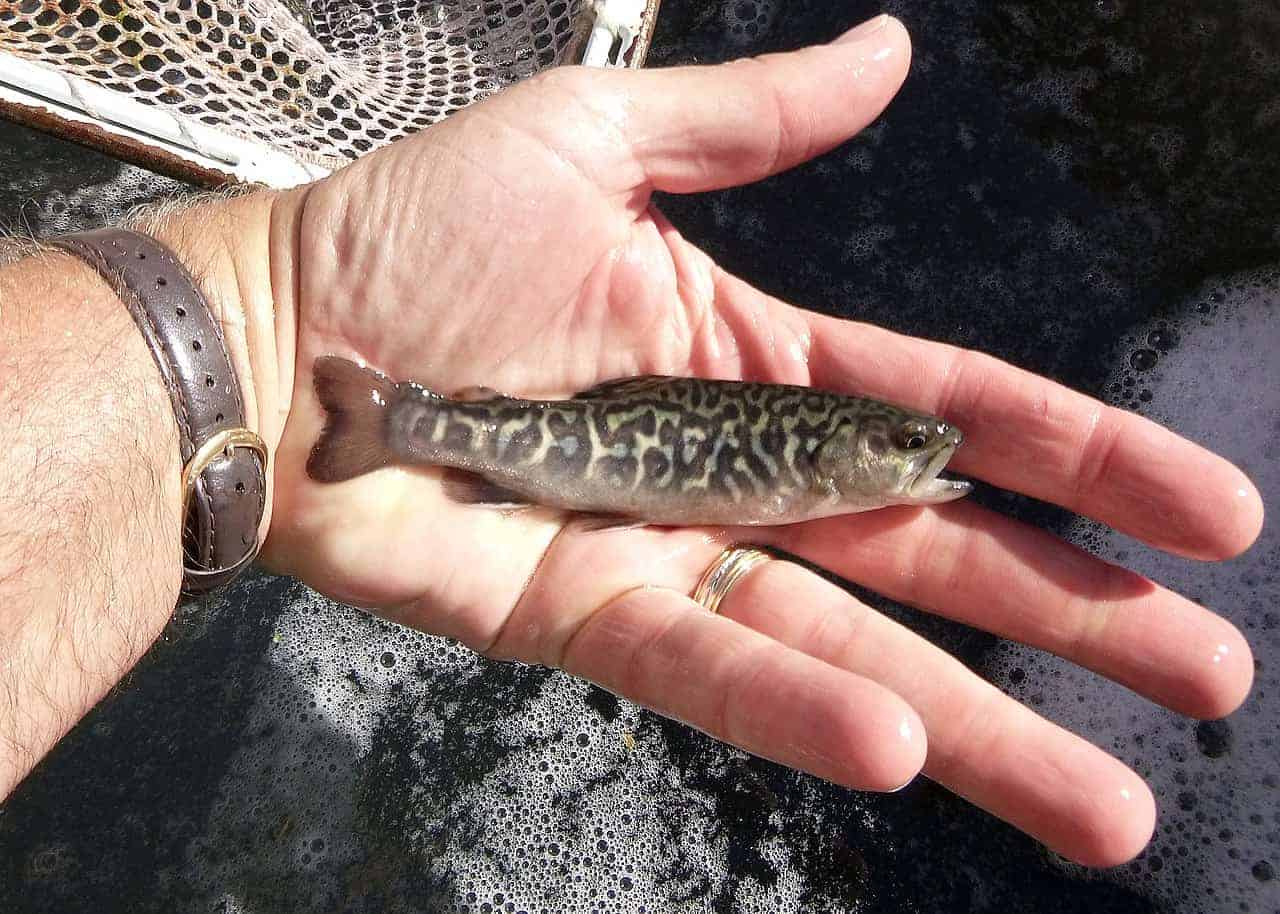
Close-up of a person holding a small fish in their hand above water, showcasing fishing catch.
A tiger trout is in a lake because somebody decided that lake needed a predator that couldn’t breed — in some waters, to eat down suckers or minnows that got out of hand. The fish on your line is a management decision with fins, and the rules attached to it are usually written for that water, not the species. I haven’t caught one, and the stocking record will help you more than any lure advice I could hand you.
At a glance · A deliberately stocked trout hybrid whose population exists only as long as management keeps replacing it
Colorado Parks and Wildlife describes its tiger trout as male brook trout × female brown trout.
Fertility
Sterile. A stocked tiger-trout fishery does not replace itself through reproduction.
Field mark
Bold maze-like or vermiculated dark markings over a lighter body; much more reticulated than either parent.
Management role
Sport fish plus controlled predator used in some lakes to consume abundant suckers, minnows, or other unwanted forage.
First planning question
Is this water currently stocked, and when was the last stocking? The population cannot rebuild itself if stocking stops.
The pattern is real; the parentage matters more
Identification & Origin
Tiger pattern
Colorado describes pronounced tiger-like stripes. In practice the pattern often reads as dark vermiculation or a maze across the flanks and back rather than the discrete spotting of a typical brown or brook trout. That makes a well-marked adult easy to recognize, although freshly stocked juveniles and poorly marked fish still deserve a careful look.
The hybrid combines brown trout, Salmo trutta, with brook trout, Salvelinus fontinalis. Pennsylvania’s 2026 propagation list recognizes tiger trout under that cross, while Colorado specifies male brook trout with female brown trout for its program.
Colorado uses tiger trout precisely because they are sterile. That sterility is not trivia: managers can add a predator without creating a self-reproducing hybrid population, then change future abundance through stocking and harvest rather than trying to remove a reproducing lineage later.
Tiger trout do not have a native geographic range in the ordinary species sense. They are hatchery-produced or exceptionally rare natural hybrids where brown and brook trout overlap. The recreational fisheries discussed here are management-created populations.
Stocking is the recruitment mechanism
A strong year class reflects hatchery production, stocking number, post-stocking survival, forage, and harvest—not a successful spawn. If a lake was stocked heavily three years ago and not since, the size distribution and catch rate should be read through that stocking history.
Colorado is evaluating tiger trout as a biological-control tool in coldwater lakes containing abundant suckers and minnows that compete with managed sport fish or contribute to water-quality problems. The appeal is a fast-growing sterile predator that can create an angling opportunity while consuming prey managers already want reduced.
A biological-control stocking plan only means something if someone keeps checking whether the suckers actually declined. Otherwise the tiger trout become the whole story and the reason they were put there quietly drops out of it.
Habitat comes from the parents, but the lake decides the layer
Cold-Water Habitat
Coldwater baseline
Tiger trout are managed as coldwater salmonids. The receiving water has to support trout physiology through the warmest part of the year; Pennsylvania explicitly requires receiving waters used for put-grow-take fingerling trout to meet trout life requirements year-round. Do not infer that a sterile hybrid is somehow freed from the oxygen and temperature limits of its parent lineages.
Cooling or newly warming surface water can expand usable shallow habitat. Points, rocky shorelines, creek mouths, weed edges, and nearshore forage can all become available when the entire upper water column falls inside a trout-friendly temperature and oxygen range.
Summer
As the surface warms, the practical search shifts toward the coolest oxygenated layer and the prey occupying it. In a stratified lake, “fish deeper” is only useful until deep water begins losing oxygen. A temperature profile plus sonar is more informative than a fixed depth recommendation.
Predation is the management point
Diet & Behavior
Predatory growth
Colorado’s program is built around tiger trout reaching predatory size quickly and consuming unwanted fish such as suckers and minnows. That supports minnow-shaped lures, streamers, small spoons, and other fish-imitating presentations once tiger trout are large enough to be piscivorous.
You’ll hear that tiger trout hit harder than either parent, as though that were a universal measured trait. Agencies value them for growth and predation, but strike willingness varies by water, prey, temperature, and individual fish. Treat aggression as an angling reputation rather than a guaranteed biological advantage.
Forage tells you where to search
In a lake stocked specifically to reduce suckers or minnows, map the prey first. Shallow forage in spring can pull tiger trout onto flats and points; suspended or deep forage in summer can move them off visible shoreline cover. The stocking goal can tell you which prey deserves priority in the search.
Fishing a fishery that exists by truck
Field Decisions
Step 1: stocking record
Confirm the lake is currently managed for tiger trout, the most recent stocking years, numbers, and fish sizes if the state publishes them. That can explain why one lake has a strong cohort of 16-inch fish while another has only scattered older survivors.
Step 2: thermal layer
During warm months, locate usable cold oxygenated water before choosing structure. During turnover or cool seasons, expand the search shallower.
Step 3: prey
Use the known prey base to choose lure size and search water. Small spoons, compact minnow plugs, jigs, and streamers are practical starting categories.
Step 4: one-variable changes
If fish are marked but not contacted, change depth, speed, or profile one at a time. The fact that a tiger trout is a hybrid does not remove the same presentation-control problem that governs ordinary trout fishing.
Harvest and conservation are management decisions
What Sterility Changes
No natural replacement
Because stocked tiger trout are sterile, every fish removed is replaced only if the managing agency stocks another one.
If releasing one, use ordinary trout handling: wet hands or a rubberized net, minimal air exposure, rapid hook removal, and additional caution during warm-water periods when coldwater fish have less physiological margin.
— · What is not established here
Don’t Fill the Hybrid With Borrowed Numbers
Species-level experimental temperature optima, dissolved-oxygen thresholds, maximum age, exact growth curves, and universal feeding periodicity didn’t turn up in strong enough tiger-trout-specific agency sources. Parent-species values should not be copied into the hybrid as though they were measured directly.
Sterility means nothing rebuilds between stockings. No wild fish are quietly filling in behind a bad year. Every tiger trout in the lake was put there on purpose, and the stocking record is about as close to population biology as this fish gets.
FEEDING ECOLOGY · STANDARDIZED
How this fish gets fed.
Primary prey
Once large enough to become piscivorous, tiger trout are managed specifically to consume fishes such as suckers and minnows. The source set does not establish a complete hybrid-specific prey inventory for younger fish.
Feeding mode / location
A cold-water predator whose feeding position follows forage: shallow points, rocky shorelines, creek mouths, and weed edges when prey is shallow; cooler oxygenated layers and suspended or deeper forage as surface water warms.
Diel / seasonal pattern
Seasonal position is better supported than a universal daily feeding clock. Cool spring and fall conditions expand shallow feeding habitat; summer stratification can compress fish and prey into a cooler oxygenated layer. A species-wide diel feeding period is not established here.
Ontogenetic diet shift
The profile supports a shift toward fish as tiger trout reach predatory size, but does not establish a sufficiently strong tiger-trout-specific juvenile diet sequence to quantify the transition.
Parent-species feeding values are not copied into the hybrid as though they were measured directly.
Choosing between a tiger trout lake and a wild-trout lake this weekend isn’t really about which fish ends up in the net. One of those fisheries gets refilled on somebody’s schedule. The other one has to pull it off by itself.
Lake FishPredominantly lake- and reservoir-centered U.S. fish profiles covering habitat, behavior, seasonal movement, fishing approaches, regional variation, and memorable biology without duplicating the River Fish cluster unless the lake fish is a distinct species, hybrid, or landlocked form. Start with Lake Fish of the United States: Species Profiles.27 articles
Species & BehaviorFish behavior, habitat, depth, forage relationships, and species-specific field decisions. Start with the Freshwater Fish Species field guide.159 articles
Cookie Consent
We use cookies to improve your experience on our site. By using our site, you consent to cookies.
Contains information related to marketing campaigns of the user. These are shared with Google AdWords / Google Ads when the Google Ads and Google Analytics accounts are linked together.
90 days
__utma
ID used to identify users and sessions
2 years after last activity
__utmt
Used to monitor number of Google Analytics server requests
10 minutes
__utmb
Used to distinguish new sessions and visits. This cookie is set when the GA.js javascript library is loaded and there is no existing __utmb cookie. The cookie is updated every time data is sent to the Google Analytics server.
30 minutes after last activity
__utmc
Used only with old Urchin versions of Google Analytics and not with GA.js. Was used to distinguish between new sessions and visits at the end of a session.
End of session (browser)
__utmz
Contains information about the traffic source or campaign that directed user to the website. The cookie is set when the GA.js javascript is loaded and updated when data is sent to the Google Anaytics server
6 months after last activity
__utmv
Contains custom information set by the web developer via the _setCustomVar method in Google Analytics. This cookie is updated every time new data is sent to the Google Analytics server.
2 years after last activity
__utmx
Used to determine whether a user is included in an A / B or Multivariate test.
18 months
_ga
ID used to identify users
2 years
_gali
Used by Google Analytics to determine which links on a page are being clicked
30 seconds
_ga_
ID used to identify users
2 years
_gid
ID used to identify users for 24 hours after last activity
24 hours
_gat
Used to monitor number of Google Analytics server requests when using Google Tag Manager
1 minute
Jetpack's built-in visitor analytics. It records page views, referring sites, search terms, and outbound link clicks, and also carries the shared visitor-tracking library used by Jetpack Instant Search and WooCommerce Analytics.