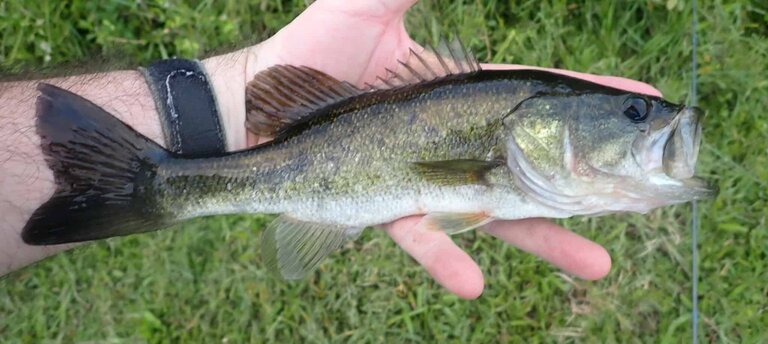
Redear sunfish crush snails with teeth in their throat, so the bottom tells you more than the weeds do. That makes the search different from chasing a bluegill school around the lake.
By HunterUpdated September 13, 2026Read 5 min
A vibrant freshwater fish, ideal for home aquariums and aquatic hobbyists.
Shellcracker is a job description more than a nickname. There are crushing teeth in this fish’s throat, and they point you at the bottom before the weeds — a shell bed doesn’t swim off the way a school does. Just don’t let that harden into thinking you need a snail on the hook. A fish built to crack shells still eats insect larvae and whatever else lives down there.
At a glance · The shellcracker is a bottom-feeding specialist, not just a bluegill one contour deeper
Scientific name
Lepomis microlophus
Field mark
Red edge on the male’s dark opercular flap, orange on females; no pumpkinseed-style blue cheek lines.
Habitat
Warm, clear, slow or non-flowing water with vegetation and mud, sand, or other bottom supporting mollusks and insect larvae.
Food
Snails and other mollusks are major prey, crushed by broad pharyngeal teeth; insect larvae and other benthic prey also matter.
Spawn
Usually late spring-early summer once water exceeds about 70 F in South Carolina; nests may be solitary or colonial.
Size
Often larger-bodied than many sunfish; one-pound fish are realistic in productive waters and much larger fish are possible.
Red on the ear flap is not enough by itself
Identification
Opercular edge
Texas and North Carolina describe a red edge on the male’s dark ear flap and an orange edge on females. The flap itself is not greatly elongated. North Carolina also notes a useful negative character: redear lack the blue cheek lines of pumpkinseed and redbreast sunfish.
Redear are deep-bodied, small-mouthed sunfish with pointed pectoral fins. Their outline can overlap bluegill enough that color and ear-flap details deserve an actual look.
The food source tells you more than “deeper than bluegill”
Habitat & Diet
Habitat
Missouri describes warm, clear water with little or no current and abundant aquatic plants; stream fish use protected bays and overflow pools instead of the main channel. South Carolina includes ponds, lakes, reservoirs, swamps, streams, and small rivers but again emphasizes slow or sluggish water and mud or sand bottoms.
The nickname is literal biology. Redear use broad, flattened pharyngeal teeth in the throat to crush snails and other mollusks. That lets them exploit benthic food that many neighboring sunfish use less efficiently.
Mollusks dominate the story, but benthic insect larvae and other bottom organisms also contribute. The field translation is broader than “find snails”: locate the weed edge, shell bed, hard-soft substrate transition, or bottom zone supporting benthic prey.
Reproduction can make shallow water lie about the rest of the year
Spawning
Temperature and season
South Carolina reports spawning once water is above about 70 F, usually late spring to early summer. Missouri records May-June nesting and sometimes another August nesting period. Latitude and local temperature shift the window.
Redear can nest alone or in groups ranging from a few nests to large colonies. South Carolina reports nests from roughly six inches to several feet deep over sand, gravel, or mud; males guard and aerate eggs after spawning.
Forty-five thousand eggs sounds like abundance until you remember it’s one report’s ceiling, not the fish in front of you. A spring bed found in two feet of water doesn’t say where that same fish sits in August.
How to find them after the beds disappear
Seasonal Field Decisions
Spring
Shallow colonies make the fish conspicuous and vulnerable. Work the outer edge of bedding areas before walking directly over nests. A concentration in two feet of water during spawning is not evidence that the same adults spend July there.
Summer
Follow benthic food and vegetation into deeper water. Outside weed lines, shell-bearing flats, points with vegetation, and the first firm-bottom break adjacent to spawning shallows are better starting points than simply adding an arbitrary number of feet to the bluegill depth.
Fall and winter
As vegetation dies back and water cools, intact deep weed edges, bottom transitions, and stable basin margins gain value. The fish remains tied to food-bearing bottom, but the exact depth is lake-specific.
Presentation
Fish the Bottom Without Burying the Bait
Natural bait
Worms, small crustaceans, and other legal natural baits on light tackle match the diet well. Keep the offering close to bottom, but use enough buoyancy or a short leader to avoid disappearing into soft silt.
Artificial
Small jigs, nymphs, and compact bottom presentations can work when moved slowly through the feeding zone. A redear is not required to believe a lure is literally a snail; it does need to encounter it where benthic prey is being used.
Daylight
Missouri describes redear as most active during daylight. That separates them from the bullhead-style night pattern and makes visual habitat reading, depth control, and bottom composition useful throughout the day.
Redear have been widely stocked in ponds and reservoirs for angling and biological use of mollusk-rich forage. Missouri notes natural populations in the southern half of the state but extensive stocking elsewhere; North Carolina now reports them common across the state except cold mountain water.
When a redear spot goes quiet, I’d look at the bottom again before deciding the fish moved. Food that stays put is a rare advantage with a sunfish, and it’s worth using up before you start searching the whole lake.
FEEDING ECOLOGY · STANDARDIZED
How this fish gets fed.
Primary prey
Snails and other mollusks are major prey, supplemented by benthic insect larvae and other bottom invertebrates.
Feeding mode / location
A bottom-oriented forager that uses broad pharyngeal teeth to crush hard prey. Productive feeding habitat includes shell beds, weed edges, firm-to-soft transitions, and bottom zones rich in mollusks and insect larvae.
Diel / seasonal pattern
Missouri describes redear as most active during daylight. Spring spawning can pull adults shallow; after spawning, benthic food and vegetation commonly lead fish toward deeper weed edges, shell-bearing flats, and other stable bottom habitat.
Ontogenetic diet shift
The sources behind this page don’t cover it.
Only documented feeding biology is summarized here; unsupported bite windows are left out.
Lake FishPredominantly lake- and reservoir-centered U.S. fish profiles covering habitat, behavior, seasonal movement, fishing approaches, regional variation, and memorable biology without duplicating the River Fish cluster unless the lake fish is a distinct species, hybrid, or landlocked form. Start with Lake Fish of the United States: Species Profiles.27 articles
Species & BehaviorFish behavior, habitat, depth, forage relationships, and species-specific field decisions. Start with the Freshwater Fish Species field guide.159 articles
Cookie Consent
We use cookies to improve your experience on our site. By using our site, you consent to cookies.
Contains information related to marketing campaigns of the user. These are shared with Google AdWords / Google Ads when the Google Ads and Google Analytics accounts are linked together.
90 days
__utma
ID used to identify users and sessions
2 years after last activity
__utmt
Used to monitor number of Google Analytics server requests
10 minutes
__utmb
Used to distinguish new sessions and visits. This cookie is set when the GA.js javascript library is loaded and there is no existing __utmb cookie. The cookie is updated every time data is sent to the Google Analytics server.
30 minutes after last activity
__utmc
Used only with old Urchin versions of Google Analytics and not with GA.js. Was used to distinguish between new sessions and visits at the end of a session.
End of session (browser)
__utmz
Contains information about the traffic source or campaign that directed user to the website. The cookie is set when the GA.js javascript is loaded and updated when data is sent to the Google Anaytics server
6 months after last activity
__utmv
Contains custom information set by the web developer via the _setCustomVar method in Google Analytics. This cookie is updated every time new data is sent to the Google Analytics server.
2 years after last activity
__utmx
Used to determine whether a user is included in an A / B or Multivariate test.
18 months
_ga
ID used to identify users
2 years
_gali
Used by Google Analytics to determine which links on a page are being clicked
30 seconds
_ga_
ID used to identify users
2 years
_gid
ID used to identify users for 24 hours after last activity
24 hours
_gat
Used to monitor number of Google Analytics server requests when using Google Tag Manager
1 minute
Jetpack's built-in visitor analytics. It records page views, referring sites, search terms, and outbound link clicks, and also carries the shared visitor-tracking library used by Jetpack Instant Search and WooCommerce Analytics.