Nobody can look at a grass carp and tell a sterile stocked fish from one that can breed, which is why the law shows up before the fishing does. The weeds they eat are also somebody else’s habitat.
By HunterUpdated September 12, 2026Read 6 min
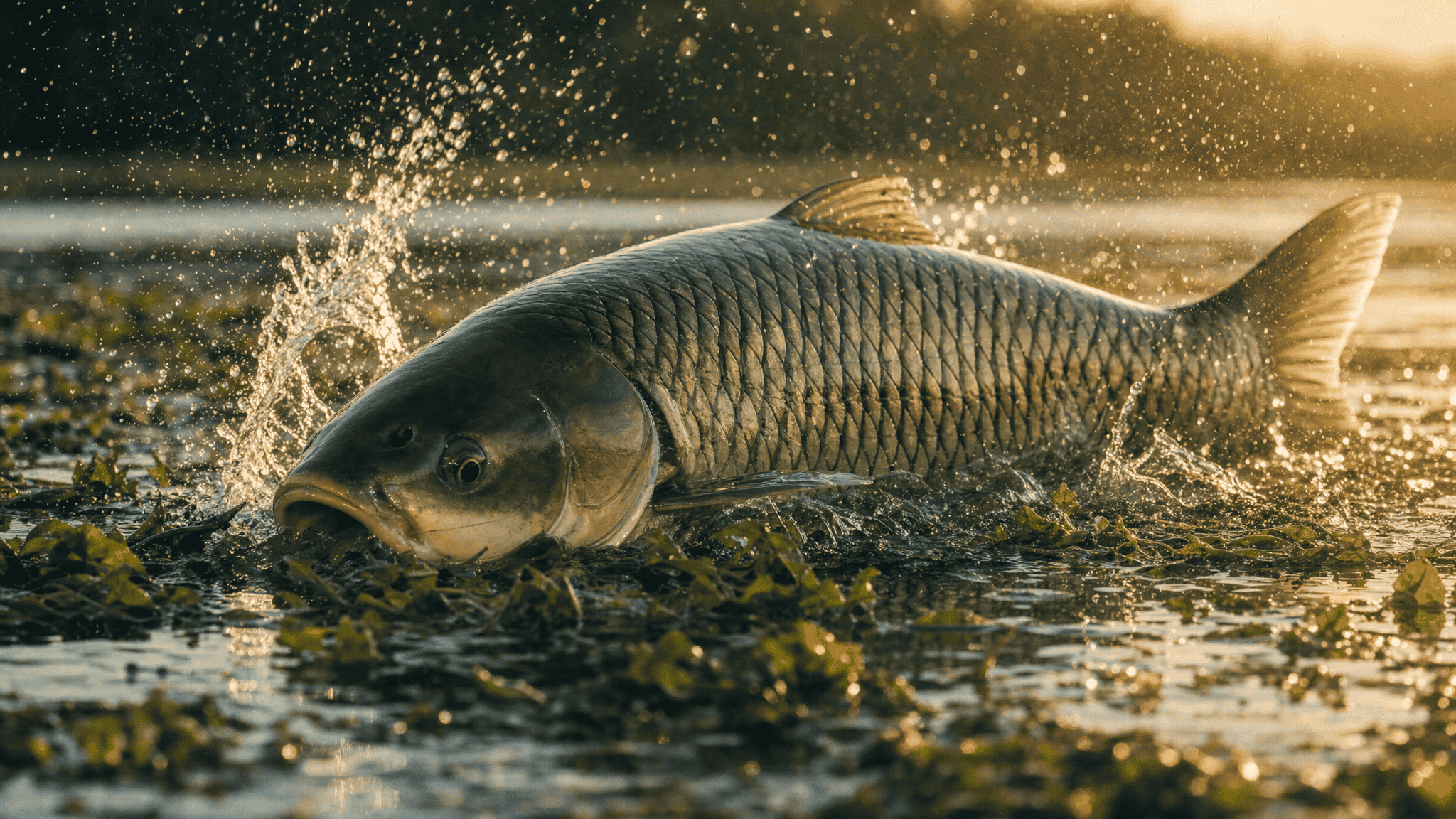
Image: weedy lake surface feeding
With most big fish the first question is how to catch one. With grass carp it’s what you’re allowed to do with it. They get stocked to eat weeds, they’re usually required to be sterile triploids, and in a lot of places what happens to one — including whether it can be moved or put back — is set by law instead of left to your judgment. Sort out the ploidy question before you think about tackle, because that’s the order the decisions come in.
This is not a common carp without barbels
Identification
Grass carp
USGS describes a laterally compressed, olive-brown to silver fish with a wide head, terminal mouth, small low-set eyes, no barbels, and large scales edged darkly. The dorsal fin is short, usually with only 7-8 rays.
Common carp have mouth barbels and a much longer dorsal fin. Grass carp lack barbels completely. A large torpedo-shaped fish cruising a weed flat should therefore be checked at the mouth and dorsal rather than labeled “carp” generically.
There is no reliable visual field mark separating fertile diploid grass carp from functionally sterile triploid grass carp. USGS states genetic/ploidy testing is necessary. That means an angler cannot look at a fish and infer whether it was a certified management stocking.
At a glance · A vegetation-control fish whose ploidy matters more than its enormous size
Scientific name
Ctenopharyngodon idella
Family
A very large minnow/cyprinid—not a common carp and not one of the filter-feeding silver/bighead carps.
Field marks
Wide head, terminal mouth, no barbels, low-set small eyes, large dark-edged scales, and a short dorsal fin with only about 7-8 rays.
Habitat
Quiet lakes, ponds, river pools and backwaters; shallow water in warm seasons, with deeper use as water cools.
Management form
Many U.S. programs require sterile triploid grass carp for vegetation control. Diploid and triploid fish cannot be distinguished reliably by appearance.
Core risk
At excessive density, plant removal can restructure littoral habitat, food webs, water clarity, spawning cover, and oxygen dynamics.
The fish was imported to change vegetation on purpose
Introduction & Management History
United States introduction
Grass carp were first imported to the United States in 1963 for aquaculture and aquatic-vegetation control. Escapes and authorized or unauthorized stockings subsequently moved the species through river systems and reservoirs.
The U.S. Fish and Wildlife Service runs a national inspection and certification program for triploid grass carp. Triploids carry three chromosome sets rather than the normal two, preventing normal reproduction. Many states restrict legal stocking to certified triploid fish because the same feeding behavior that controls nuisance plants can damage natural aquatic habitat if a reproducing population establishes.
USFWS certification depends on producer testing and inspection of identified lots. It is not something a private owner or angler can establish from a photograph, receipt description, or body shape after the fish is in the lake.
USGS places grass carp primarily in lakes, ponds, pools, and backwaters of large rivers. Individuals often use shallow water when temperatures support feeding and move deeper as conditions cool.
Adults often show limited routine movement outside spawning migrations, but USGS summarizes reports of juveniles moving hundreds of kilometers, including extreme movements near 1,000 km from spawning grounds. A grass carp population cannot be managed as though every fish stays inside the pond or reservoir where it was first noticed.
USGS summarizes a preferred temperature around 25.3 C in experimental work, feeding declining sharply below roughly 14 C, and broad survival tolerance across much wider temperatures. Those are laboratory and synthesis values, not a claim that every lake’s fish will feed best at exactly one number.
Don’t rule a grass carp out just because the nearest stocking you know about is a long way off. USGS summarizes reports of juveniles moving hundreds of kilometers, a few close to 1,000. Distance won’t settle where a fish came from — the stocking and certification records are the only thing that gets close.
“Vegetarian” is real, but the ecosystem effect is indirect and large
Feeding & Habitat Change
Aquatic plants
Grass carp are managed specifically because they consume large quantities of aquatic vegetation. The problem is selectivity: USGS notes they can prefer native plants over the target nuisance species. A stocking intended to open one weed-choked cove can therefore remove habitat the manager meant to keep.
Removing vegetation changes much more than plant biomass. USGS summarizes reduced structured littoral habitat, altered invertebrate communities, loss of fish food and spawning substrate, changes in bluegill habitat, increased nutrients from waste and plant decay, algal blooms, reduced clarity, and oxygen effects in some stocked systems.
The ecological difference between useful vegetation control and habitat simplification can be stocking density. This is why grass carp are a fisheries-management tool rather than a species that should be casually added to private or connected water.
Angling
Stealth Before Tackle
Locating fish
In warm weather, large fish can be seen cruising shallow weed edges, points, and open pockets. Because they often feed without the explosive strike behavior of predatory carp-sized fish, observation and approach can matter more than covering water quickly.
Conventional presentations
Where hook-and-line fishing is legal, anglers use plant- and grain-based baits, bread-like offerings, and other compact natural foods. Those are angling conventions rather than evidence that one bait is biologically “correct.”
Tackle
Use enough rod, line, and drag capacity to control a large powerful fish without an unnecessarily prolonged fight, while keeping terminal tackle unobtrusive enough for clear shallow water. The exact setup depends on fish size, vegetation, and legal method.
The law comes first with this fish, and there isn’t a softer way to say it. Once that’s settled you’ve got a big, wary vegetarian cruising a weed edge, which is a better fishing problem than it sounds like. I haven’t fished for grass carp myself, so I’m not about to hand you a secret bait recipe.
— · Sources
FEEDING ECOLOGY · STANDARDIZED
How this fish gets fed.
Primary prey
Aquatic macrophytes and other plant material dominate the adult diet; grass carp can also consume filamentous algae and incidental animal material while grazing.
Feeding mode / location
A grazing herbivore that feeds heavily in shallow vegetated margins, ponds, lakes, backwaters, and river pools when plant growth and temperature support active feeding.
Diel / seasonal pattern
Seasonal temperature is strongly relevant: feeding falls sharply below roughly 14°C in the cited synthesis, while warm seasons support more shallow grazing and cooling water shifts fish deeper. No universal daily feeding clock is established.
Ontogenetic diet shift
Larvae and small juveniles begin on zooplankton and small animal prey, then shift strongly toward aquatic vegetation as the digestive system and body size develop.
The experimental preferred temperature near 25.3°C remains a thermal-preference value, not a promise that every fish feeds best at exactly that number.
Lake FishPredominantly lake- and reservoir-centered U.S. fish profiles covering habitat, behavior, seasonal movement, fishing approaches, regional variation, and memorable biology without duplicating the River Fish cluster unless the lake fish is a distinct species, hybrid, or landlocked form. Start with Lake Fish of the United States: Species Profiles.27 articles
Species & BehaviorFish behavior, habitat, depth, forage relationships, and species-specific field decisions. Start with the Freshwater Fish Species field guide.159 articles
Cookie Consent
We use cookies to improve your experience on our site. By using our site, you consent to cookies.
Contains information related to marketing campaigns of the user. These are shared with Google AdWords / Google Ads when the Google Ads and Google Analytics accounts are linked together.
90 days
__utma
ID used to identify users and sessions
2 years after last activity
__utmt
Used to monitor number of Google Analytics server requests
10 minutes
__utmb
Used to distinguish new sessions and visits. This cookie is set when the GA.js javascript library is loaded and there is no existing __utmb cookie. The cookie is updated every time data is sent to the Google Analytics server.
30 minutes after last activity
__utmc
Used only with old Urchin versions of Google Analytics and not with GA.js. Was used to distinguish between new sessions and visits at the end of a session.
End of session (browser)
__utmz
Contains information about the traffic source or campaign that directed user to the website. The cookie is set when the GA.js javascript is loaded and updated when data is sent to the Google Anaytics server
6 months after last activity
__utmv
Contains custom information set by the web developer via the _setCustomVar method in Google Analytics. This cookie is updated every time new data is sent to the Google Analytics server.
2 years after last activity
__utmx
Used to determine whether a user is included in an A / B or Multivariate test.
18 months
_ga
ID used to identify users
2 years
_gali
Used by Google Analytics to determine which links on a page are being clicked
30 seconds
_ga_
ID used to identify users
2 years
_gid
ID used to identify users for 24 hours after last activity
24 hours
_gat
Used to monitor number of Google Analytics server requests when using Google Tag Manager
1 minute
Jetpack's built-in visitor analytics. It records page views, referring sites, search terms, and outbound link clicks, and also carries the shared visitor-tracking library used by Jetpack Instant Search and WooCommerce Analytics.