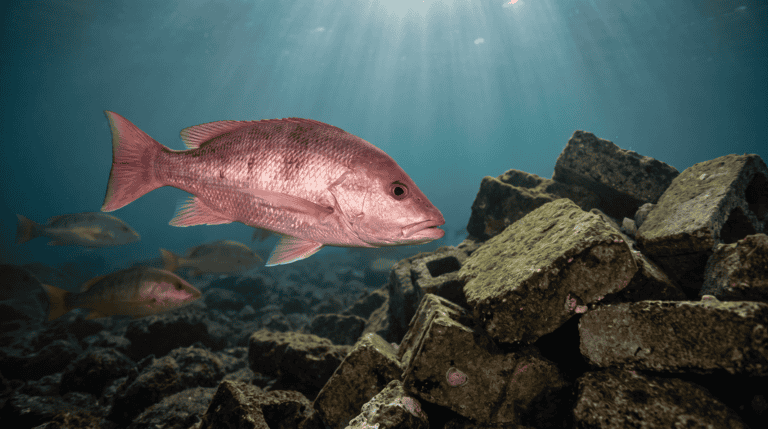
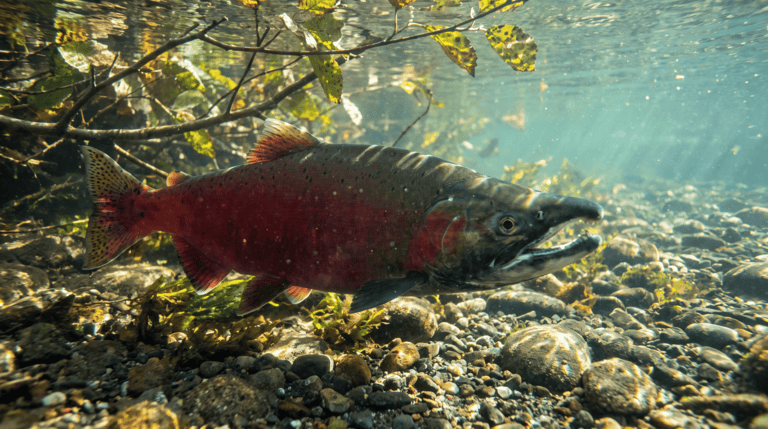
The third time the same undersized rockfish comes up on the same drop, it isn’t bad luck anymore. Something about the spot, the depth or the bait keeps putting that fish on your hook, and reeling it up faster doesn’t change the answer.
FIELD PLATE · AFTER WE LEAVE
Tackle that leaves the boat does not stop working.
That’s bycatch at its smallest. The full definition covers a lot more: the unintended catch of non-target fish, marine mammals, sea turtles, seabirds and other animals during fishing. Some of it goes back alive. Some gets injured or killed. How much, and how bad, depends heavily on the fishery, gear, location, season, species and handling.
Which turns gear design into an ecology question. Can a method keep catching what it’s after while catching less of everything else?
One word for a lot of different problems
A small undersized fish released from hook-and-line gear isn’t the same problem as an endangered sea turtle caught in commercial gear. A seabird hooked during a longline set isn’t the same as a non-target fish passing through a trawl. The word is broad, and the fixes have to be specific or they don’t fix anything. That’s why useful bycatch reporting breaks out species, number, condition, gear, effort and outcome instead of burying everything inside one percentage.
Change the encounter first
Managers and fishing crews cut bycatch by changing where, when or how gear fishes. A seasonal closure can avoid a migration, and a depth change can separate species that overlap. Bait and hook changes shift what interacts with the gear in the first place. Acoustic devices, streamer lines, weak links, escape panels and other tools can reduce specific risks in specific fisheries. No device works everywhere — the point is figuring out why the wrong animal keeps meeting the gear and breaking that pathway.
The cleanest reduction is usually never having the encounter at all. If a protected species is concentrated in one area or depth, moving the gear can do more than improving release after the fact. If a bait keeps drawing the wrong species, changing bait beats getting quicker at handling the same unwanted catch. Roughly, the order goes: avoid the encounter when you can, reduce capture when avoidance is incomplete, reduce injury when capture still happens, and improve release once the animal reaches the deck, the net or your hand. Different fisheries come into that sequence at different points, but the logic holds for all of them.
Build it into the gear, then count
Turtle excluder devices
In shrimp trawl fisheries, a turtle excluder device uses a grid and an escape opening so sea turtles and other large animals get out while shrimp keep moving into the cod end. NOAA and the fishing industry built and refined these over decades, not overnight. It’s conservation designed into working gear instead of bolted on after the catch is already on deck.
It also only works because it keeps enough target catch and practicality that crews actually use it. Conservation gear that fails at the fishery’s main job doesn’t survive outside a demonstration.
Somebody has to count
Bycatch management depends on knowing what gets caught. At-sea observers, logbooks, cameras, vessel monitoring, port sampling and scientific surveys all contribute. Monitoring isn’t perfect — coverage can be incomplete and methods can skew estimates — but a fishery can’t reduce a problem it refuses to measure. Good data can also show that a feared problem is smaller than assumed, or concentrated in a narrower season, area or gear setup than anybody expected.
Fishing effort belongs in the denominator
A raw count of unwanted animals can sound alarming or reassuring without saying how much fishing produced it. Ten interactions during ten sets and ten interactions during ten thousand sets are completely different problems. Managers look at rates by unit of effort, location, season, vessel, target catch or gear type to find where the problem is concentrated.
That doesn’t make a rare interaction unimportant when the species is highly vulnerable. It makes the evidence specific enough to design a response instead of guessing.
“Released” isn’t “survived”
Watching a fish go back over the rail feels like the end of the story. It isn’t automatically a win. Hook injury, barotrauma, exhaustion, temperature, handling, predation and time out of water can all affect survival. That’s why some fisheries use descending devices, handling requirements, release gear and other practices built around the biology of the species involved.
The first time you clip a descending device onto a rockfish with its eyes bulging, it feels a little like doing surgery with a coat hanger. It gets less awkward quickly, and the tool was built for exactly that fish’s problem.
Survival is also hard to see from the boat. An animal that swims off strong can still die later, and one that looks stressed can recover. Researchers use tagging, telemetry, holding studies, observer data and other methods to estimate what survival looks like after release, which is why handling advice should come from species-specific evidence and not from how confident the release looked. “It swam away” is an observation. “It survived” is a much bigger claim.
Cleaner catch can be better business
Unwanted catch takes time to handle, can damage gear, burns bait and fishing effort, and can force closures when protected-species interactions climb too high. Gear that selects the target better can help conservation and the fishing operation at the same time. That doesn’t erase every tradeoff — more selective gear can cost money or change target catch rates — and the designs that stick around are the ones that work in the real fishery, not only on a diagram.
On a rod and reel
Recreational bycatch is usually smaller in scale than a major commercial fishery, but the logic doesn’t change. Know the likely species before you start, use tackle that fits both the target and the current gear rules, have release tools ready, and change location or method when protected or unwanted species keep showing up.
That rockfish on the third drop is the whole lesson. Doing the identical thing faster isn’t conservation; it’s the same encounter with better technique. Repeated deep-hooking may call for a different hook, bait presentation, strike timing or spot. Repeated encounters with a protected species can mean the responsible move is to stop fishing that area.
Let evidence decide, not disgust
Pictures of unintended catch can be upsetting. Management still needs fishery-specific evidence to act on: how often the interaction happens, which species, what fraction survive, which gear change reduces it and what that change does to the target fishery. None of those questions excuse avoidable mortality. They make the response more likely to work instead of merely feeling decisive.
Technology helps when it changes the encounter
Cameras, sensors, electronic monitoring, better mapping and real-time communication can all improve bycatch data. The step that matters more is using that information fast enough to change what boats do. If a fleet can identify where a vulnerable species is concentrated and safely avoid that area, information becomes a selective tool. If the cameras only make a more detailed record of the same interaction happening again, the conservation benefit stops there. Measurement that never changes a decision is just paperwork with a lens on it.
How selective can it get?
Fishing will never be perfectly selective. Hooks, nets, lines and traps sit in water full of moving animals that don’t follow our labels. The standard can still improve: better gear can let the wrong animal out before capture, skip the encounter altogether, reduce injury or make release faster.
Gear that keeps fishing after everybody’s gone home is its own problem, and The Line Is Still Fishing After We Leave gets into it. Stewardship runs the same avoid-harm-first thinking through ordinary angling.
So when somebody pitches a new piece of fishing technology, the first thing I’d want to know is whether it helps catch what the fishery’s allowed to catch while leaving more of everything else alone. The spec sheet usually skips that part.