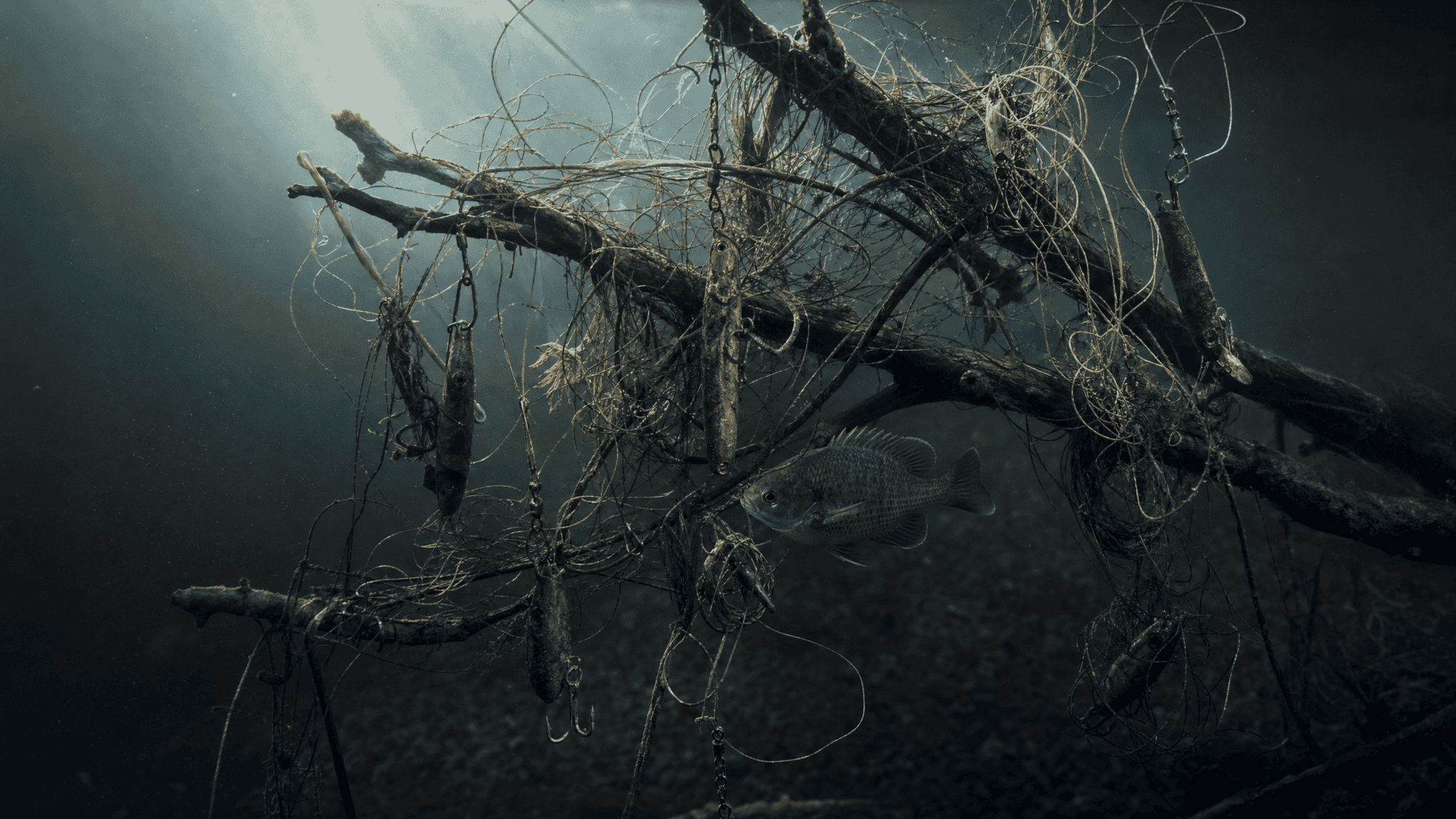
You hang a jig on a log, pull, and the line pops somewhere up near the rod tip. You grumble, tie on another one, and the day moves on. The line still wrapped around that log doesn’t go home when you do.
FIELD PLATE · AFTER WE LEAVE
Tackle that leaves the boat does not stop working.
If a hook’s still on it, the hook can stay baited. A loop can tighten around a bird’s leg, a turtle, a fish or something bigger. Scale it up to a lost net or trap and it can keep catching animals with nobody around to check it. NOAA calls that ghost fishing, which is one of the few official terms that sounds exactly like what it is.
Not every lost rig is the same problem
A short piece of mono lying on clean bottom isn’t the same risk as a baited hook, line hanging in shoreline brush, or a commercial net nobody’s tending anymore. What matters is the kind of gear, where it ended up, what it’s made of, whether hooks or bait are still attached, and how long it sticks around.
“Never lose anything” isn’t a real standard for anybody who fishes near cover. The one you can actually hit is losing less than you have to, and making sure whatever you can safely get back ends up in a trash can instead of the lake.
Mono hides, braid hangs on
Clear mono is close to invisible in water and brush, which is the whole point while it’s tied to your lure and the whole problem once it isn’t. Birds get it around a leg or a wing. Turtles and fish can run into loops or hooks long after the break-off.
If nobody local recycles line, cut leftovers into short pieces for the trash, and keep them contained instead of loose in an open boat compartment. Line-recycling bins at marinas, tackle shops, parks and piers say what they take, so read the label — a lot of them are built for monofilament and don’t want braid, hooks or mixed tackle.
Braid has the opposite trouble. It’s thin and strong, and those same traits make an abandoned wad of it hard to break and slow to go anywhere. A ball of braid around a branch, piling or prop doesn’t turn harmless because it was great line on the reel. Pull badly wrapped braid when that’s safe and legal. If the snag’s out of reach, getting it back isn’t worth a fall, a drowning risk, a boat collision or a trespassing problem.
Know where your rig breaks
When something fails, rig design decides what stays behind. If the weak point is predictable, a break costs you a short leader and a lure. If it lets go farther up, a long section of line stays tied to the snag.
That’s not an argument for line too light for the job. Strength still has to match the fish, the cover, the current and landing fish efficiently. It’s an argument for knowing where your setup is likely to give. Retie scuffed leaders, replace damaged line, and check any connection that’s been dragged through wood or rock. A break-off you could have prevented costs tackle and leaves more junk in the water.
And if the same cast has already eaten three rigs, tying on a fourth isn’t persistence. It’s inventory for the bottom. Change the angle, the weight, hook orientation, cast length, the lure or the approach. Sometimes a fish really is worth working around a log for, and the route you picked to get to it can still be wrong. Conservation and catching more fish want exactly the same thing here.
Piers show it in miniature
Put a lot of people on one fixed casting spot and cut line piles up around the railings, pilings, rocks and whatever trees are close. The fix is boring: a cut leader goes straight into a pocket or container, not on the deck “for later.” Hooked bait doesn’t get left beside the cleaning table. A tangle that’s miserable to pick apart still goes in the trash or the recycling tube, not over the rail. Five seconds of that keeps the wind, wildlife or the next person’s shoe from moving the problem somewhere else.
Line almost never leaves alone, either. It takes hooks, swivels, sinkers, lures, soft plastics, beads or bait with it. When you can get a snagged rig back safely, bring in the whole thing rather than clipping the line and leaving a bare hook for a person or an animal to find. Sinkers and jigs are a problem of their own, and the lead tackle and loons piece picks that one up.
If the line you recover is wrapped around a hurt animal, it can get beyond you quickly. When it needs more handling than you can do safely and legally, call the wildlife agency or a permitted rehabilitator.
Before you leave, look over the bank, deck, pier or shoreline once and pick up cut line, leaders, hooks, bait containers and lure packaging. Empty pockets and compartments into an actual trash or recycling container before loose stuff can blow out later. If a backlash or wind knot made you cut line during the day, check the spool too. Loose coils have a talent for turning up somewhere they were never supposed to go. It’s about as unglamorous as stewardship gets, which is exactly why it’s easy to skip.
Nets and traps are a different league
Nets, traps, pots and long sections of line can keep capturing or tangling animals after anybody’s actively fishing them, which is why NOAA treats abandoned, lost and discarded gear as a serious marine-debris problem. Commercial and recreational gear aren’t close in scale or regulation. The mechanism is the same, though — gear nobody’s watching can still trap or entangle wildlife — and that’s why marking, retrieval, reporting and disposal rules matter wherever they apply.
Finding one doesn’t make it your job to haul it up. A net, trap, rope or mass of line can be heavy, hooked, under tension, wrapped around structure, or tied to something below the surface you can’t see. Don’t improvise a recovery that puts your hands near loaded hooks, wraps your prop or drags the boat into current. In some places lost commercial gear is regulated property that should be reported, not pulled up by somebody untrained, so follow the local agency’s current instructions. Less abandoned gear is the goal. A second emergency isn’t.
What I’d want from the next generation of tackle
Gear gets sold on strength, sensitivity, durability, action and how many fish it catches. The question nobody prints on the box is what happens once it isn’t attached to anyone. Could a breakaway component leave less line behind? Could a trap stop fishing after it’s lost? In regulated fisheries, can retrieval systems or biodegradable escape features cut long-term capture? Can materials get collected and recycled where most of the discarding happens?
No single fix suits every fishery. Tackle keeps getting stronger, lighter, more specialized and more durable, and durability is great right up until the gear’s abandoned — then the same property works against everything that swims into it. The upgrade I’d actually get excited about is gear built for recovery and safer failure that fishes every bit as well while it’s still in your hands.