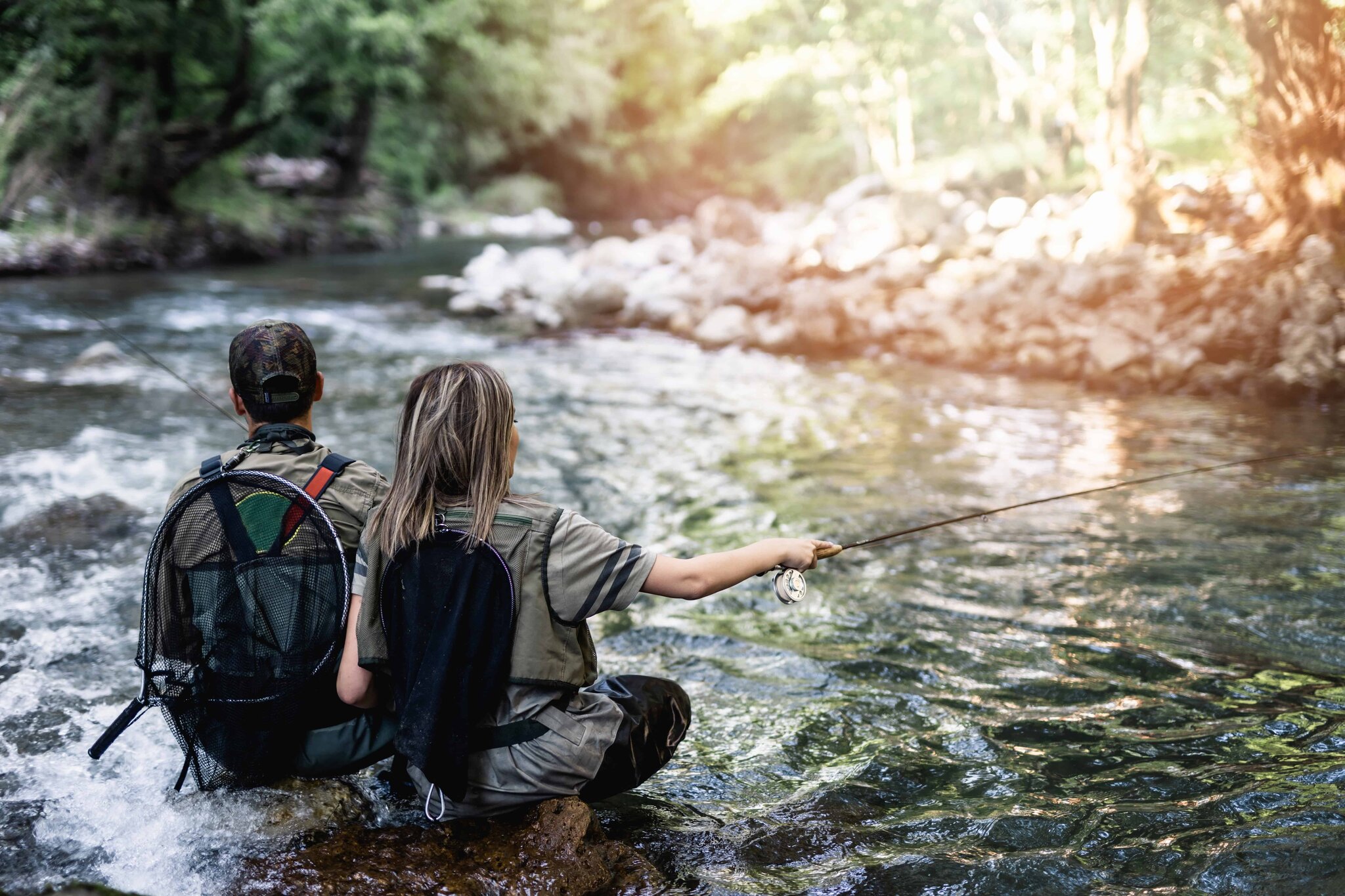
Two anglers in one fast run need a single positioning plan: who moves and who holds, whose lane is whose, how you’ll actually talk over the water, and what happens when a fish or a bad step rearranges all of it. Without that, it’s two people six feet apart quietly fishing different rivers.
A pair really does cover fast water better than one person. We can compare lanes, watch each other’s drift, help with a landing, and point out the piece of current the other one’s been staring directly through for fifteen minutes without seeing it.
We can also cross lines, stand in the only good step, push each other into worse footing, and each spend an hour correcting for drag the other one’s line is helping create. Current takes a small misunderstanding and moves it downstream while both of us are still working out what happened.
I read the pair before I read the run
I start with the two of us, not the best-looking seam — how comfortable each person is standing in current, how well they control a cast, and what kind of help they’d actually want. The stronger angler doesn’t automatically get the best position. Usually the stronger angler is the one with the most room to adapt around somebody else.
Then I say out loud what the session’s actually for. Teaching a new drift, testing two presentations, or just fishing next to a friend all want different spacing. Two people can’t coordinate when one thinks this is a lesson and the other’s quietly entered a tournament nobody announced.
I get the specifics settled on the bank first: the first two positions, each casting lane, who moves first, the calls we’ll use, where a fish gets landed and who takes the net, and what ends the session. It costs a minute, and it’s the last easy conversation either of us will have until we’re both back out of the water.
Lanes
Fast water is rarely one uniform conveyor belt. There’s the main push, the softer edges and seams, pockets behind structure, shallow shelves, deeper slots, and places where a quick surface hides slower water underneath or beside it.
We set up so each of us works a distinct lane without dragging line across the other’s drift. If both presentations keep landing in the same useful water, we’re not covering more river — we’re just running a small traffic problem with hooks in it.
The two positions do different jobs. Whoever’s upstream is usually better placed to work a near seam, feed a controlled drift, and watch water heading toward the other person. Whoever’s downstream can often see line belly, the tail of the run, and fish that moved because of the first presentation. Neither role is permanent. We rotate when the water, the wind, the footing, or the point of the session changes, and I recheck the arrangement after every real move.
One moves, one holds
Any new position that means wading, climbing, stepping around rock, or crossing behind a casting lane happens one person at a time. Whoever stays put watches the footing, the loose line, and anything coming down from upstream.
Both people moving at once removes the stable reference. It also makes a sudden problem much harder to read, because now it could be the current, the footing, the line, or the fact that we both picked the same rock at the same moment.
Short calls that need an answer
Fast water erases normal conversation. I keep a small set of clear calls — moving, casting, crossing behind, fish on, net ready, stop, leaving — and I want an answer back before any move that changes spacing or puts someone inside another casting lane.
A nod only works if the other person’s actually looking, and a shout only works if you both heard the same word. Communication out here should be boringly obvious. The river’s already got plenty of personality on its own.
The lane comes before the cast
Each of us needs room for the rod path, the line, the backcast where that applies, and the recovery after a cast that went wrong. I check the lane every time spacing changes. A safe lane goes bad when one person steps higher on the bank, drops downstream, lengthens line, or switches from a compact cast to a wide one.
I don’t fix a cramped lane by asking the less experienced person to cast more precisely under pressure. I move somebody instead. Technique should be buying better fishing, not covering for a layout that never made sense in the first place.
We compare one thing
Two rods can test a real contrast: higher and lower in the water, near seam and far seam, a bigger and smaller profile. We pick one. We fish it long enough that the result actually means something, and we tell each other what the presentation’s doing down there.
Change depth, weight, pattern, distance and position every cast between the two of us and we’ve doubled the activity and produced no evidence at all. The second rod earns its place a different way anyway: a partner can see line belly, drag building downstream, a following fish, or a route to softer water that the person facing upstream is never going to notice.
I keep that feedback short and pinned to something visible. The line’s crossing the seam early. The drift accelerates below the rock. I save the full casting biography for when my partner isn’t still trying to stand up.
I sort out the landing early
We decide who takes the net, where a fish can be guided out of the strongest current, which bank or shelf has stable footing, and how loose line stays clear of both of us. I confirm the net, the tools, and the legal retention or release plan are all within reach before it matters.
When a fish is hooked, whoever’s fighting it calls the direction it’s moving. The other person clears line and moves only once the route’s understood. Running downstream with a net looks committed right up until it turns into an equipment demonstration for gravity.
I help without taking over
Teaching in fast water should be removing decisions, not adding them. One instruction, then I let the angler feel the result. Constant correction makes it impossible for anyone to separate the current from the tackle from their own body position from the voice behind them.
I ask before taking the rod, changing the rig, or moving the other person. Help should leave the angler’s understanding of what happened intact — otherwise the lesson is just that the setup works whenever somebody else takes over.
When you’re the one standing in the push, feeling slow while your partner crosses rocks you’re still testing with one boot, that’s not you failing at this. Current makes everybody slow for a long while. Say so when the pace is too fast. Anybody worth fishing with will be glad you did.
When we close the gap
We come back together when the water gets loud enough that calls stop being reliable, when the light or the footing goes, when the current rises, or when one of us is cold or worn out. Same thing if the route back is uncertain, or the next position needs a move the other person can’t watch from where they’re standing.
Two anglers aren’t safer just because there are two of them. We’re safer while each of us can still see, hear, and reach the other. Past that distance we’re just sharing a parking spot.
Fast water makes position part of the presentation, and with two rods in it, position becomes something we own together. The run gets covered because one of us steps and the other already knows why.
Part of Field Library.