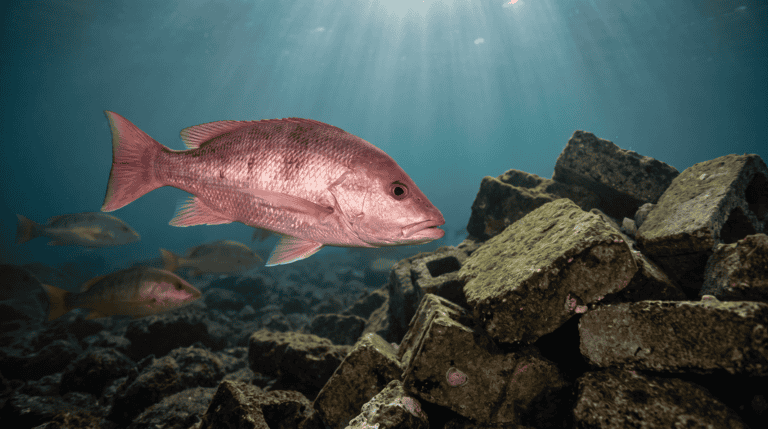
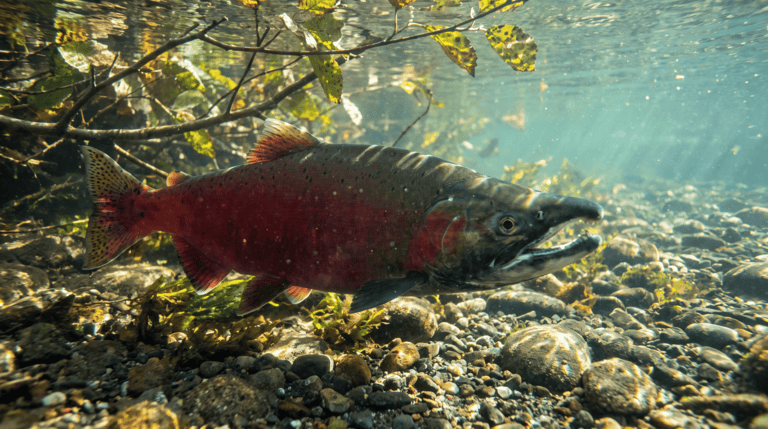
The fish is in the net, it fought like it had somewhere better to be, and the water it came out of is clear enough to count rocks on the bottom. None of that tells you whether there’s PFAS in the fillet.
SYSTEM PLATE · WHAT BUILDS UP
Dilute in the water, concentrated in the fish.
Most water problems leave something to look at. Trash piles up in the eddy, a storm turns the river brown, dead fish float. PFAS can move through water and up the food web without leaving a sign anybody can reliably read from the bank, which is an annoying thing to run into when reading the bank is most of what you do all day.
What I’m worried about isn’t today’s bite. It’s whether, twenty or thirty years from now, landing a fish still comes with the ordinary choice — release it, keep it, eat it — without a chemistry degree attached.
The problem is built to be invisible
PFAS is shorthand for thousands of per- and polyfluoroalkyl substances, used because they shrug off heat, grease, oil, stains and water. That’s also why some of them hang around so long. The property that makes a raincoat bead up is the same one that makes the chemical hard to break down once it’s loose.
Once these compounds get into rivers, lakes, groundwater or sediment, some of them work their way into fish. EPA’s national freshwater-fish monitoring data has shown PFOS — one of the better-studied PFAS compounds — as a major contributor to the PFAS turning up in sampled fish fillets.
That doesn’t mean every lake carries the same load. It means how the fish looks isn’t evidence either way. What’s upstream, the water chemistry, the species, how old the fish is and what it’s been eating all matter more than anything you can see from the boat.
A clean-looking lake isn’t a lab result
I’ve gotten pretty decent at the visible stuff — water color, weed growth, bugs, baitfish, how built-up the shoreline is. For this one question, that whole skill set is useless. Gin-clear water can carry something you can’t see, smell or taste.
There’s no bank-side test. If a state, tribe or local health authority has tested the fish and posted a consumption advisory for that water, the advisory outranks how the fish looked coming over the side. So the question stops being “does this look clean?” and turns into “has anybody tested these fish, and what does the current advisory say?”
An advisory isn’t the same as a closure
A consumption advisory might tell you to limit how much you eat, or spell out which species, sizes or waters it covers. A regulation that closes the fishery or bans harvest is a different animal. You can be fishing completely legally on water that has an advisory, which is exactly why the wording is worth reading instead of guessing at.
Before keeping fish from water with known or suspected PFAS, check the current state, tribal or local guidance for that exact water. Not the lake two exits over, and not a screenshot somebody passed around two years ago. Testing changes and advisories get updated — old information isn’t automatically wrong, but it isn’t automatically right either.
And if the advisory says don’t eat fish from that water, that isn’t a puzzle you solve by picking the cleanest-looking fillet in the livewell.
The real problem starts upstream of the fish
By the time PFAS shows up in a fish, you’re looking at the tail end of the problem. Where it came from depends on the watershed: industrial discharge, old waste sites, firefighting foam, contaminated groundwater, wastewater treatment.
No angler controls any of those releases, and it’s still a fishing problem, because a river runs past factories, neighborhoods, treatment plants and farms and then straight through the fish. The water doesn’t check whose property the chemical started on. Road salt follows the same land-to-water route — it’s just a lot easier to see piled up in a parking lot.
This runs on a longer clock than a season
Persistent chemicals mess with the timeline I usually think in. A river can bounce back on fish numbers while the contamination question is still wide open, which is why long-term monitoring matters as much as one good year class.
“Are there enough fish for next season?” is the question I’m used to. PFAS asks a harder one: will this water still grow fish people trust enough to eat, decades from now? Advisories change how families use the water close to home, and how tribal communities exercise fishing rights that go back further than any regulation. A fishery can stay technically open and still lose part of what made it worth fishing.
I don’t need to be a chemist to be useful here
Mostly it comes down to trusting the right source over your own eyeball.
Look up the current fish-consumption advisory before keeping anything from water you don’t fish regularly, and follow what it actually says about species, size, location and preparation. Keep that separate in your head from the fishing regulations — both matter, and they aren’t the same rule. If you see an obvious spill or discharge, report it to the right state, tribal or federal channel, and back the monitoring that actually tests fish and water, because the alternative is everybody guessing. That’s most of what stewardship looks like on this one.
The first time you open an advisory page it can look like a tax form. Find your water and your species first; the rest of the table can wait.
Nobody’s making a highlight reel of somebody reading an advisory. It still does more for your dinner than a good fish photo does.
Good monitoring is what keeps the choice mine
What I want out of all this is easy to say and hard to do: stop contamination before it starts, clean up the sites that already have it, and test well enough that advisories get specific. Specific cuts both ways. A vague warning can scare people off water that’s actually fine.
If a lake’s safe to eat out of, I want to know that for a fact. If a species or a stretch needs limits, I want to find out before dinner’s in the pan. And if something’s actively contaminating a watershed, the fix is stopping it at the source, not expecting every angler downstream to work around it forever.
Before anything goes in the cooler
Fishing has always meant working around things you can’t control — weather, current, water level, wherever the fish decided to hold today. Pollution shouldn’t quietly turn into one more condition everybody’s expected to shrug at.
A healthy fishery ought to include the plain, ordinary choice to eat something you legally caught, where the regs and advisories allow it. So the advisory for that exact water gets checked first, every time. The fish will keep looking fine either way. That’s the whole reason to check.