FLY TIPPET · COMPACT TERMINAL
Tie a Clinch on everything for long enough and eventually one lands on a size 20 fly, where the barrel is basically its own fly. Most terminal knots buy their strength with length. The Orvis builds a small self-locking figure-eight instead of a long coil, so the finished connection stays short behind the eye, and nylon and fluorocarbon still get enough line-on-line contact to grip.
Stage four is where the lock is decided
Nylon and fluorocarbon fly tippet or leader.
Orvis describes it for light tippet all the way up through comparatively heavy leader, roughly into 20–30-pound territory depending on material and diameter.
Slick PE line doesn’t give these crossings anything to bite on. Use a braid knot there.
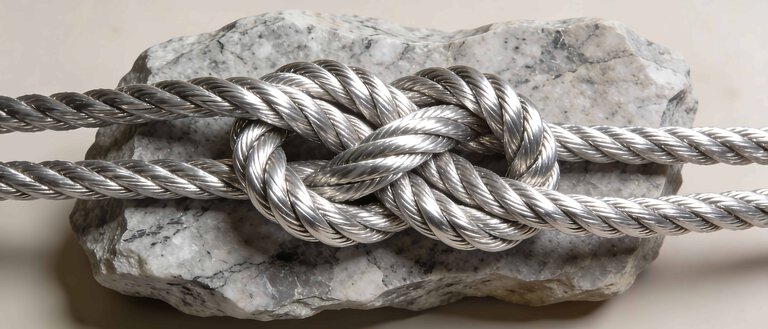
A small symmetrical lock right behind the eye. No long barrel hanging off a fly that’s smaller than the knot used to be.
The tag locks around a small loop instead of stacking wraps down the line
The tag crosses the standing line, passes through a small loop near the eye, then comes back through the opening that crossing just made. Seat it and those crossings cinch against each other. The knot stays short. That’s the whole argument for it on small flies, where a long terminal barrel is just extra material hanging off the eye.
Thread, cross, pass, return
- Pass the tippet through the eye and bring the tag behind the standing line.
- Cross the tag to form a small loop beside the eye.
- Pass the tag through that loop.
- Route it through the secondary opening the crossing created, following the Orvis path.
- Moisten the nylon or fluoro, pull the tag to organize the lock, then the standing line to seat it.
- Inspect, pull-test, and trim.
The return pass is the usual suspect
The tag can take the wrong secondary opening, or the lock can close early and never travel down to the eye. Dry fluorocarbon heats as it cinches, which is the reason I wet it first, every time. And sometimes the leader is just too bulky for a small fly eye, which isn’t a tying problem at all. If the return pass takes you a handful of tries before it feels obvious, you’re right on schedule for a knot this compact.
Where it earns the spot behind the eye
Use: general fly-to-tippet work in mono or fluoro, including larger flies and heavier tippet. Skip: braid. Compare: Davy for minimal size, Clinch for the familiar spiral, Pitzen or the World Fair Knot for other compact light-line terminal knots.
CHECKING IT
I’ll watch the return pass at half speed, then go look at my own knot anyway
Video helps with this one because the return pass is a pain to describe in words, but I still hold the finished knot up to the light before I trust it — watching someone else tie it is not the same as checking mine. Orvis / Pete Kutzer — Orvis Knot video · Orvis Learning Center — Orvis Knot · NetKnots — Orvis Knot animation · Orvis News — Master Class Monday
If you’re not sure the knot in a clip is the real Orvis Knot, the Pete Kutzer / Orvis School demos are the ones to trust.
Open the deeper knot workflowJob, material, route, dressing, seating, pull-test checks and the standardized comparison record.
THE SIX-MOVE CHECK
Job → Material → Route → Dress → Seat → Test
- Job. Name what the connection has to do before choosing the knot.
- Material. Confirm the line, leader, rope, wire, and hardware actually suit this structure.
- Route. Trace every pass before tightening anything.
- Dress. Put strands, wraps, and loops in their intended order with no accidental crossings.
- Seat. Tighten in the order this knot needs. More force does not repair bad geometry.
- Test. Inspect the finished shape, load it by hand when appropriate, and retie if anything moves or fails the article-specific checks.
Practice / pass test. Tie this knot three clean times without rushing. A tie passes only when it matches this article’s What to check before you trust it geometry, shows none of the listed failure clues, and survives the stated load/inspection test. If you cannot tell why one attempt is better than another, keep practicing—the lesson is recognition, not memorization.
KNOT SPEC
Orvis Knot — the short answers
- ALSO CALLED
- Orvis Knot, sometimes the Becker Knot after Larry Becker, who submitted it to the Orvis knot contest that gave it the name it is known by. No regional aliases. Used mostly by fly anglers, and by light-tackle anglers who want a short terminal knot in mono or fluoro.
- KNOT TYPE
- Terminal knot, self-locking figure-eight
- WHAT IT CONNECTS
- Tippet or leader to fly, hook, or small hardware. Not a line-to-line knot, not a loop knot, and not a substitute for a braid-to-leader connection.
- LINE TYPES
- Nylon and fluorocarbon, from fine tippet up through fairly heavy leader. Not for braid — slick PE gives these crossings nothing to bite on and the tag pulls through. Not for wire, not tied in fly line.
- STRENGTH BAND
- High for a compact terminal knot in mono and fluorocarbon. It holds its own against the clinch family across a wider size range than either Davy, provided the tag takes the correct return opening. On braid it is not a strength knot at all.
- DIFFICULTY
- Intermediate. Nothing about it is physically hard, but the return pass is awkward to describe and easy to get wrong the first several times. A child can tie it after watching it slowly; nobody learns it from words alone.
- STEPS AND WRAPS
- Six moves and no wrap count. Thread, cross behind the standing line, pass the tag through the loop by the eye, then back through the opening the crossing made, wet, seat. No braid variant, because braid is the wrong material for it.
- TIE TIME
- Fast once the return pass is automatic — fifteen to twenty seconds. Before that it is a bench knot, because hunting for the second opening on the water costs more time than the knot saves.
- POOR CONDITIONS
- Good in wind and current; there is no wrap count to lose. Low light is its weak point, since the return pass is a thing you see rather than feel. Cold hands cope well because the movements are short.
- THROUGH THE GUIDES
- Compact and symmetrical, sitting close behind the eye rather than trailing a barrel down the tippet. It clears guides freely and leaves a small fly riding the way it was dressed to.
- LUBRICATION
- Yes. Wet before the seating pull. Fluorocarbon in particular heats as it cinches dry, and this knot pulls line across line at the crossings, which is exactly where that heat does damage.
- TAG END
- Leave enough to control the return pass — three inches or so — then trim close, about an eighth of an inch, once it has passed a pull test. No braid difference to give, since braid is off the list.
- TOOLS
- None. Nippers to trim. Magnification helps on the smallest hooks, but the knot itself asks nothing beyond your hands.
- BEST SUITED TO
- Trout, grayling and panfish on the fly, and light inshore or bass work on mono and fluoro. Not species-specific — chosen when you want one compact knot that covers most of the tippet range in the box.
The strength bands are rough on purpose. Published knot tests don’t agree with each other — the same braid-to-leader knot has tested near ninety percent of line strength on one machine and under half on another, because the line brand, its diameter, how fast it got cinched, whether it was wet and whose hands tied it all move the number more than the knot does. Use the band to compare this knot with the others, not as a number to quote.
FIELD INTELLIGENCE
Where it earns its place, and where it costs you
Advantages
- Covers a much wider tippet and hook range than the Davy family while staying short behind the eye.
- No wrap count to remember or miscount, so a tired angler ties the same knot as a fresh one.
- Symmetrical when correct, which makes a bad one easy to spot before you fish it.
- Works equally well in nylon and fluorocarbon, including the heavier leader sizes where compact knots usually run out.
Disadvantages
- The return pass is the hardest thing in this knot to learn and the easiest to get wrong in the dark.
- A tag through the wrong secondary opening produces a knot that looks close to right and is not.
- No use on braid, so it does not travel to a braid-first tackle box.
- The lock can close early and never travel down to the eye, leaving the knot standing off the hardware.
- Bulky leader on a small fly eye defeats it, and that is a leader problem the knot cannot solve.
Use a different knot when
- Davy or Double Davy — when the fly is very small and you want the least possible mass at the nose
- Improved Clinch or Trilene — when you want a familiar wrapped knot and the extra length behind the eye does not matter
- Palomar — when you are on braid, where these crossings have nothing to grip
- Non-Slip Loop Knot — when the fly or lure needs to swing freely rather than sit cinched to the eye
WHAT TO CHECK BEFORE YOU TRUST IT
The Orvis Knot is the one to learn if you want a single compact terminal knot for the whole mono and fluoro box. It gives up almost nothing to the clinch family on strength and it stops the long barrel that makes a size 18 fly look like it is towing something. The useful check is symmetry and travel: a correct one is a small even lock seated hard against the eye, and a bad one either sits crooked or hangs up short of the hardware. The real tradeoff is the learning curve. Until the return pass is automatic, it is a knot you tie at home.
What actually makes it fail
- The tag taking the wrong secondary opening, which builds a knot that looks tidy and lets go under load.
- The lock closing early so the knot never travels down and seats against the eye.
- Cinching dry, which heats fluorocarbon exactly where line crosses line.
- A leader too heavy or too stiff for the fly eye, so the knot is forced into a bend it cannot hold.
- Tying it on braid, where the crossings slide instead of gripping.
How to test it, and how it ages
Wet it, pull the tag first to organize the crossings, then draw the standing line steadily and watch the lock travel down and seat against the eye. Hold it up and look: compact, centered, symmetrical, no open loop standing off one side and no strand pinched between knot and eye. Then load it with a firm steady pull against the standing line, not a snatch — the knot that took the wrong opening usually gives up on that first honest pull. Trim only afterwards.
Over a session: Stable over a session. Because it is short and locks against itself it does not creep the way a long wrapped barrel can. Check it after every fish, and retie any time the fly has been dragged through rock or gravel.
Troubleshooting
Why does my knot stop before it reaches the eye?
The lock closed early. Keep it loose until the last moment, wet it, and let the standing-line pull carry the whole structure down to the hardware.
Why does it keep breaking at the knot on fluoro?
You are cinching dry or fast. Wet it and pull steadily — fluorocarbon is punished hardest at line-on-line crossings.
How do I know I took the right return opening?
A correct one seats symmetrical. If the finished knot is lopsided or has a loop hanging off the side, you took the wrong one. Cut it and start again.
Can I use this on braid?
No. The crossings need friction that braid does not give. Use a Palomar or another braid-specific knot.
Why can I tie it at home and not on the water?
Because the return pass is a visual move. Practice it enough that your fingers find the opening, or carry a light.