ORIGINAL HOOK DIAGRAM
Two eye passes first. Wraps second.
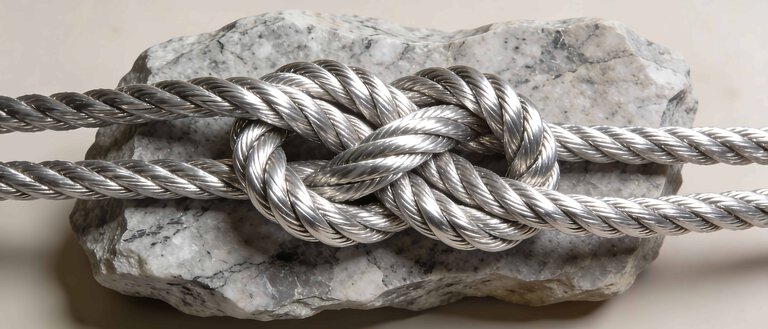
Original Hook the Horizon schematic. It focuses on the doubled eye contact and return path instead of reproducing third-party art.
What it’s forMono and fluoro terminal connections when the eye takes two passes without a fight, and I want that eye contact doubled up.
Structural difference
Two passes through the eye give you a doubled contact point before the tag ever wraps the standing line.
Main nuisance
Tiny eyes or stiff line make that second pass a pain. If I’m deforming the line to force it through, I tie something else.
Inspection clue
Both eye loops should stay open and parallel long enough for the tag to come back through them clean.
WHY THE SECOND EYE PASS MATTERS
It starts by spreading its grip around the hardware.
The Trilene runs through the eye twice, wraps the tag around the standing line, then sends that tag back through both eye-side loops. So the finished knot has two strands bearing at the hardware before the coil stack even gets involved. That’s the point of the design: a rough eye has to wear through two strands instead of chewing on one.
The catch is that the second pass only helps if it stays tidy. Force two strands through an eye that barely takes one and they lie across each other instead of side by side. Now one strand carries the load with the other pressing into it, which is worse than the single pass you were trying to improve on.
Two passes at the eye, then the wraps
- Run the tag through the eye, circle it back, and pass it through the eye a second time. That leaves you two loops sitting at the hardware.
- Leave those loops loose enough to work with and make about five or six wraps around the standing line.
- Bring the tag back down and pass it through both eye loops. Both of them. Catching only the near loop is a common way to end up with a knot that looks right and isn’t.
- Wet it and tighten with steady pressure, keeping the two eye loops parallel the whole way down.
- Look over the double eye contact and the wrap stack, pull-test, then trim.
Three neighbors that handle the eye differently
Improved Clinch
One eye pass, two-loop finish. Faster around small hardware, but less contact wrapped around the eye.
Palomar
Doubled line through the eye and a pass-through loop. Cleaner for a lot of braid work, provided the hardware actually fits through that loop.
Uni / Grinner
A wrap-inside-a-loop that’s flexible and adapts across a whole family of knots.
HOW I CHECK MYSELF
I watch the second eye pass and the return through both loops before I trust my own version of it.
The return through both loops is the step people skip without noticing, since a knot that only caught one loop can still look finished at a glance. Comparing my hands against a clean demonstration is how I catch that before it costs me a fish instead of after.
Wired2Fish — tutorial + video · NetKnots — animation · Sufix/Rapala — manufacturer knot guide
Open the deeper knot workflowJob, material, route, dressing, seating, pull-test checks and the standardized comparison record.
THE SIX-MOVE CHECK
Job → Material → Route → Dress → Seat → Test
- Job. Name what the connection has to do before choosing the knot.
- Material. Confirm the line, leader, rope, wire, and hardware actually suit this structure.
- Route. Trace every pass before tightening anything.
- Dress. Put strands, wraps, and loops in their intended order with no accidental crossings.
- Seat. Tighten in the order this knot needs. More force does not repair bad geometry.
- Test. Inspect the finished shape, load it by hand when appropriate, and retie if anything moves or fails the article-specific checks.
Practice / pass test. Tie this knot three clean times without rushing. A tie passes only when it matches this article’s What to check before you trust it geometry, shows none of the listed failure clues, and survives the stated load/inspection test. If you cannot tell why one attempt is better than another, keep practicing—the lesson is recognition, not memorization.
KNOT SPEC
Trilene Knot — the short answers
- ALSO CALLED
- Trilene Knot, occasionally written as the double-loop clinch. The name comes from a line brand rather than a region or a person. No meaningful regional aliases.
- KNOT TYPE
- Terminal knot, doubled eye pass with wrapped tag
- WHAT IT CONNECTS
- Line to hook, lure, swivel or snap where the eye will take two passes of the line. Not a line-to-line knot and not a loop knot.
- LINE TYPES
- Monofilament and fluorocarbon, light to medium. Braid slips in it the same way it slips in a clinch. Heavy or stiff leader makes the second eye pass a fight and is where it stops being worth tying.
- STRENGTH BAND
- Solid, and generally a step up on the Improved Clinch for the same line because the load is shared across two strands at the hardware. It still sits below the doubled-line terminal knots.
- DIFFICULTY
- Beginner to Intermediate. Anyone who can tie an Improved Clinch can tie this; the only new skill is keeping two eye loops open and parallel while you wrap. Children manage it on larger eyes.
- STEPS AND WRAPS
- Five moves. Two passes through the eye, then five or six wraps around the standing line, then the tag back through both eye loops. Wrap count does not change much by line type because it is not a braid knot.
- TIE TIME
- Moderate — slower than a clinch because of the second eye pass, but still a boat knot. Thirty to forty-five seconds once learned, longer on small eyes.
- POOR CONDITIONS
- Harder than the clinch in cold hands and low light, because threading a small eye twice is a fine-motor job. Wind and a rolling deck make the second pass the step you start skipping.
- THROUGH THE GUIDES
- Slightly bulkier at the eye than a clinch because two strands bear there, but still compact enough to pass rod guides without catching. Rarely relevant, as it lives at the hook.
- LUBRICATION
- Yes. Wet before the final draw. Two strands at the eye means more surface sliding under tension, so a dry cinch generates more friction heat than it does in a single-pass knot — and fluorocarbon shows that damage first.
- TAG END
- An eighth of an inch or so. Do not trim flush; the wraps settle under the first real load and a flush tag can withdraw through the loops.
- TOOLS
- None. Clippers to trim. Good light helps more than any tool, because the whole knot depends on seeing two loops stay separate.
- BEST SUITED TO
- General freshwater and light inshore work on mono and fluoro — bass, walleye, trout, inshore species on leader. Chosen by hardware more than by species: it suits any eye that takes two passes cleanly.
The strength bands are rough on purpose. Published knot tests don’t agree with each other — the same braid-to-leader knot has tested near ninety percent of line strength on one machine and under half on another, because the line brand, its diameter, how fast it got cinched, whether it was wet and whose hands tied it all move the number more than the knot does. Use the band to compare this knot with the others, not as a number to quote.
FIELD INTELLIGENCE
Where it earns its place, and where it costs you
Advantages
- Two strands bear against the hook eye instead of one, which is real protection when the eye is rough or the wire is thin.
- It is a familiar structure — if you can tie a clinch, the extra step is quick to learn.
- No need to pass the lure through a loop, so it works with big or awkward baits.
- Reliably strong on mono and fluoro in the sizes most anglers actually fish.
Disadvantages
- It needs an eye that takes two passes without a fight. Small eyes, crowded split rings and heavy line rule it out.
- If the two eye strands cross instead of lying side by side, the knot is worse than the single-pass version it replaced.
- It slips on braid, so it is not a general-purpose terminal knot.
- The final tag must pass through both eye loops, and catching only one produces a knot that looks finished but is not.
- Slower than a clinch at exactly the moment you are rushing.
Use a different knot when
- Improved Clinch — when the eye is small, rough or crowded and will not take two passes without deforming the line
- Palomar — when you are on braid, or when you want a doubled-line knot and the lure will pass through a loop
- Uni / Grinner — when the line is heavy or stiff enough that the eye loops will not seat parallel
- Non-Slip Loop Knot — when the lure needs to swing freely rather than be locked hard against the eye
WHAT TO CHECK BEFORE YOU TRUST IT
The Trilene earns its place when the hook eye itself is the weak point — a cheap eye with a rough gap, a fine-wire hook, or any eye that has already chewed a single-strand knot. Spreading the bearing load over two strands is not a strength trick so much as an abrasion trick. The useful check is the pair of eye loops during the draw: parallel and open means the design is working, crossed means the second strand is pressing into the first and doing harm rather than good. The tradeoff is time and hardware fit, and if the eye argues, stop arguing.
What actually makes it fail
- The two eye strands crossing during the draw, so one strand loads while the other digs into it.
- The tag returning through only the near eye loop instead of both, which leaves an incomplete lock.
- Forcing two passes through an undersized or rough eye and abrading the line before the knot is even tied.
- Dry cinching, which produces more heat here than in a single-pass knot and glazes the line at the eye.
- Being tied on braid, where the wraps slip regardless of how well the eye passes are made.
How to test it, and how it ages
Wet it, then draw down slowly while watching the two eye loops stay side by side. Before trimming, look for three things: two parallel strands hugging the eye, a wrap stack with no crossings, and a tag that emerged from both loops rather than one. Then load it steadily against the rod. Slippage under that pull, or a wrap stack that shifts, means the tag missed a loop. Retie rather than pulling it tighter.
Over a session: Holds up well over a session because the doubled eye contact resists the wear a single strand takes at the hardware. Still retie after a hard fish or a snag, and check the eye strands are still parallel — they can shift after a heavy load.
Troubleshooting
Why does the second pass keep chewing up my line?
The eye is too small or too rough for the line you are using. That abrasion is the knot telling you to tie an Improved Clinch on this hook instead.
Why do the two eye loops keep crossing?
You are pulling the tag before the loops have settled. Keep them loose and separate while you wrap, and start the draw slowly so they can line up.
How do I know the tag went through both loops?
Look before you tighten. Two distinct loops should close around the tag together. If only one closes on it, back the whole thing out and redo the return pass.
Why does it slip on braid?
Same reason a clinch does. The wraps cannot grip slick fiber, and the doubled eye pass does nothing about that. Use a braid-proven terminal knot.
Is it worth the extra step over an Improved Clinch?
On a rough or fine-wire eye, yes. On a smooth, generous eye with fresh mono, the difference is small and the clinch is faster.