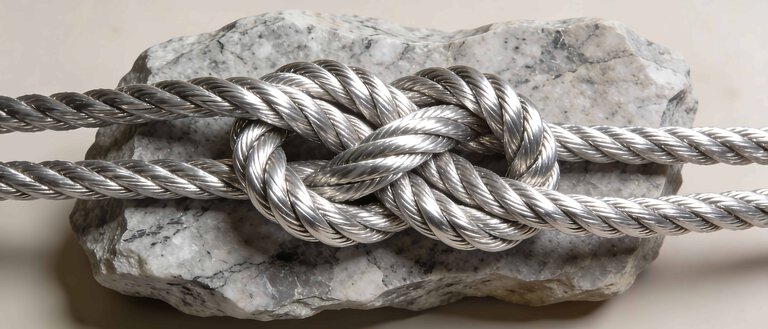
BEND · TWO ROPES
Your dock line’s two feet short of the cleat, and the only other rope aboard is thinner, stiffer and a different color. A square knot handles that pairing badly. The sheet bend was more or less invented for it.
ORIGINAL HOOK DIAGRAM
Which rope does what, at each stage — mixing that up is the one way to get this wrong.
Panel three is the one that matters. The thin rope passes behind both legs of the bight. Go around just one leg and nothing holds the tuck down — it looks like a knot right up until something pulls on it.
What I reach for it on
Joining two ropes that have nothing in common — thick to thin, stiff to soft, new to old.
Which rope is which
The thicker or stiffer rope gets folded into the bight and then sits still. The thinner one does all the traveling.
Big mismatch
Take a second turn around the bight before the final tuck and I’ve made a double sheet bend, which is what a real difference in size wants.
How I know it’s wrong
Both short ends should finish on the same side of the knot. If they’ve ended up on opposite sides I’ve tied the less secure version, and I pull it apart and redo it.
WHY THE SQUARE KNOT LOSES HERE
Two ropes of different sizes don’t grip each other evenly.
A square knot works by each rope pinching the other, which is fine while the two are close in diameter and behave the same way under strain. Put a thin line and a thick one into one and that balance is gone. The thin rope can roll around the thick one and the whole join lets go.
The sheet bend gives up the symmetry on purpose. The thick rope folds into a bight and does nothing but hold its shape. The thinner rope comes up through it, wraps behind both legs, and traps itself under its own turn, so the pull on the line is what keeps the tuck down. Nothing in that depends on the two ropes being alike.
It reads much harder on the page than it feels in my hands. Two goes with actual rope and it clicks. The bight’s the one thing worth slowing down for, because forming it in the thin rope instead of the thick one is the mistake I keep having to catch myself making, and it’s easy to miss once everything’s pulled up tight.
How I tie it
- Work out which of the two ropes is thicker or stiffer. Fold that one back on itself into a bight and hold it.
- Bring the working end of the thinner rope up through the bight from underneath.
- Take it around behind both legs of the bight.
- Tuck it back under itself, under the part that came up through the bight, so it’s trapped between its own turn and the bight.
- Check that both short ends have finished on the same side.
- Pull on all four parts to set it, and leave a good tail on each rope.
- Where the diameters are a long way apart, I go around the bight twice before that final tuck.
When it’s the wrong knot
It joins two ropes. That’s the entire list. A fixed loop is a bowline, making fast to a ring or a rail is a round turn and two half hitches, and keeping an end from running out through a chock is a figure-eight stopper.
It’s also the wrong answer for a permanent join. A sheet bend is bulky, so a line carrying one will hang up the first time it tries to go through a fairlead or a block. A join that spends its life going slack and then getting snatched from a fresh angle is a join I want to keep checking, and on slippery synthetic line the second turn is cheap insurance.
So it sits where it belongs, as the knot that gets me off the ramp today. If a dock line needs one every single time I tie up, no knot is going to solve that. The rope’s too short, and the fix for that happens at home with a longer rope, not with a better bend.
EXTERNAL PRACTICE / CROSS-CHECK
Use the animation to keep the two ropes’ jobs separate.
Animated Knots: Sheet Bend shows the thicker rope forming the bight and the thinner rope doing the travel around both legs. It also calls out longer tails for critical loads, which is a useful check our compact diagram cannot show well.
THE SIX-MOVE CHECK
Job → Material → Route → Dress → Seat → Test
- Job. Name what the connection has to do before choosing the knot.
- Material. Confirm the line, leader, rope, wire, and hardware actually suit this structure.
- Route. Trace every pass before tightening anything.
- Dress. Put strands, wraps, and loops in their intended order with no accidental crossings.
- Seat. Tighten in the order this knot needs. More force does not repair bad geometry.
- Test. Inspect the finished shape, load it by hand when appropriate, and retie if anything moves or fails the article-specific checks.
Practice / pass test. Tie this knot three clean times without rushing. A tie passes only when it matches this article’s What to check before you trust it geometry, shows none of the listed failure clues, and survives the stated load/inspection test. If you cannot tell why one attempt is better than another, keep practicing—the lesson is recognition, not memorization.
KNOT SPEC
Sheet Bend — the short answers
- ALSO CALLED
- Also called the weaver’s knot or becket bend. The two-turn version is the double sheet bend. The names are old and used interchangeably; there is no regional variant worth learning.
- KNOT TYPE
- Bend joining two rope ends, with the bight formed in the thicker rope
- WHAT IT CONNECTS
- Joining two ropes, especially two that do not match in diameter, stiffness or material. Not a loop, not a hitch, and not a join to trust with a towline, an anchor rode or anything overhead.
- LINE TYPES
- Handles three-strand nylon to double-braid, old rope to new, thick to thin. Least secure in slick synthetic cordage and springy polypropylene, where the double version is the minimum. Wet rope reduces the bite. Frozen rope makes dressing it close to impossible.
- STRENGTH BAND
- Moderate, and the honest framing is that it becomes the weakest point of whatever you joined. It costs more rope strength than a bowline, and the mismatch between the two ropes matters more than the knot does. On a boat the answer is one rope long enough for the job.
- DIFFICULTY
- Beginner to tie, intermediate to tie correctly every time. The confusion is which rope plays which role. A child can learn it; the real check is whether they can tell the secure version from the one with the ends on opposite sides.
- STEPS AND WRAPS
- Four moves. Bight in the thicker rope, thin rope up through it, around behind both legs, tucked back under itself. A second turn around the bight before that tuck makes it a double sheet bend, which is what a real diameter mismatch wants.
- TIE TIME
- About ten seconds once the roles are clear. Working out which rope is the thicker one is what takes the time on a dark dock, and it is not a step to skip.
- POOR CONDITIONS
- Awkward in the cold and in gloves, because it wants both hands and a clear view of which rope is doing what. In low light the check that saves you is the ends: both short ends must finish on the same side.
- THROUGH THE GUIDES
- No rod guides, and this is the field that matters most here. A sheet bend is bulky and will hang up in a fairlead, chock or block. Never put one in a line that has to run through hardware, and check the join clears everything before you load it.
- LUBRICATION
- Lubrication is irrelevant. Wet or slick rope loses grip and the join can roll, so add the second turn. It does not jam badly, though a soaked and heavily loaded sheet bend in stiff rope can be stubborn to open.
- TAG END
- A good tail on both ropes, and more on the thinner one. Short tails are the commonest reason a sheet bend rolls out. On slippery cordage, a stopper knot in each tail is worth the extra seconds.
- TOOLS
- None. Gloves make the dressing harder rather than easier. A knife only if the join has been loaded hard in stiff rope, which is a sign it was carrying more than it should.
- BEST SUITED TO
- Temporary joins: a dock line that came up short, a heaving line to a mooring pennant, a line somebody throws you from the pontoon. Not for towlines, anchor rodes, trailer tie-downs, lifting, or anything holding weight above a person.
The strength bands are rough on purpose. Published knot tests don’t agree with each other — the same braid-to-leader knot has tested near ninety percent of line strength on one machine and under half on another, because the line brand, its diameter, how fast it got cinched, whether it was wet and whose hands tied it all move the number more than the knot does. Use the band to compare this knot with the others, not as a number to quote.
FIELD INTELLIGENCE
Where it earns its place, and where it costs you
Advantages
- It joins ropes that do not match, which is exactly where a square knot fails and fails dangerously.
- It unties easily after load, so the two ropes go back to being two ropes.
- The double version costs one extra turn and covers a much larger diameter mismatch.
- It is quick and needs no hardware, which is the whole point on a dock at dusk.
Disadvantages
- It is bulky and will hang up in a fairlead, chock or block.
- It can roll and capsize under slack-and-snatch loading, especially in slick or springy rope.
- The insecure version, with the ends on opposite sides, looks close enough to fool a tired eye.
- It is a temporary fix. A join in a loaded line is a weak point however well it is tied.
Use a different knot when
- A single rope long enough for the job — whenever the load matters — towing, anchoring, trailer tie-downs or anything overhead
- Double sheet bend — when the two diameters are a long way apart, or the rope is slick or springy
- Two bowlines, loop through loop — when you want a join that is easy to inspect and to break apart afterwards
- Figure-eight stopper — when what you actually need is to keep an end from running out, not to join anything
WHAT TO CHECK BEFORE YOU TRUST IT
The sheet bend earns its place the moment the rope in your hand is two feet short and the only other rope aboard has nothing in common with it. Check one thing first: both short ends finishing on the same side of the knot. The version with them on opposite sides is less secure and looks almost identical. The second check is the bight, which belongs in the thicker or stiffer rope — forming it in the thin one is the mistake that hides once everything is pulled up tight. The tradeoff is that a join is a weak point, and this one is a way home rather than a rig.
What actually makes it fail
- The bight formed in the thinner rope instead of the thicker one, so the join rolls under load.
- Both ends finishing on opposite sides of the knot, which is the less secure version of the same shape.
- The thin rope passed around only one leg of the bight, leaving nothing to hold the tuck down.
- Short tails, which let the knot capsize and roll out under slack-and-snatch loading.
- Slick or springy cordage with only a single turn, where a double sheet bend was the minimum.
How to test it, and how it ages
Lay it flat and read it: bight in the thicker rope, thin rope up through it, around behind both legs, tucked under its own turn, and both short ends on the same side. Pull all four parts to set it, then load it with a steady lean rather than a snatch and watch the tuck. A good one tightens and stays symmetrical. Any sign of the thin rope rolling around the bight means retie it as a double, or go and find a longer rope.
Over a session: Fair under steady tension and poor under repeated slack and snatch, which is exactly what a dock line does. Check it each time you pass, and treat it as something to remove rather than something to keep.
Troubleshooting
Why did it pull apart under load?
Almost always the bight was in the thin rope, or the ends finished on opposite sides. Either version looks similar and neither holds well.
Which rope makes the bight?
The thicker or stiffer one. It folds back on itself and then does nothing but hold its shape while the thinner rope does the travelling.
It keeps slipping on new slippery rope — what now?
Take a second turn around the bight before the final tuck, making it a double sheet bend, and leave longer tails.
Can I use it to extend a dock line permanently?
No. It is bulky, it will hang in a chock, and a join in a loaded line is a weak point. Buy a rope that is long enough.
Is a square knot ever a substitute?
Not for two ropes of different size. The thin rope rolls around the thick one and the join lets go. That is the exact problem this bend exists to solve.