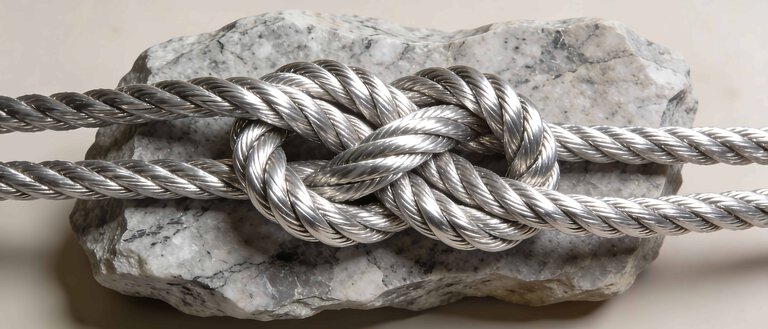
FIXED LOOP · MOORING AND TOW
Plenty of knots buy their grip by welding themselves shut. A bowline can have a boat leaning on it all night and still come apart in your fingers the next morning, and that’s most of the reason I trust it.
ORIGINAL HOOK DIAGRAM
One continuous move. I had to slow it way down before it made sense to my hands.
Panel three is the step that goes wrong. The end goes behind the standing part, not across the front of it, and crossing it wrong is easy to miss until the knot refuses to set.
What I reach for it on
A loop that has to stay exactly the size I made it. Over a piling, through a mooring ring, a loop in a towline.
After the load
It sets hard and holds, then breaks open with a push on the collar. No picking, no fid, no knife.
Where it’s weak
Slack. A bowline that gets shaken, flogged and cycled loose with nothing steady pulling on it can work its own tail back through.
How I know it’s wrong
No collar. If the working end isn’t wrapped around the standing part with a neat bight of rope sitting over it, whatever I tied isn’t this knot.
WHY IT COMES UNDONE ON PURPOSE
Nothing inside it is getting crushed against itself.
Load a bowline and the pull runs around the loop and into the collar, and the collar clamps down on the standing part. The parts press together hard. What they don’t do is grind into one fused lump the way the guts of a jamming knot will after a few hours of strain.
Take the load off and the collar slackens by a fraction. That fraction is the whole trick. Push the collar forward toward the loop, the rope opens up, and the knot falls apart in my hands.
The rabbit-and-the-hole gets most people through their first ten. Throwing one with one hand takes a lot longer than that, and it’s worth the time, because holding a boat off a piling with one arm while the other makes the loop is an ordinary situation on any small boat. Expect a long stretch where it feels like fumbling. Do that stretch on the lawn, not with a piling coming at the bow.
How I tie it
- Work out how big the loop needs to be and leave plenty of tail beyond it.
- Make a small loop in the standing part, with the rest of the rope running away underneath it.
- Bring the working end up through that small loop from below.
- Pass the end behind the standing part.
- Bring it back down through the small loop, running alongside where it came up.
- Hold the big loop in one hand and the standing part in the other, and pull to set it.
- Look for the collar around the standing part, and check the tail is long enough that it can’t creep back through.
When it’s the wrong knot
It doesn’t adjust. Once the loop’s made, that’s the size it stays, so a bowline is no use for anything I want to snug down tight around an object, and it’s no use where a tide’s going to change the length I need. It also isn’t the knot for a line that spends its life going slack and then getting yanked from a new direction every few seconds. That job goes to a round turn and two half hitches instead.
For rode onto an anchor there’s a better answer too, because an anchor bend puts extra turns through the ring, and those turns are what stop the rope sawing itself apart while the boat works in a swell. And a bowline, like every knot, takes something out of the rope’s strength. I buy that back with rope diameter, not with technique.
All of which makes the loop size a decision I’d rather have already made. I tie it on the ramp, tie it on the run out, tie it any time other than the moment a piling is coming at the bow — because that’s exactly when I don’t want to be thinking about it at all, just doing it.
EXTERNAL PRACTICE / CROSS-CHECK
Watch the collar form, then check the tail.
Animated Knots: Bowline gives a frame-by-frame tying sequence and also documents the bowline’s important limitation: it can shake loose when repeatedly unloaded. Use that alongside our collar and tail checks rather than treating a familiar-looking loop as proof.
THE SIX-MOVE CHECK
Job → Material → Route → Dress → Seat → Test
- Job. Name what the connection has to do before choosing the knot.
- Material. Confirm the line, leader, rope, wire, and hardware actually suit this structure.
- Route. Trace every pass before tightening anything.
- Dress. Put strands, wraps, and loops in their intended order with no accidental crossings.
- Seat. Tighten in the order this knot needs. More force does not repair bad geometry.
- Test. Inspect the finished shape, load it by hand when appropriate, and retie if anything moves or fails the article-specific checks.
Practice / pass test. Tie this knot three clean times without rushing. A tie passes only when it matches this article’s What to check before you trust it geometry, shows none of the listed failure clues, and survives the stated load/inspection test. If you cannot tell why one attempt is better than another, keep practicing—the lesson is recognition, not memorization.
KNOT SPEC
Bowline — the short answers
- ALSO CALLED
- Usually said as boh-lin. No widely used alternative name. Sailors, dock hands, arborists and rescue crews all call it the same thing, which makes it one of the few knots you can name to a stranger on a pontoon and be understood.
- KNOT TYPE
- Fixed loop tied in the end of a rope
- WHAT IT CONNECTS
- A loop of a set size in the end of a line — over a piling or bollard, through a mooring ring, an eye in a towline. It does not adjust, it joins nothing, and it is the wrong answer where the length has to change.
- LINE TYPES
- Good in three-strand nylon and polyester double-braid. On stiff, slick or very smooth modern cordage the tail can work out, so it wants a backup there. Wet nylon makes it easier to break open rather than harder. Frozen rope makes it stubborn but still workable.
- STRENGTH BAND
- Moderate to solid. The rope turns through a tight radius inside the collar and that costs strength, more than a splice would. Every knot costs some, and on a boat the answer is rope diameter, not technique. Its real virtue is that it never jams shut.
- DIFFICULTY
- Beginner to learn, intermediate to trust. Most people have it in an afternoon with the rabbit story and kids pick it up fast. Tying one behind your back, one-handed, or around your own waist takes far longer than the first version does.
- STEPS AND WRAPS
- Five moves and no wrap count: small loop in the standing part, end up through, behind the standing part, back down through, set. There is no variation by rope type. The one-handed version is the same five moves rolled into one wrist motion.
- TIE TIME
- A boat knot. Five seconds once it lives in your hands, which is why it survives being needed with a piling coming at the bow. Decide the loop size before you start, because that is the part you cannot change afterwards.
- POOR CONDITIONS
- Good in cold hands and gloves because the moves are big, and fine in the dark once it is learned by feel. Wind and a swinging boat are the real problem: they take the loop size away from you rather than the knot.
- THROUGH THE GUIDES
- No rod guides. The loop drops over a piling or bollard cleanly, and the knot is compact enough to pass most chocks and fairleads, though the collar can snag on a rough ring. Nothing about the finished knot fouls.
- LUBRICATION
- Lubrication is irrelevant. Wet rope makes no difference to how it holds and makes it slightly easier to break open afterwards. Frozen rope is stiff to tie and stiff to release, but this is still one of the better knots to be stuck with in ice.
- TAG END
- Long — a hand’s width at least, and more in slick cordage. The commonest failure is a short tail creeping back through under slack-and-snatch loading. Back it up with a stopper knot in the tail, or tuck the tail back through the loop.
- TOOLS
- None. Gloves if the rope is cold or rough. A knife is not the escape route here, because a bowline is the loop you can always undo by hand no matter what has been leaning on it.
- BEST SUITED TO
- Mooring pennants, dock lines onto pilings and bollards, towline eyes, fender lanyards, a loop to hand to somebody on the dock. Back it up before leaving a boat on it unattended, and use rated hardware rather than a bowline for lifting or anything overhead.
The strength bands are rough on purpose. Published knot tests don’t agree with each other — the same braid-to-leader knot has tested near ninety percent of line strength on one machine and under half on another, because the line brand, its diameter, how fast it got cinched, whether it was wet and whose hands tied it all move the number more than the knot does. Use the band to compare this knot with the others, not as a number to quote.
FIELD INTELLIGENCE
Where it earns its place, and where it costs you
Advantages
- It unties after heavy load. A line that held a boat all night still comes apart with a push on the collar, no fid and no knife.
- The loop stays the size you made it, so a mooring or towline eye does not creep tighter around what it is on.
- Fast and memorable. Most people can still tie one under pressure years after they last used it.
- It can be thrown one-handed once learned, which matters when the other hand is holding a boat off a piling.
Disadvantages
- It does not adjust. The wrong loop size means untying and starting again, and a changing tide is not something it can answer.
- The tail can work out under slack-and-snatch loading, or over days unattended, so it needs a backup where the loop matters.
- It is not the strongest loop available. The turn inside the collar is tight, and a spliced eye keeps more of the rope.
- It is easy to tie inside out or with the end finishing outside the loop, and the wrong version looks close enough to fool a tired eye.
Use a different knot when
- Round turn and two half hitches — when the line goes slack and snatches, or you need to tie it while it is already loaded
- Eye splice — for a permanent loop on a mooring pennant or dock line, where strength and abrasion resistance matter
- Anchor bend — for rode onto an anchor ring, where extra turns stop the ring sawing at the rope
- Cleat hitch — when the fitting is a horn cleat and you want a one-flick cast-off
WHAT TO CHECK BEFORE YOU TRUST IT
The bowline earns its place the morning after, not the evening you tie it. A knot that held a boat leaning on it all night and still opens in your fingers has saved you a cut rope and the length that goes with it. Check two things: a collar sitting neatly around the standing part, which tells you the knot is the knot, and a tail long enough that it cannot creep. The real tradeoff is rigidity. It gives you a loop that will not move, and if the water level is going to move, that is not a virtue.
What actually makes it fail
- A short tail creeping back through on a line that goes slack and snatches, or one left unattended for days.
- The working end finishing outside the loop instead of inside it, which makes a weaker knot that looks nearly right.
- The small loop made in the working end rather than the standing part, which gives a slip knot that closes under load.
- Ring loading, where the loop is pulled from two opposing points at once and the collar rolls.
- Chafe where the loop bears on a rough piling or a rusted ring, which is rope damage rather than knot failure.
How to test it, and how it ages
Look for the collar first: a neat bight of rope wrapped around the standing part, with the tail coming out inside the loop and lying alongside it. Set it by pulling the loop against the standing part with a steady lean rather than a jerk, then look at the tail again, because setting it draws some in. On a line you are about to walk away from, add the backup before you leave rather than after thinking about it twice.
Over a session: Stable under steady tension and easy to read at a glance. Under repeated slack and snatch the tail shortens a fraction each cycle, so check it whenever you pass and re-tie rather than trying to pull it tighter.
Troubleshooting
Why does my bowline keep coming apart?
Almost always a tail too short for the rope and the loading. Leave a hand’s width, and put a stopper in the tail on anything you will not be standing next to.
I tied it and the loop slips shut — what did I do?
You made the small loop in the working end instead of the standing part. That gives a slip knot which looks similar and closes under load.
Why can I not undo one that has been loaded hard?
Push the collar forward toward the loop rather than pulling on the tail. A bowline breaks open from the collar and will fight you from anywhere else.
Is one bowline enough to leave the boat on?
Not on its own where the line will go slack and snatch. Back up the tail with a stopper, or use a round turn and two half hitches instead.
Why does it come out wrong every second or third try?
The working end is going across the front of the standing part instead of behind it. Slow that one step down and the rest follows.