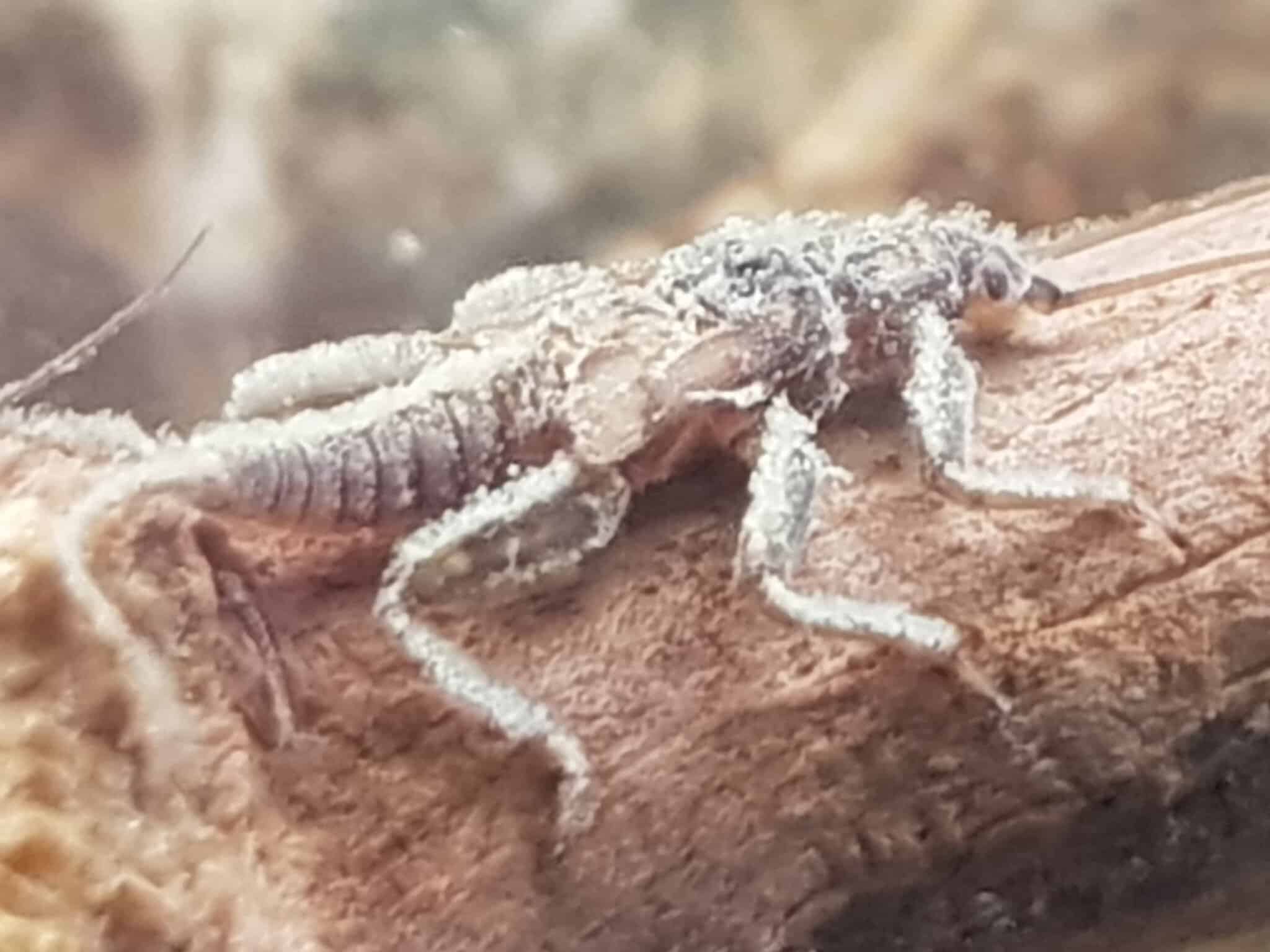
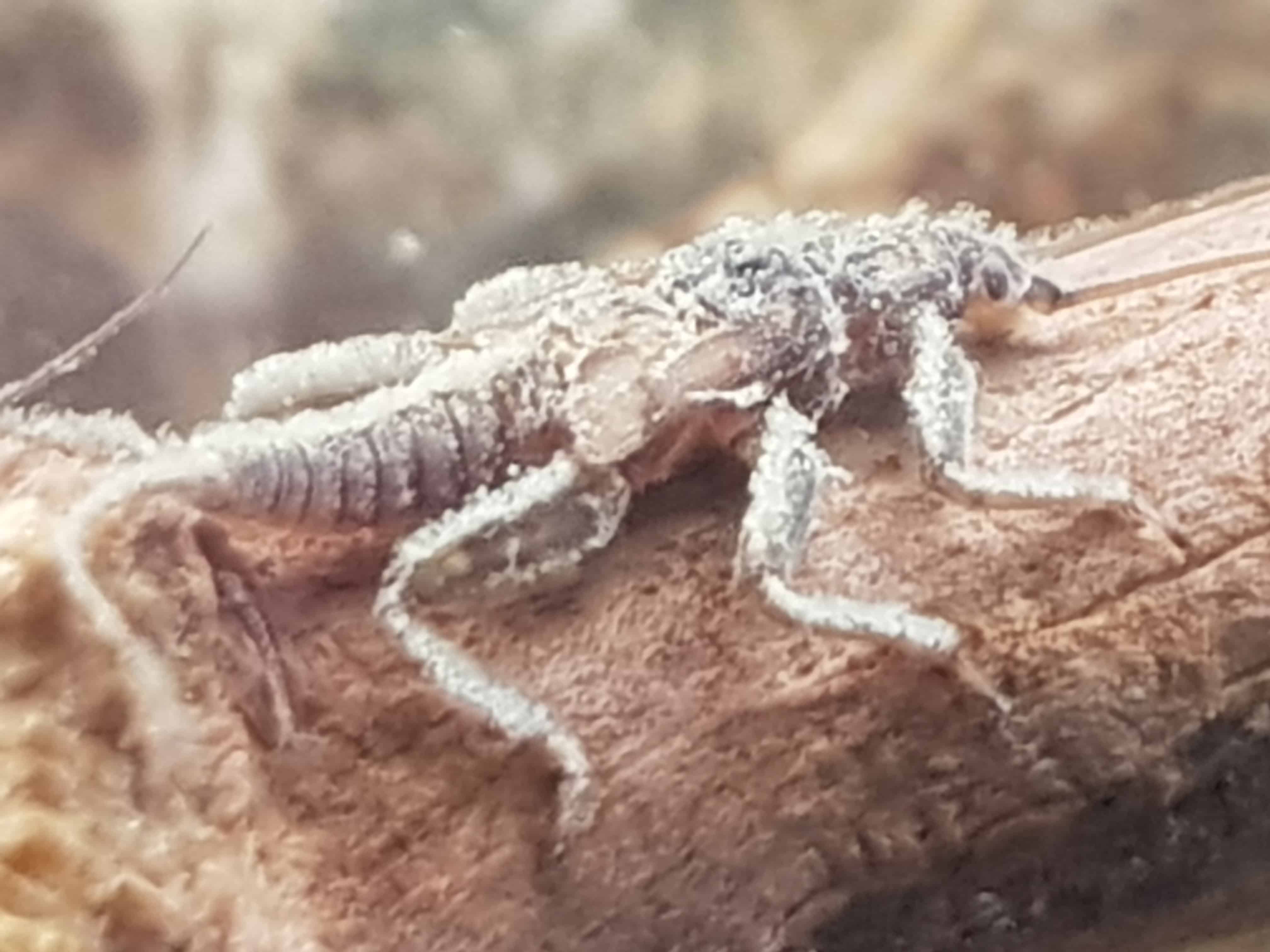
Stoneflies are the ones you find by looking at dry rock. Empty split skins left on a boulder above the waterline, on streamside vegetation, on whatever solid thing happened to be closest. The insect walked out of the river to finish the job, and it left the evidence sitting where anybody can read it.
A stonefly result is a broad Plecoptera call. Habitat supports the comparison and can’t make it on its own. The strongest field result puts several things together: life stage, two tails, antennae, wing pads or adult wings, body form, position, and movement.
They walk out
Egg, aquatic nymph, winged adult. No pupal stage anywhere in there. Nymphs may spend most of their lives crawling around on submerged rock and woody debris, and when one is ready, it doesn’t rise up through the water column and pop out on top. It climbs out and sheds the nymphal skin on something solid.
That’s why an empty shuck on a streamside surface counts for something. It supports emergence — for that insect, on that rock. It says nothing about what’s going on through the rest of the water.
Two tails is where most people stop, and two tails isn’t enough
Two tails and the call gets made. That’s the quickest way to land on the wrong order here, and it’s repeated often enough to sound like a rule.
- Two tail filaments.
- Two long antennae.
- A segmented body with developing wing pads on the thorax.
- Two claws at the end of each leg. This one needs a close view.
- Thread-like gills in some groups, usually around the thorax or the leg bases rather than leaf-like gills down the abdomen.
- Crawling on rocks, woody debris, or other submerged surfaces.
All of that together — two tails, long antennae, paired wing pads, a robust segmented body, crawling — is what a stonefly nymph call should be built on.
The claw check is real and it takes a hand-lens sort of look. If you don’t have one, skip it. There’s plenty on that list without it, and nobody’s grading the observation.
What should move you off the call: leaf-like gills along the abdomen, three tails, and the classic upright wing posture all point at a mayfly instead. A soft larval abdomen behind a hardened head, with thoracic legs and hooks at the back end, is more consistent with caddisfly.
Flat wings
- Wings held flat and parallel along the body at rest.
- Hindwings folded underneath the forewings.
- A body generally more robust than a delicate winged mayfly.
- Adults often stay near aquatic habitat, though proximity by itself identifies nothing.
Flat along the body is the thing to check. Not upright, not tent-like — flat.
Cool water, and what that does and doesn’t prove
Many stoneflies are associated with cool, well-oxygenated flowing water, and they’re used in biological monitoring for that reason. It’s useful context for where these insects tend to live.
It is not proof of a match, and it is not a water-quality assessment. A current assessment takes actual sampling by people doing that work. Finding a stonefly on a rock doesn’t make that finding for you.
Reviewed sources
- NOAA GLERL — Aquatic Insect Field Guide
- U.S. EPA — Macroinvertebrate Identification Tip Sheet
- Maine DEP — Stonefly Larvae
- National Park Service — Stoneflies in Aquatic Habitat
Source check: July 29, 2026. Broad identification only; habitat association does not establish species, current hatch activity, or water quality.
You must be logged in to post a comment.