
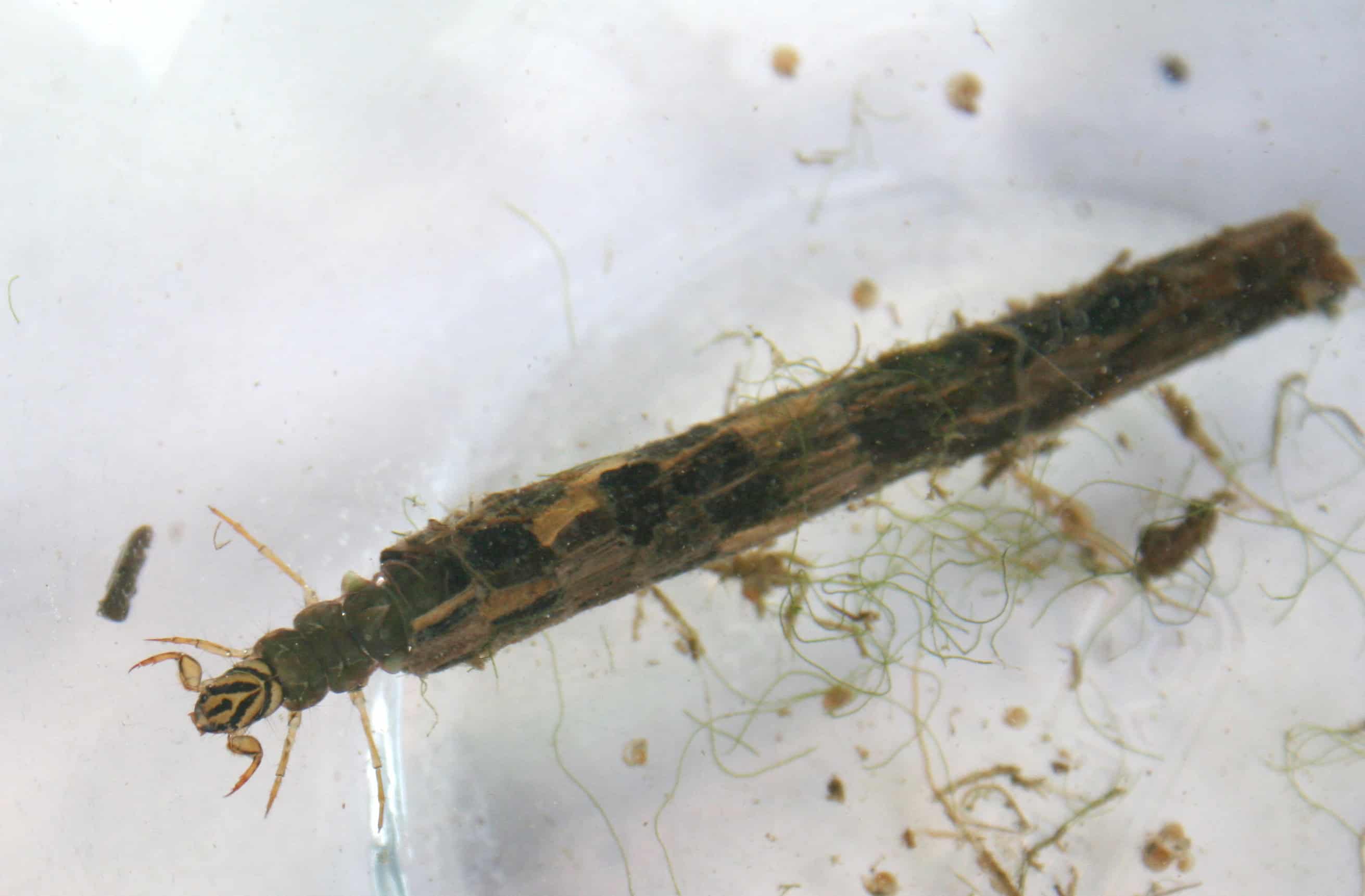
The little stick-and-gravel house is what everybody remembers about caddisflies, and it’s the one field mark on this page the insect built on purpose. Which makes it feel like a signature. It isn’t. Plenty of caddis larvae never build a portable case at all — some construct fixed retreats and stay put, and some are free-living and carry nothing.
So a caddis result covers a big, varied order, and the comparison that holds up joins body structure, life stage, case or retreat evidence, wings, position, and movement.
The pupa nobody sees
Here’s the part that actually separates caddisflies from the other two orders on this site, and it’s the part you’ll almost never lay eyes on. Caddisflies go through complete metamorphosis: aquatic larva, then pupa, then winged adult. Mayflies and stoneflies have no pupal stage whatsoever.
The pupa develops inside a case or a retreat before the adult comes out. Near emergence, movement through the water column, a trailing shuck, or an insect struggling in the surface film can all be useful observations. None of them proves an emergence is running water-wide.
Case, retreat, or nothing at all
- A portable case built from plant material, sand, gravel, or other debris — or no portable case at all.
- A fixed retreat the larva holds in rather than hauls around.
- Movement that may include crawling, swimming, or sitting tight in that retreat.
A case adds evidence. It doesn’t decide anything, and its absence doesn’t rule caddisflies out.
If you turned a rock and found something that looked like a soft grub with no house on it and figured you’d missed the important part — you didn’t. Free-living caddis larvae are a real thing, and finding one bare is an observation, not a mistake.
Hard front, soft back
A hardened head and at least part of the thorax, then a softer abdomen that often looks worm-like. Three pairs of legs bunched up close to the head. Terminal prolegs or hooks at the back end, the ones that hold onto rock, debris, or the case itself. That combination is what supports a larval caddis call, with or without a house attached.
Two things should pull you off it. A nymph with two tails, long antennae, and obvious wing pads is more likely a stonefly. And a smooth fly larva that doesn’t have three pairs of thoracic legs probably belongs somewhere else in Diptera.
Hairy wings, tent roof
- Two pairs of hairy wings.
- Wings held downsloping or tent-like over the body at rest.
- No long mayfly-style tail filaments.
- Skittering or skating happens, but behavior on its own isn’t enough to go on.
Hairy, tent-shaped wings strengthen an adult caddis call. Upright wings and long tails push the other way, toward a mayfly.
For larvae, the two things worth going back and checking are the three pairs of legs near the head and the hooks at the tail end, then whether the case is portable, fixed, or missing. For adults, look at wing texture and how the wings sit at rest. Color is the easiest thing to notice and the least reliable thing to decide on.
Reviewed sources
- NOAA GLERL — Aquatic Insect Field Guide
- U.S. EPA — Macroinvertebrate Identification Tip Sheet
- National Park Service — Macroinvertebrates
Source check: July 29, 2026. Broad identification only; a case, color, or skating behavior alone is not enough.
You must be logged in to post a comment.